Chapter 8 – The Voice of a Dead Woman
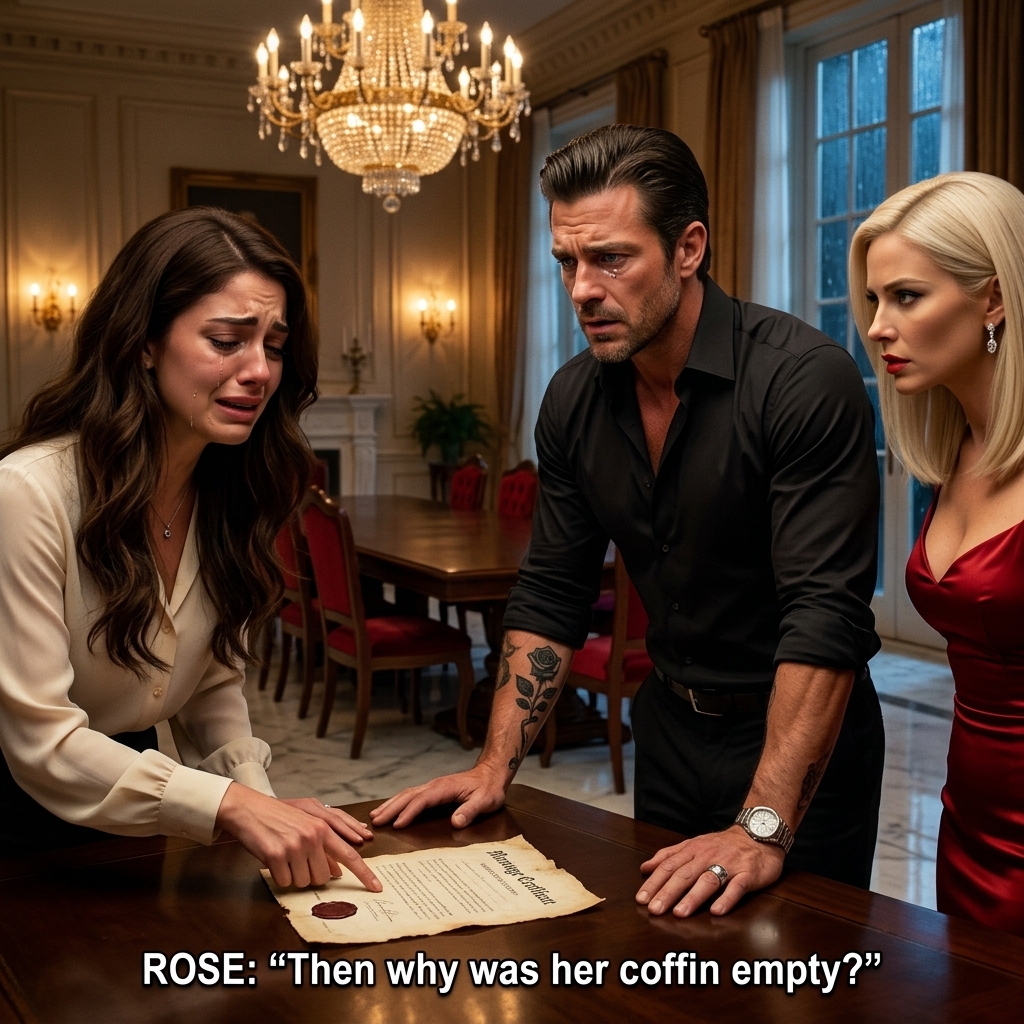
Agent Mara Chen did not look impressed by Lorenzo’s surname. She met Rose in a public building, asked to see identification, and explained the limits of what she could confirm. Protected-witness information could not simply be handed over to a powerful family, even one claiming to search for a missing wife. Rose understood. She had spent years wishing someone had kept Elena safe. She could not demand that safety be abandoned now.
Chen offered a supervised way to send a message without disclosing a location. Rose wrote about thunderstorms and the paper boats Elena used to fold from grocery receipts. She included no threats, no demand to come home, and no promise that Lorenzo had changed. When a reply came, it was a postcard with a lighthouse drawn in the corner. Beneath it was a line about the night they hid under their grandmother’s kitchen table.
Rose cried before she finished reading. Lorenzo stayed at the other end of the room. He wanted to touch the card but waited until Rose offered it. Bianca, watching from the doorway, understood that this was not a contest she could win by being the louder wife. A living woman existed behind the evidence. That fact changed every argument they had been having.
“Who else knew the nickname before the call arrived?” Rose asked.
The next difficulty was not a gunman or a threat shouted from a car. It was a contradiction between two pieces of paper. Lorenzo compared a coded postcard with a lighthouse sketch against the dates already established. One entry could be explained by an error; the next required a person to have acted deliberately. Bianca drew a line beneath the inconsistency and asked whether the original could be obtained without warning whoever had altered the file.
By evening the argument had become personal. Agent Mara Chen accused Bianca of caring more about a secure telephone line than about the people who had been hurt. Bianca answered too sharply, then regretted it when Agent Mara Chen looked away. They were both exhausted by the need to be brave in rooms where everyone else seemed to possess a hidden advantage.
Agent Mara Chen folded a hand around the edge of a chair. “I stayed when it was easy to walk away. That should count for something.”
A memory returned in fragments, not in the clean sequence of a confession. Agent Mara Chen recalled the smell of wet wool, the scrape of shoes on stone, and someone using a name that did not belong in that room. None of it was sufficient evidence. Rose insisted they separate recollection from record. Together they wrote two columns: what someone had seen, and what someone had been told. Elena had entered a confidential protection arrangement belonged in only one of those columns until they could verify its origin.
Agent Mara Chen met Rose in a neutral office with no family photographs on the walls. She explained that the agency could not confirm whether Elena was in any protective arrangement, nor could it release a location simply because Rose was her sister. Rose was furious at the answer until Chen asked what would happen if the people who had arranged the explosion followed her. Lorenzo stayed quiet. He had money and guards, but none of them could purchase Elena’s consent. Chen offered to deliver a message through authorized channels if a protected person matching the records could be identified. Rose wrote about their mother, the cracked blue bowl in their kitchen and the name Elena used when Rose was afraid of storms.
The reply arrived through counsel two days later. It contained no address and no photograph, only a recording of a woman singing the first three notes of the lullaby Elena had invented. Rose began crying before the voice finished. Lorenzo reached for the phone and stopped himself. The sound might be a recording, a trick or a genuine contact; Chen insisted on independent verification before anyone made plans. Bianca listened from the doorway and did not intrude. She had spent years believing the dead could be made to stay quiet with paperwork. Now a voice had crossed the distance between the living and the supposedly buried, and the house seemed smaller than it had ever been.
A second message warned them not to return to the mansion for the planned meeting. Security logs showed someone had used an old master credential to enter the service corridor after midnight. Arthur recognized the credential number as one issued to Vittorio’s former chief of security. Lorenzo ordered the staff evacuated to a hotel and gave them their wages in advance. Rose made sure the servers who had witnessed Bianca’s slap were offered the same protection as the family. The message’s last line was written in Elena’s familiar shorthand: “Tell Rosie the thunder isn’t hers to carry.” Rose recognized the phrase but refused to mistake recognition for proof. She asked Chen to arrange a supervised meeting.
“That’s cruel,” Agent Mara Chen murmured. “To ask a person to doubt the worst night of their life.”
Lorenzo spent the afternoon looking through old photographs of Elena, not for clues but because he no longer trusted the version of her he carried in his head. In one picture she stood beside a wheelchair user at a community fundraiser, listening with her whole body as the woman spoke. Lorenzo remembered being impatient that night, eager to leave. He had told Elena the event was a waste of time. The photograph made him ashamed. Elena had spent years caring about people his family treated as scenery. Rose found him holding the picture and said the woman was a disability-rights organizer who had helped Elena document missing charity funds. They located her through an attorney rather than arriving unannounced. She agreed to speak and described being pressured to sign false expense reports. Her account connected the charity to the shell companies without relying on a family member’s memory. Later, Rose replayed the voice message once and then stopped. She wanted to hear it forever, but she feared turning the sound into another kind of imprisonment. Chen told her that any future meeting would require Elena’s consent and a security assessment. Rose nodded. For eight years she had wanted to find her sister. Now she had to learn how to let her sister choose to be found.
The confrontation with Bianca began badly. Nobody was prepared to be generous, and each person arrived carrying a different version of the same history. Rose placed the phrase only the sisters used as children where everyone could see it, then stepped back. Bianca reached for it, stopped, and asked permission. That small hesitation surprised them all.
They tested the new lead against the least dramatic explanation first. Could a protected-witness contact protocol be a clerical mistake? Could a witness have misremembered the order of events? Could someone have copied a signature without knowing what it authorized? Lorenzo insisted on asking those questions even when the answers might disappoint Bianca. A good story would have accepted the most sensational possibility. They needed a true one.
On the way back through a quiet law office, Bianca noticed how easily fear could disguise itself as loyalty. A person could say they were protecting the family while protecting only its most powerful member. A person could claim to be protecting a sister while refusing to let that sister make her own choices. Agent Mara Chen listened as Bianca struggled to say the distinction aloud.
Arthur asked whether the security credential could have been copied. Chen said that was possible and cautioned everyone against treating the log as proof of a particular person’s presence. Rose appreciated the distinction, even while it frustrated her. She had spent years being told that certainty was available for a price; now the investigators insisted on admitting what they did not know. Bianca helped the servers pack their belongings and arranged transport for an elderly cook who could not manage the stairs alone. Lorenzo stood in the doorway, watching the staff leave a house he had always called safe. He had never asked whether they agreed.
“Then we stop pretending the answer was supposed to do all the work,” Agent Mara Chen said.
Rose waited for the secure connection in a room without windows. Chen had warned her that the voice on the other end might choose not to speak. Lorenzo remained outside, sitting beside Arthur, while Bianca brought water and left it untouched on the table. When the line opened, Rose heard breathing before a woman said her childhood nickname. Rose covered her mouth. She asked a question no stranger could answer: what had Elena hidden in the cracked blue bowl during a thunderstorm? The woman replied that it had been a paper star and that their mother had pretended not to find it. Rose began to sob. Chen raised a hand, reminding her that recognition was not yet permission to disclose a location. Then the woman’s voice changed. “Rosie, listen carefully. Somebody at the mansion knows I’m alive.” A sharp noise sounded on the connection, followed by a man’s voice ordering the caller away from the telephone. The line went dead. Chen was already reaching for her secure radio.