Chapter 3 – The Butler’s Missing Hour
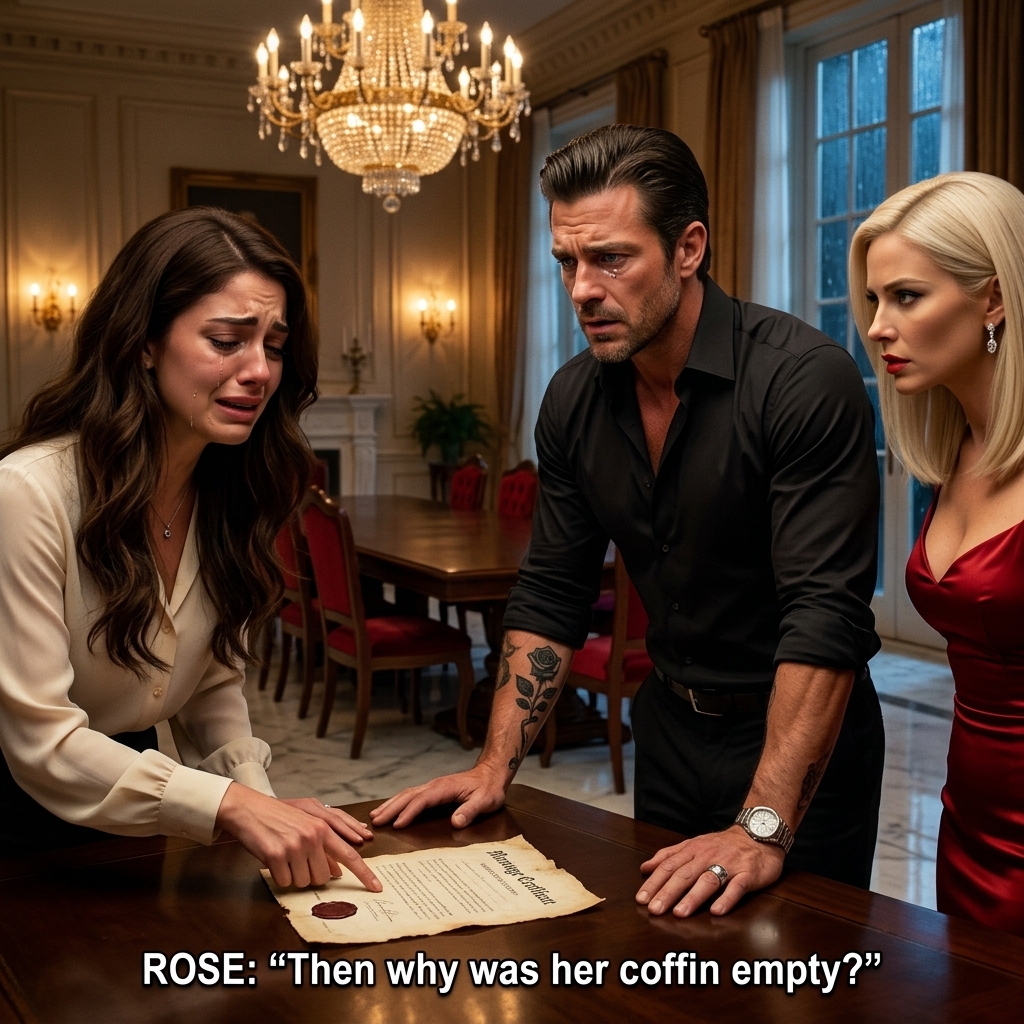
Arthur had spent decades mastering the art of entering a room without becoming its subject. In the service corridor he could no longer disappear. Rose placed the transport ledger on a narrow table and waited. Lorenzo stood behind her, giving the old man room to speak. Arthur’s hands shook as he traced a line in pencil: 11:43 p.m., private ambulance, north gate.
“I carried her,” Arthur said. “She was breathing. I remember because she kept asking for her sister.”
Rose felt the floor tilt. “Did she say my name?”
“She said Rosie. She said you hated thunderstorms.”
That was true. Elena had invented stories to distract her during storms when they were children. Arthur did not know those stories. Rose pressed a fist against her mouth and turned away so he would not mistake her tears for forgiveness.
Arthur insisted he had not known where the ambulance went. A man with a hospital badge took charge, and armed men in plain coats watched the gate. The butler had been threatened with the deaths of his grandchildren. Lorenzo could understand the fear without absolving the silence. The ledger was not proof that Elena survived for years, but it established she had left the scene alive. For the first time the mystery had a direction rather than a hole.
“Why was the paper filed on a day when the office was closed?” Arthur asked.
The next difficulty was not a gunman or a threat shouted from a car. It was a contradiction between two pieces of paper. Rose compared a rain-stained hospital wristband against the dates already established. One entry could be explained by an error; the next required a person to have acted deliberately. Lorenzo drew a line beneath the inconsistency and asked whether the original could be obtained without warning whoever had altered the file.
Arthur laid his old service keys on the kitchen table like a man surrendering weapons. Eight years earlier, the west passage had been filled with smoke when he found a wounded woman wearing Elena’s pearl earrings. He remembered her breathing because he had pressed two fingers to her throat while the security alarm wailed. He did not know whether she was Elena; he had obeyed an order to put her into a private ambulance and never ask. Rose struck the table with her palm. “You could have told us she was alive.” Arthur did not defend himself. “I knew someone was alive,” he said. “I let them tell me who.” The difference was small enough to sound cowardly and important enough to matter.
The butler retrieved a torn page from a maintenance ledger he had hidden inside the binding of a cookbook. It listed a service-gate opening at 1:41 a.m. and the registration of a medical vehicle not owned by the city. Lorenzo recognized the authorization initials: V.D., his uncle Vittorio De Luca. Arthur admitted he had copied the entry because the original ledger vanished the next morning. Bianca asked why he had waited so long to reveal it. “Because I liked my life,” Arthur said, looking directly at her. “And because I was frightened of the man who paid for it.” Rose felt anger rise at the admission, but she could not afford to mistake a guilty witness for a useless one.
A junior houseman, Marco, had been listening from the corridor. When Arthur saw him, he demanded that the young man come inside rather than hide. Marco said his father had driven a supply truck through the same gate that night and had spent years refusing to discuss it. The father was now in assisted living, alert only in short intervals. Rose asked whether they could visit with his consent. Arthur insisted on coming too, though he knew the man might accuse him. Before leaving, Marco handed Rose a photograph of the old gate. On the reverse was a date written in Elena’s distinctive slanted handwriting, three days after the official date of her death.
By evening the argument had become personal. Bianca accused Lorenzo of caring more about the security footage from the service entrance than about the people who had been hurt. Lorenzo answered too sharply, then regretted it when Bianca looked away. They were both exhausted by the need to be brave in rooms where everyone else seemed to possess a hidden advantage.
Marco’s father, Paolo, recognized Arthur as soon as they entered the care home. His hand began to shake against the arm of his wheelchair. Arthur crouched so their eyes were level, an unfamiliar gesture for a man who had spent his career looking down from the top of the servants’ hierarchy. Paolo accused him of taking a payment to open the gate. Arthur admitted he had signed a false inventory but denied receiving the money. Rose asked them to stop arguing long enough to establish what Paolo had seen. The older man described a white ambulance with its rear doors open and a woman on a stretcher whispering a name he could not hear. A second woman in bridal fabric had been carried out under a sheet. Paolo had believed both were dead until he heard a cry from the ambulance. He tried to stand in his wheelchair, upset by the memory, and Marco steadied the chair before it moved. Arthur apologized without asking Paolo to forgive him. When they left, Paolo pressed a folded service receipt into Rose’s hand. It bore the contractor’s initials and the time the ambulance crossed the gate. Rose promised to preserve it exactly as it was, with the crease and coffee stain intact. For the first time, Arthur understood that confession was not an event he could complete in one evening. It was a responsibility that would follow him into every room where someone remembered what he had done.
A memory returned in fragments, not in the clean sequence of a confession. Bianca recalled the smell of wet wool, the scrape of shoes on stone, and someone using a name that did not belong in that room. None of it was sufficient evidence. Arthur insisted they separate recollection from record. Together they wrote two columns: what someone had seen, and what someone had been told. Arthur had carried a living injured woman into an ambulance belonged in only one of those columns until they could verify its origin.
The confrontation with Lorenzo began badly. Nobody was prepared to be generous, and each person arrived carrying a different version of the same history. Arthur placed a timestamp showing the ambulance left before the official explosion report where everyone could see it, then stepped back. Lorenzo reached for it, stopped, and asked permission. That small hesitation surprised them all.
They tested the new lead against the least dramatic explanation first. Could a handwritten transport ledger be a clerical mistake? Could a witness have misremembered the order of events? Could someone have copied a signature without knowing what it authorized? Rose insisted on asking those questions even when the answers might disappoint Lorenzo. A good story would have accepted the most sensational possibility. They needed a true one.
Rose returned to Paolo’s room the following afternoon with a lawyer and a recording device. She asked permission before taking notes, and she did not push him to remember details he could not supply. Paolo pointed to the old gate photograph and identified the ambulance driver by his distinctive wedding ring. The driver had laughed when Arthur asked for a destination, Paolo recalled. Arthur stood in the doorway, ashamed that another worker had carried the memory alone. When the visit ended, Rose thanked Paolo for speaking despite his fear. He replied that the wheelchair had never made him powerless; the family’s threats had. Rose wrote the sentence in her notebook, then asked the lawyer to arrange a formal witness interview.
On the way back through a small room overlooking the river, Lorenzo noticed how easily fear could disguise itself as loyalty. A person could say they were protecting the family while protecting only its most powerful member. A person could claim to be protecting a sister while refusing to let that sister make her own choices. Bianca listened as Lorenzo struggled to say the distinction aloud.
Arthur returned to the mansion through the servants’ entrance, a route he had walked for thirty years without once noticing how narrow it was. On the kitchen counter lay a parcel addressed to him in the careful handwriting of a man who had been dead for eight years. Inside was a duplicate of the ambulance receipt and a photograph of the old east gate. The photograph showed Arthur standing beside the vehicle, but someone had circled a figure in the passenger seat. A woman with dark hair was looking directly toward the camera. Arthur recognized the scarf around her neck: Elena had borrowed it from a server before the wedding. He sat down heavily. The figure was alive when the picture was taken, and the timestamp placed it after the supposed moment of her death. He called Rose, intending to tell her everything. Before she answered, the kitchen door opened behind him. A familiar voice said, “Mr. Vitale, you were told never to keep copies.” Arthur turned and saw Vittorio’s former security chief standing in the doorway.