Chapter 4 – The Wife Who Signed a Lie
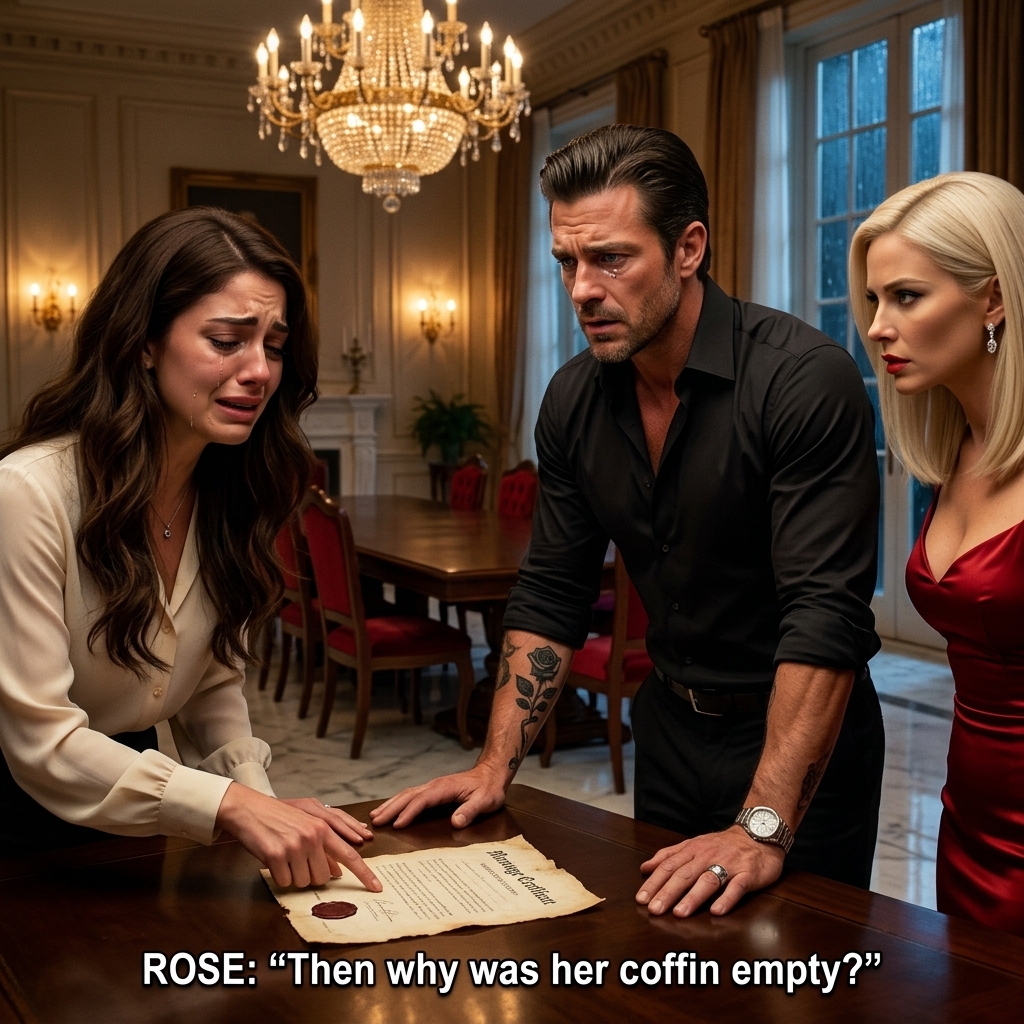
Lorenzo arrived with a warning that someone had asked about the documents that morning. They spoke in low voices because neither trusted the walls anymore. They were not yet friends, and their disagreements were often more revealing than their agreements. Bianca wanted an answer that could be used in court. Lorenzo wanted a human explanation. Neither was willing to sacrifice one for the other.
“Don’t tell me what you think happened,” Bianca said. “Tell me what you can prove.”
Bianca had kept the agreement because she thought destroying it would make her look guilty. In the bedroom where she once prepared for charity galas, she laid it on the bedspread and asked Lorenzo not to raise his voice. He stayed by the doorway. Rose stood near the window, uncomfortable with the intimacy of a marriage unraveling in front of her.
“I was told she was dead,” Bianca said. “Then I was told the paperwork still had to be fixed. Your uncle said you couldn’t bear to discuss it.”
“You signed without telling me?” Lorenzo asked.
“I was twenty-six. Your family owned the lawyers. I wanted you to choose me without looking backward.”
It was a confession of vanity and cowardice, not of murder. Rose refused to let either become an excuse. She asked who had delivered the agreement. Bianca named a lawyer whose office had closed years earlier. The purported notarization was on a holiday. When a real attorney examined the copy, he found the seal belonged to a different jurisdiction. Bianca sat on the edge of the bed and began to cry, not because she was being accused but because she finally understood how eagerly she had believed a lie that benefited her.
At a quiet law office, Bianca made a small decision that felt larger than it should have: to leave the door open while Lorenzo spoke. In the De Luca household, doors were usually closed before anyone mentioned a problem. The openness did not guarantee safety, but it meant the conversation would not become another secret hidden in a locked room. On the table lay a notarized settlement agreement. The detail looked ordinary when separated from the fear surrounding it, and that ordinariness was exactly what disturbed Bianca.
Bianca took the settlement agreement from a velvet-lined box beneath her dressing table. She had once kept it there because she believed it protected her marriage. Now she could not look at the paper without remembering the afternoon Vittorio’s attorney had slid it across a polished desk. He told her Lorenzo’s first marriage had been dissolved by a confidential order, that Elena’s death was a painful subject, and that a good wife would not force her husband to revisit it. Bianca had signed a confidentiality undertaking and accepted the explanation. She had not seen the underlying court order. Rose’s anger sharpened when she heard the story. “You were willing not to know,” she said. Bianca could not deny it.
Lorenzo called an independent matrimonial attorney, who refused to give a verdict over the telephone. A first marriage, a supposed dissolution and a later ceremony had to be examined under the relevant records and governing law. The attorney also warned that a forged document could create separate criminal and civil questions without automatically answering every question about the spouses’ intentions. Bianca listened with both hands clenched. For years she had introduced herself as Mrs. De Luca, hosted charity dinners and let Rose carry her coat. Now she understood that status had been built on a piece of paper she had never bothered to verify. The humiliation did not excuse her slap. It made her see how easily she had passed the same contempt downward.
Bianca apologized to Rose in the kitchen where the servers could hear her. Rose did not accept it immediately. “You wanted an audience when you hit me,” she said. “You don’t get to choose a private room when you apologize.” Bianca’s eyes filled. Arthur watched from the doorway, his expression unreadable. Later Bianca found a bank statement showing a payment from a family trust to the attorney who had arranged her signature. The date matched the supposed dissolution. She photographed the statement, placed the original back in its folder and sent a copy to counsel. For the first time, she was willing to lose her position in order to learn whether it had ever been hers.
“What did the person who vanished have to lose by telling the truth?” Bianca asked.
The next difficulty was not a gunman or a threat shouted from a car. It was a contradiction between two pieces of paper. Lorenzo compared the attorney’s allegedly genuine signature against the dates already established. One entry could be explained by an error; the next required a person to have acted deliberately. Rose drew a line beneath the inconsistency and asked whether the original could be obtained without warning whoever had altered the file.
By evening the argument had become personal. Arthur accused Rose of caring more about a bank transfer routed through a family trust than about the people who had been hurt. Rose answered too sharply, then regretted it when Arthur looked away. They were both exhausted by the need to be brave in rooms where everyone else seemed to possess a hidden advantage.
A memory returned in fragments, not in the clean sequence of a confession. Arthur recalled the smell of wet wool, the scrape of shoes on stone, and someone using a name that did not belong in that room. None of it was sufficient evidence. Bianca insisted they separate recollection from record. Together they wrote two columns: what someone had seen, and what someone had been told. Bianca had been told Elena’s marriage was legally dissolved belonged in only one of those columns until they could verify its origin.
“It’s crueler to let somebody else use that night to control them,” Bianca replied.
The confrontation with Rose began badly. Nobody was prepared to be generous, and each person arrived carrying a different version of the same history. Bianca placed the attorney denied witnessing any dissolution where everyone could see it, then stepped back. Rose reached for it, stopped, and asked permission. That small hesitation surprised them all.
“You don’t get to rewrite what happened because the truth is inconvenient,” Bianca said.
Lorenzo watched them with the wary patience of someone who had been disappointed before. An apology without action would not help. They settled on one concrete task: retrieve a dated original, identify a witness, or disclose a withheld conversation. Rose agreed, although the agreement seemed to cost more than pride. It cost the illusion that silence had kept anyone safe.
They tested the new lead against the least dramatic explanation first. Could a notarized settlement agreement be a clerical mistake? Could a witness have misremembered the order of events? Could someone have copied a signature without knowing what it authorized? Lorenzo insisted on asking those questions even when the answers might disappoint Rose. A good story would have accepted the most sensational possibility. They needed a true one.
The test exposed a detail nobody had anticipated: the same reference number appeared in a second record created by an independent office. That did not prove the entire theory, but it narrowed the ways the record could have been forged. Rose photographed both pages and wrote down the source of each. They placed the originals in separate protective sleeves and made arrangements for independent review. For the first time that day, Lorenzo felt the possibility of standing in front of a judge without being dismissed as a grieving relative.
On the way back through the crowded dining hall, Rose noticed how easily fear could disguise itself as loyalty. A person could say they were protecting the family while protecting only its most powerful member. A person could claim to be protecting a sister while refusing to let that sister make her own choices. Arthur listened as Rose struggled to say the distinction aloud.
Bianca carried the forged dissolution papers to the attorney’s office herself. She had expected to be treated as the wronged wife. Instead the lawyer asked her to explain exactly when she learned about Elena, what Vittorio’s representative had promised, and why she had never told Lorenzo. She answered every question, including the humiliating ones. On the way out, she passed Rose in the corridor. Rose was sitting beside a server who had been at the dinner and was afraid of losing her job for telling the truth. Bianca stopped. “You will be paid for the time you spend with investigators,” she said to the server. “And nobody in that house will fire you for it.” Rose asked whether Bianca had authority to make that promise. Bianca swallowed. “Then I’ll put it in writing and sign my own name.” Her phone vibrated before she could do so. A message from an unknown number contained a photograph of the signed agreement and a warning: IF LORENZO SEES PAGE FOUR, HE WILL KNOW WHAT YOU DID. Bianca opened the document. Page four was missing from her copy.