Chapter 5 – The Sister Who Refused to Give Up
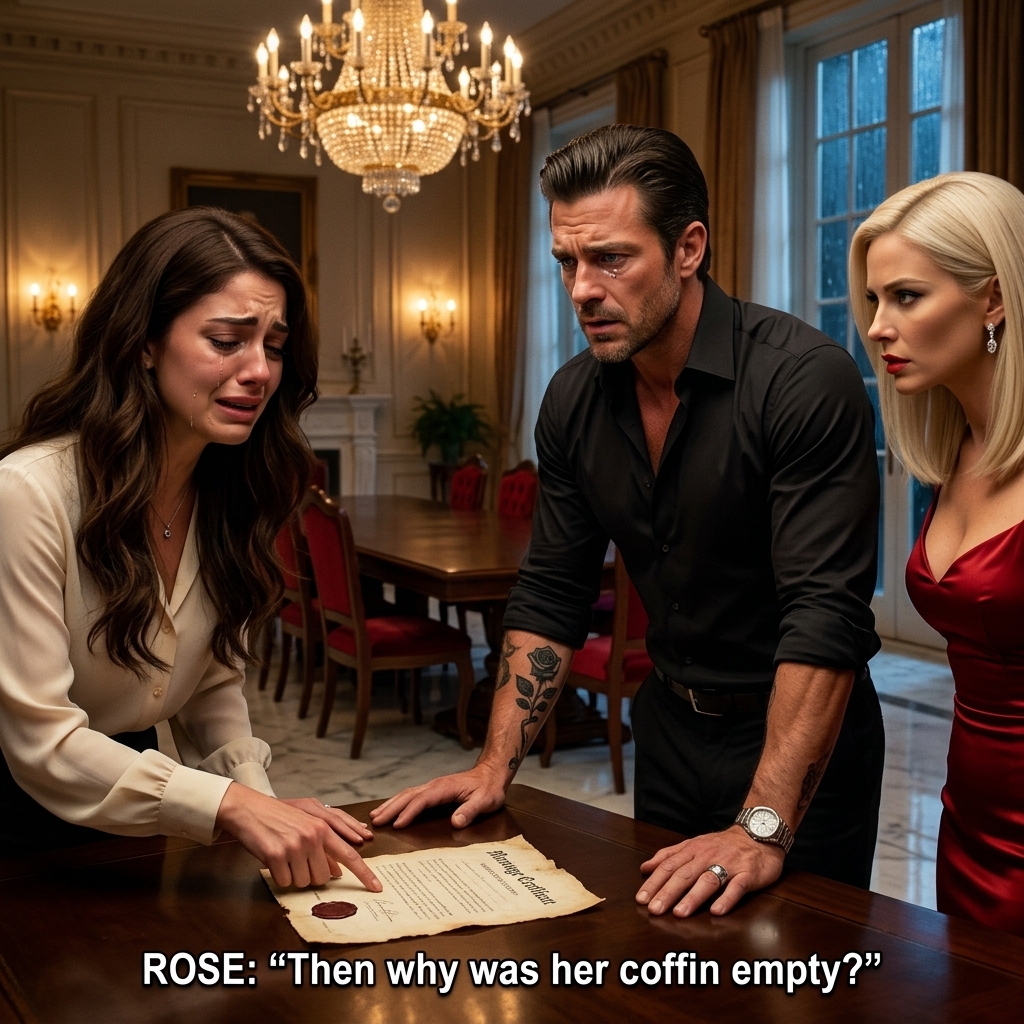
Rose’s apartment was smaller than Lorenzo’s dining room, and she had never been ashamed of that until she watched him hesitate in the doorway. She showed him the cardboard box of Elena’s letters: recipes scribbled in margins, school photographs, a birthday card that promised the sisters would never lose each other. There was no grand conspiracy in those objects, only the ordinary proof that Elena had existed beyond a marriage certificate.
“I didn’t take the job to get close to you,” Rose said. “I took it because your family was the last place anyone saw her.”
Lorenzo held a photograph without touching the face. He had forgotten that Elena wore her hair braided when she cooked. Memory had preserved her in a wedding dress and abandoned the rest. Rose showed him bank statements with anonymous payments to their mother after the explosion. The transfers stopped when their mother died, then resumed under a new beneficiary code. The account was active. Someone had remembered the family when the world insisted Elena was gone.
Bianca called to warn them that a dark sedan had been parked outside Rose’s building for an hour. Lorenzo did not order Rose to hide; he asked what she wanted. She chose to stay and photograph the car from the stairwell. For the first time, the choice was hers.
At a rain-dark street, Rose made a small decision that felt larger than it should have: to leave the door open while Lorenzo spoke. In the De Luca household, doors were usually closed before anyone mentioned a problem. The openness did not guarantee safety, but it meant the conversation would not become another secret hidden in a locked room. On the table lay a box of Elena’s childhood letters. The detail looked ordinary when separated from the fear surrounding it, and that ordinariness was exactly what disturbed Rose.
“Which part of your memory belongs to you, and which part was planted by grief?” Rose asked.
The next difficulty was not a gunman or a threat shouted from a car. It was a contradiction between two pieces of paper. Lorenzo compared a recurring payment to a coastal clinic against the dates already established. One entry could be explained by an error; the next required a person to have acted deliberately. Bianca drew a line beneath the inconsistency and asked whether the original could be obtained without warning whoever had altered the file.
By evening the argument had become personal. Arthur accused Bianca of caring more about a photograph with its date deliberately scraped away than about the people who had been hurt. Bianca answered too sharply, then regretted it when Arthur looked away. They were both exhausted by the need to be brave in rooms where everyone else seemed to possess a hidden advantage.
Rose returned to the apartment she had shared with Elena’s mother, where the hallway light still flickered when the refrigerator started. She opened a shoebox of letters Elena had written before the wedding. One described Lorenzo teaching her to drive in an empty parking lot; another described a strange man asking about financial records at her office. Rose had ignored that second letter for years because she was sixteen when it arrived and the warning had sounded like grown-up business. Now she read it beside the payment statements and realized Elena had been frightened before the explosion. The discovery did not make Rose proud. It made her wish she could apologize to the sister she had believed buried.
When Rose stepped outside, a black sedan rolled slowly along the curb. The driver lowered his window and told her to stop digging. Rose backed toward the building rather than approach the car. Lorenzo arrived just as the sedan accelerated away. He reached for her shoulder and she pulled back. “Don’t touch me without asking,” she said. He lowered his hand immediately. The boundary mattered more to her than the offer of protection. Inside, Rose insisted on filing a police report and preserving the building camera footage. Lorenzo offered security; she accepted a driver only after choosing the route and making sure the guard understood that he worked for her safety, not her obedience.
The next morning Rose visited the bank named in the transfers to her mother. The teller could not disclose the sender’s identity, but a compliance officer agreed to accept the records through Rose’s lawyer and explain the process for a lawful request. Rose left without an answer and without compromising the evidence. At the corner she met a former housekeeper from the De Luca mansion who remembered Elena visiting the staff kitchen to share birthday cake. “She asked us our names,” the woman said. “Most people in that house never did.” Rose held onto the sentence all the way home. She was no longer investigating a certificate. She was trying to restore a person the family had reduced to a photograph.
A memory returned in fragments, not in the clean sequence of a confession. Arthur recalled the smell of wet wool, the scrape of shoes on stone, and someone using a name that did not belong in that room. None of it was sufficient evidence. Rose insisted they separate recollection from record. Together they wrote two columns: what someone had seen, and what someone had been told. Rose had received anonymous money after Elena disappeared belonged in only one of those columns until they could verify its origin.
That night Rose sat with her old friend Natalie, who worked at a neighborhood diner and had never met Lorenzo. Natalie read the newspaper story twice and asked why the article called Rose a maid but described Bianca as a philanthropist. Rose laughed bitterly. The distinction was not accidental. The people who wrote the headlines had already decided whose pain deserved a surname. Natalie offered to stay with her until the threats stopped. Rose refused at first, afraid of dragging another person into danger, but Natalie reminded her that isolation was exactly what powerful families relied on. They made tea and wrote down everyone who might remember Elena’s last weeks at work. A former colleague answered after midnight. She remembered Elena asking for a secure place to copy files and saying she was frightened of a relative by marriage. Rose asked if she would speak to an investigator; the woman said yes, provided her employer was not contacted without notice. Rose passed the condition to counsel. When she finally slept, she dreamed of Elena teaching her to braid hair and woke angry that the dream had ended before her sister turned around. She wrote one more line in her notebook: Find the living witnesses before the family teaches them to forget.
The confrontation with Bianca began badly. Nobody was prepared to be generous, and each person arrived carrying a different version of the same history. Rose placed a current account number attached to the payments where everyone could see it, then stepped back. Bianca reached for it, stopped, and asked permission. That small hesitation surprised them all.
They tested the new lead against the least dramatic explanation first. Could a box of Elena’s childhood letters be a clerical mistake? Could a witness have misremembered the order of events? Could someone have copied a signature without knowing what it authorized? Lorenzo insisted on asking those questions even when the answers might disappoint Bianca. A good story would have accepted the most sensational possibility. They needed a true one.
Before bed, Rose opened the old kitchen cupboard where her mother had kept birthday candles. The blue bowl was still there, its crack repaired with glue. Elena had once hidden a paper star inside it to convince Rose that thunder could not reach their apartment. Rose ran her finger along the rim and felt the grief she had suppressed at the mansion finally catch up with her. Natalie sat beside her without asking questions. For a long time they listened to the refrigerator hum. Rose understood that finding the truth would not restore the eight years she had lost, but it might give her sister the dignity of being remembered accurately.
On the way back through the mansion’s east library, Bianca noticed how easily fear could disguise itself as loyalty. A person could say they were protecting the family while protecting only its most powerful member. A person could claim to be protecting a sister while refusing to let that sister make her own choices. Arthur listened as Bianca struggled to say the distinction aloud.
Rose placed Elena’s letters in a new archival box and labeled each envelope with the date it had arrived. The ritual made her feel closer to her sister than the arguments at the mansion ever had. Natalie was washing cups when a message arrived from the former colleague. It contained a photograph of a payroll ledger and a note saying Elena had arranged to meet a financial investigator three days before the explosion. The meeting had never taken place. Rose called the attorney, who advised her not to circulate the image until its origin could be verified. She agreed, then asked Natalie to stay the night. At two in the morning, someone slipped a plain white envelope under the apartment door. Inside was a photograph of Rose and Elena as children, standing in front of their mother’s house. On the back, written in Elena’s slanted handwriting, were five words: ROSIE, DON’T TRUST THE HOUSE. Rose stared at the message. The photograph was recent enough to have been printed on modern paper, but the handwriting was unmistakable. Someone had access to her sister’s past—and perhaps to her present.