Chapter 7 – The Butler’s Last Confession
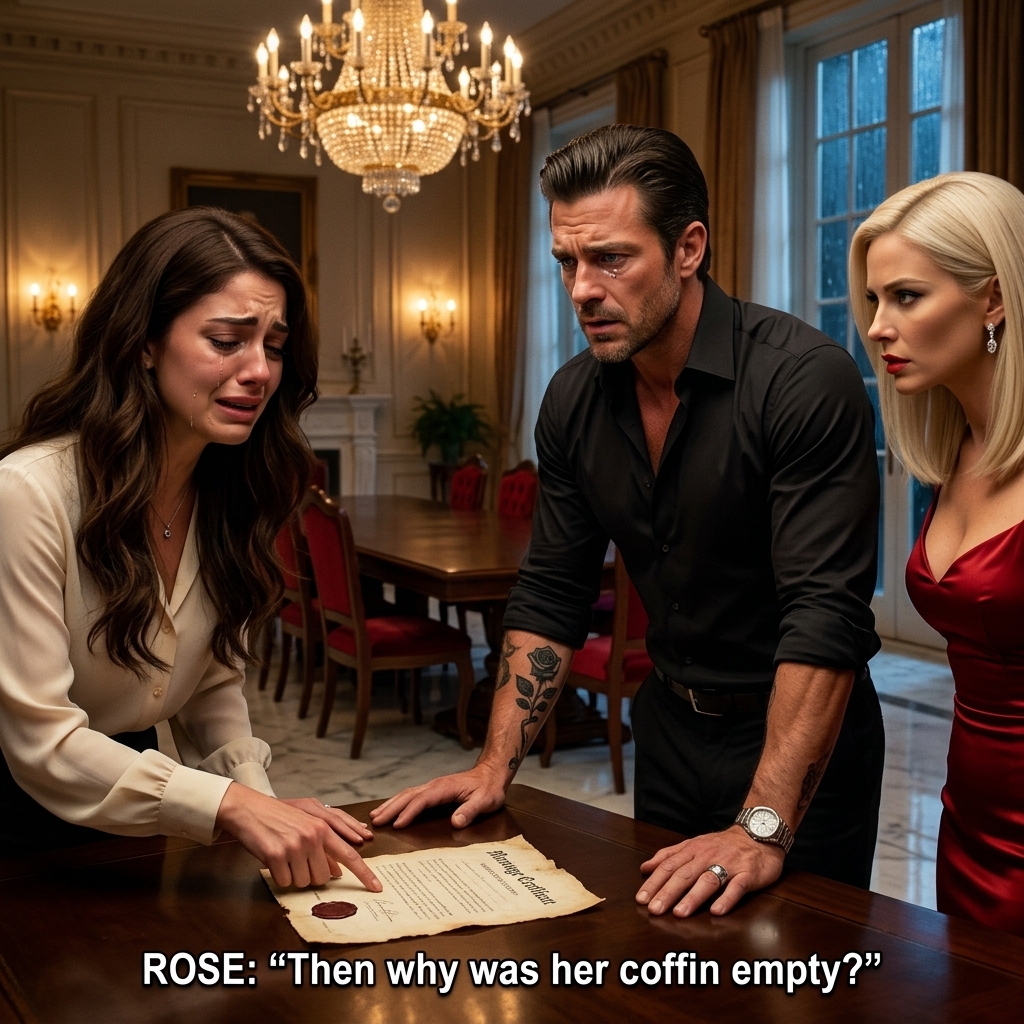
Arthur insisted on making the recording in his own voice. He sat beside a lamp in the safe house, his hands folded around a mug of untouched tea, and spoke into a device that had been checked for tampering. He named the ambulance company, the men at the gate, and the address where he had delivered the injured woman. He described her breathing and the way she clutched a pearl earring.
“I told myself I was protecting her,” he said. “Then I let you bury an empty coffin. I cannot call that protection anymore.”
Rose listened from the hallway. She wanted to enter and tell him that a confession could not return eight years to her family. She also wanted to thank him for carrying Elena away from the fire. Both impulses were true. Lorenzo did not demand forgiveness on Arthur’s behalf. He wrote down each detail and called the investigator handling the case.
At dawn Arthur was gone. The window was shut, his coat remained on its hook, and the recorder lay beneath a folded note: Don’t trust the service gate. On the device was a second voice, faint but unmistakably a woman’s. “Lorenzo,” it said, “I didn’t leave because I stopped loving you.”
At a secluded guest room, Arthur made a small decision that felt larger than it should have: to leave the door open while Rose spoke. In the De Luca household, doors were usually closed before anyone mentioned a problem. The openness did not guarantee safety, but it meant the conversation would not become another secret hidden in a locked room. On the table lay an encrypted voice recorder. The detail looked ordinary when separated from the fear surrounding it, and that ordinariness was exactly what disturbed Arthur.
“What would you do if the evidence cleared the person you hated?” Arthur asked.
The next difficulty was not a gunman or a threat shouted from a car. It was a contradiction between two pieces of paper. Rose compared a torn ambulance dispatch card against the dates already established. One entry could be explained by an error; the next required a person to have acted deliberately. Lorenzo drew a line beneath the inconsistency and asked whether the original could be obtained without warning whoever had altered the file.
By evening the argument had become personal. Bianca accused Lorenzo of caring more about a duplicate key to the old service gate than about the people who had been hurt. Lorenzo answered too sharply, then regretted it when Bianca looked away. They were both exhausted by the need to be brave in rooms where everyone else seemed to possess a hidden advantage.
Arthur sat before a small recorder in the law office and gave his account without interruption. He described the smoke, the private ambulance, the woman’s pulse and the order that had come through Vittorio’s security chief. He named the two men who had carried the stretcher. When the attorney asked why he had signed a statement confirming Elena’s death, Arthur covered his face. “I thought if I lied once, they would leave her alone,” he said. Rose wanted to tell him that a lie had never protected her family. Instead she asked him to repeat the names slowly, so the recording would be clear. For the first time in eight years, the missing woman had witnesses rather than mourners.
That evening Arthur failed to arrive for a scheduled meeting. His car remained in the driveway with the keys on the seat. The security camera showed two men in maintenance jackets leading him toward the old service gate. He appeared to walk under his own power, but one man’s hand gripped his elbow. Lorenzo wanted to send armed men to the address on the van’s registration. Rose stopped him. “We need him alive and able to testify,” she said. They gave the footage and the registration to investigators, who arranged a welfare check. Bianca found Arthur’s spare glasses in the pantry and began crying quietly. She had never asked what it cost the butler to serve their family.
A courier delivered a sealed packet to the attorney’s office just before midnight. Inside was a second recording Arthur had prepared in case he disappeared. He described a woman calling herself Isabel Torres who had been used as a decoy at the wedding venue, and he identified the hospital transport contractor by name. The attorney preserved the packet and notified investigators rather than playing it for the household. Rose waited in the corridor, watching the clock. When the detective emerged, he said Arthur had been located at a roadside motel and was frightened but physically unharmed. Then he added that Arthur refused to leave until he could speak to the person who had ordered the ambulance. That person, he said, was already on the way.
A memory returned in fragments, not in the clean sequence of a confession. Bianca recalled the smell of wet wool, the scrape of shoes on stone, and someone using a name that did not belong in that room. None of it was sufficient evidence. Arthur insisted they separate recollection from record. Together they wrote two columns: what someone had seen, and what someone had been told. Arthur had hidden Elena from the men sent to finish the job belonged in only one of those columns until they could verify its origin.
The detective assigned to Arthur’s disappearance refused Lorenzo’s offer of private guards. He explained that an armed rescue by family employees could destroy evidence and endanger the witness. Lorenzo argued until Rose interrupted. “You want to be useful?” she asked. “Tell them where Vittorio keeps the old contractor files.” Lorenzo knew the address. He had signed checks to the building for years without asking what was stored there. He gave it to the detective, then sat beside Bianca in a waiting room where neither of them had authority. Arthur’s coat hung on a chair, still damp from the rain. Rose noticed that he had sewn a tiny pocket inside the lining, just large enough for a memory card. With counsel present, she handed the coat to the investigators untouched. The detective later confirmed that the pocket contained a backup of Arthur’s first recorded statement. It did not prove every allegation, but it established that Arthur had feared interference before he vanished. At dawn Marco arrived with a paper cup of coffee for Rose. She accepted it and asked whether his father was safe. Marco said the care home had increased security and that Paolo wanted to testify if his health allowed. Rose felt exhausted, furious and suddenly hopeful. A family built on intimidation was being challenged by people who had never been invited to its table.
The confrontation with Lorenzo began badly. Nobody was prepared to be generous, and each person arrived carrying a different version of the same history. Arthur placed a recording of Elena saying she had not abandoned Lorenzo where everyone could see it, then stepped back. Lorenzo reached for it, stopped, and asked permission. That small hesitation surprised them all.
They tested the new lead against the least dramatic explanation first. Could an encrypted voice recorder be a clerical mistake? Could a witness have misremembered the order of events? Could someone have copied a signature without knowing what it authorized? Rose insisted on asking those questions even when the answers might disappoint Lorenzo. A good story would have accepted the most sensational possibility. They needed a true one.
Bianca brought Arthur’s spare coat to the police station and waited until a property officer could receive it. She did not ask to see the evidence or learn where the butler was being held. In the waiting room she met Marco, who looked exhausted from traveling between his father and the investigators. She offered him money for a taxi. He refused, saying he wanted a written guarantee that the household staff would not be punished for cooperating. Bianca took out her phone and called the estate attorney in front of him. By the time she left, a letter was being prepared. It was a small act, but she knew the family had made a habit of refusing even small acts to people without power.
On the way back through the kitchen after midnight, Lorenzo noticed how easily fear could disguise itself as loyalty. A person could say they were protecting the family while protecting only its most powerful member. A person could claim to be protecting a sister while refusing to let that sister make her own choices. Bianca listened as Lorenzo struggled to say the distinction aloud.
Arthur emerged from the roadside motel under police escort, looking older than he had that morning. He had refused to leave because he wanted to face the former security chief who had threatened him. The detective would not permit the confrontation. Instead Arthur identified the man from a photograph and described the voice he had heard on the phone. Rose waited behind the police line, angry that the butler still wanted to settle the matter privately. When he saw her, he held up his empty hands. “I have nothing else hidden,” he said. She wanted to believe him. Then an investigator approached with a small evidence bag. It contained a brass key recovered from the motel room, stamped with the number of the old service gate. Arthur stared at it. “That isn’t mine,” he whispered. “Mine was destroyed after the explosion.” The investigator turned the bag over. On the other side of the key was a fresh fingerprint label bearing the name of a person the family had declared dead eight years ago.