Chapter 10 – The Marriage That Never Ended
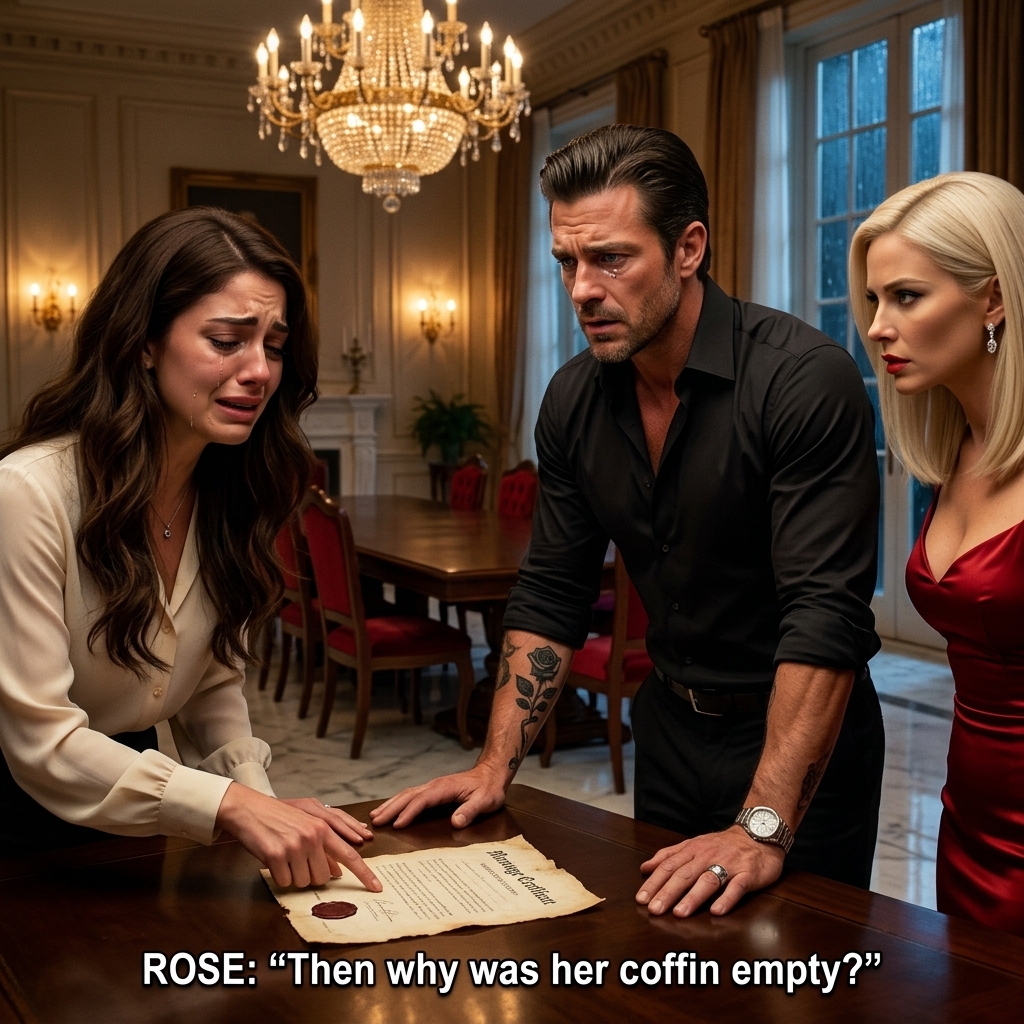
Elena arrived with a warning that someone had asked about the documents that morning. They spoke in low voices because neither trusted the walls anymore. They were not yet friends, and their disagreements were often more revealing than their agreements. Lorenzo wanted an answer that could be used in court. Elena wanted a human explanation. Neither was willing to sacrifice one for the other.
Elena looked at the folder. “That’s the first honest question anyone in this family has asked.”
The hearing did not repair the family. It made a record. Investigators presented the financial transfers, Arthur’s sworn account, the false death identification, and Elena’s testimony under protections approved by the court. Vittorio’s lawyers challenged every document; the discrepancies remained. Bianca signed a statement admitting she had concealed the settlement paper and identifying the person who delivered it. Her honesty did not make her earlier cruelty disappear. She apologized to Rose without asking for friendship.
Lorenzo’s lawyers began proceedings to determine the status of both marriages. Nobody pretended a dramatic reunion could settle a legal question. Elena did not ask Lorenzo to choose her. She asked him to stop treating her survival as something he owned. Rose watched him accept the rebuke and wondered whether that, more than any speech, marked the beginning of change.
Arthur returned to testify. His voice shook but did not fail. Afterward he stood with Rose beneath a courthouse awning while rain moved through the street. “I should have spoken sooner,” he said.
“Yes,” she replied. Then, after a moment: “You spoke now.”
“What does justice look like when every person at this table has lied?” Lorenzo asked.
Elena did not answer immediately. The silence was not empty; it contained years of assumptions, favors owed, and occasions when telling the truth had seemed more dangerous than swallowing it. At last Elena said, “I can tell you what I know. I won’t dress it up as certainty.” That distinction mattered. It allowed them to write down a fact without turning it into an accusation. They agreed to keep a copy of the conversation, with the date and the names of everyone present.
The hearing room was smaller than Lorenzo expected. There were no chandeliers, no men standing at doors and no servants to make his life easier. Investigators presented the transfer records, Arthur’s testimony, the false death identification and Elena’s account. Vittorio’s attorney challenged each link and demanded proof of every claimed motive. The judge did not announce a sweeping verdict; the proceeding concerned protective orders and the handling of evidence while the criminal investigation continued. Rose watched Lorenzo struggle with the unfamiliar discipline of waiting. In the mansion, he could end an argument by speaking louder. Here he had to let the record speak, even when it exposed his family’s cruelty.
Bianca gave a statement about the document she had signed and admitted she had kept it from Lorenzo. She also acknowledged striking Rose at the dinner, with guests and staff present. “I was angry because I thought I was losing everything,” she said. Rose replied that losing status did not entitle anyone to humiliate a worker. Bianca accepted the rebuke without asking to be forgiven. An independent lawyer explained that the validity and consequences of the two marriage ceremonies would require examination of the original marriage record, the alleged dissolution, the later ceremony and applicable law. Elena declined to be treated as a prize Lorenzo could recover. She wanted safety, her own name and the freedom to decide what came next.
Afterward Arthur stood beside Rose under the courthouse awning. He had testified with a shaking voice and still looked surprised to be alive. Rose thanked him for finally telling the truth, then told him she could not erase the years he had stayed silent. He nodded. Across the street Lorenzo met Elena without guards between them. He said he would cooperate with investigators even if it meant surrendering family property. Elena asked him to prove that promise with actions, not another grand declaration. A sealed envelope arrived at the attorney’s office that evening: a newly discovered account statement bearing a signature Lorenzo recognized as his late father’s. The investigation had reached beyond Vittorio, and the next chapter of the family’s history was waiting to be opened.
The next difficulty was not a gunman or a threat shouted from a car. It was a contradiction between two pieces of paper. Elena compared the original marriage register and the false dissolution against the dates already established. One entry could be explained by an error; the next required a person to have acted deliberately. Rose drew a line beneath the inconsistency and asked whether the original could be obtained without warning whoever had altered the file.
“Not by stealing it,” Elena said. “We need someone who can testify to where it came from.”
By evening the argument had become personal. Bianca accused Rose of caring more about a court-supervised handover to investigators than about the people who had been hurt. Rose answered too sharply, then regretted it when Bianca looked away. They were both exhausted by the need to be brave in rooms where everyone else seemed to possess a hidden advantage.
A memory returned in fragments, not in the clean sequence of a confession. Bianca recalled the smell of wet wool, the scrape of shoes on stone, and someone using a name that did not belong in that room. None of it was sufficient evidence. Lorenzo insisted they separate recollection from record. Together they wrote two columns: what someone had seen, and what someone had been told. Vittorio’s scheme was exposed and the false legal record challenged belonged in only one of those columns until they could verify its origin.
The confrontation with Rose began badly. Nobody was prepared to be generous, and each person arrived carrying a different version of the same history. Lorenzo placed a signed statement from Bianca and Arthur corroborating the fraud where everyone could see it, then stepped back. Rose reached for it, stopped, and asked permission. That small hesitation surprised them all.
Elena watched them with the wary patience of someone who had been disappointed before. An apology without action would not help. They settled on one concrete task: retrieve a dated original, identify a witness, or disclose a withheld conversation. Rose agreed, although the agreement seemed to cost more than pride. It cost the illusion that silence had kept anyone safe.
They tested the new lead against the least dramatic explanation first. Could the complete financial evidence package be a clerical mistake? Could a witness have misremembered the order of events? Could someone have copied a signature without knowing what it authorized? Elena insisted on asking those questions even when the answers might disappoint Rose. A good story would have accepted the most sensational possibility. They needed a true one.
The test exposed a detail nobody had anticipated: the same reference number appeared in a second record created by an independent office. That did not prove the entire theory, but it narrowed the ways the record could have been forged. Rose photographed both pages and wrote down the source of each. They placed the originals in separate protective sleeves and made arrangements for independent review. For the first time that day, Elena felt the possibility of standing in front of a judge without being dismissed as a grieving relative.
The attorney warned Lorenzo that any court determination about his marriages would be separate from the criminal case against Vittorio. The forged dissolution might be evidence of fraud, but the legal effect of the documents required a proper proceeding. Lorenzo signed the authorization for independent counsel to obtain certified records. He did not contact Elena to demand a decision. Rose watched him leave the office without an entourage and thought of the man who had entered the dining hall demanding answers. That man had wanted everyone to obey. The man walking into the rain had finally begun to understand that an answer was not something he could command.
On the way back through the hospital records wing, Rose noticed how easily fear could disguise itself as loyalty. A person could say they were protecting the family while protecting only its most powerful member. A person could claim to be protecting a sister while refusing to let that sister make her own choices. Bianca listened as Rose struggled to say the distinction aloud.
By evening, the courthouse steps were empty. Lorenzo returned the mansion keys to the estate administrator and told the staff that their wages and housing would be protected while the investigation continued. Bianca moved into a separate apartment and began working with her own attorney. Elena returned to a secure address chosen with investigators; she had not promised Lorenzo a reunion, and he did not ask for one. Rose went home with a box of her sister’s letters and the knowledge that the empty coffin had never been the whole mystery. The evidence against Vittorio was moving through the legal process, not a convenient family tribunal. That night the attorney called with a new discovery. An account tied to the original foundation had been opened years before Vittorio took control, and its authorizing signature matched Lorenzo’s late father. Lorenzo stared at the scanned page. The handwriting was genuine, but the date was impossible: the transaction had been approved six months after his father’s funeral. He called Rose and said only, “We have another death certificate to check.”