Chapter 1 – Chapter 1 – The Certificate on the Table
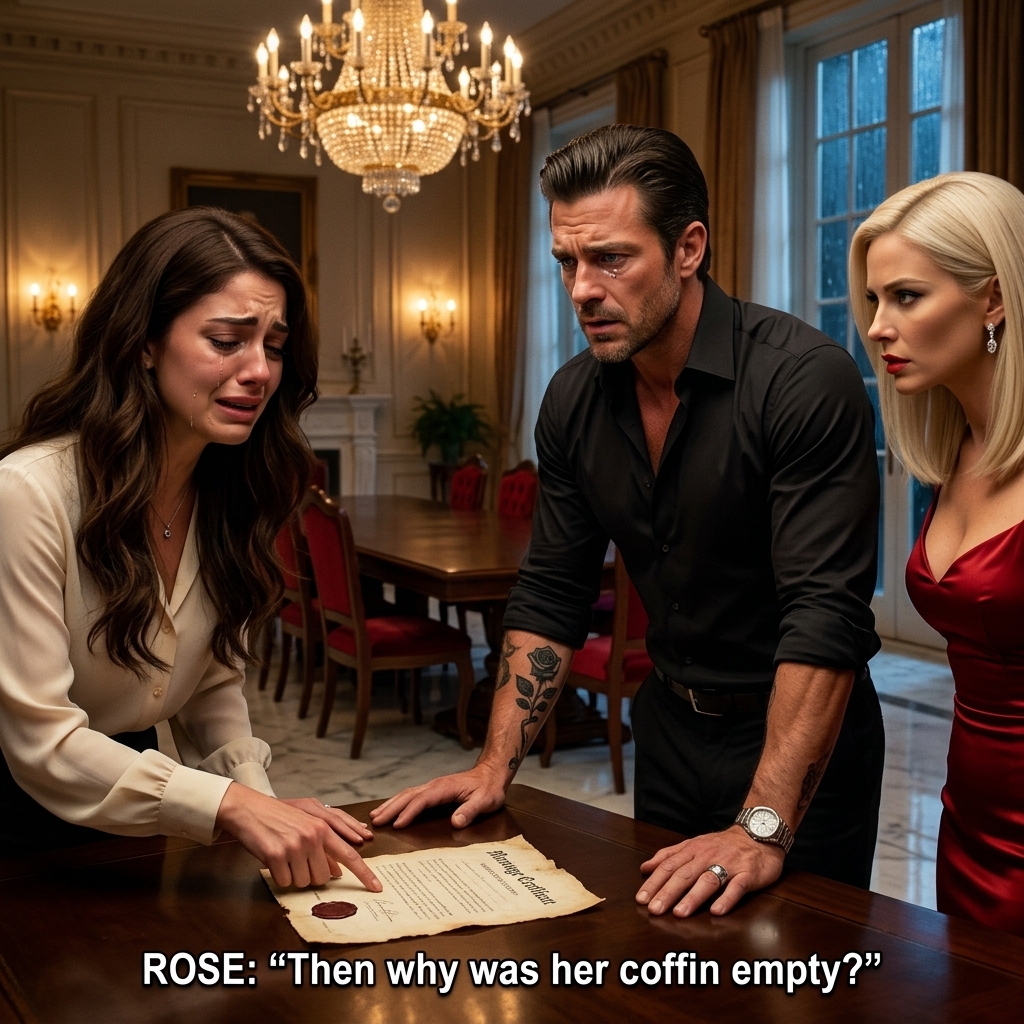
The slap came before anyone at the table had time to stand. Bianca De Luca’s palm flashed across the warm light of the chandelier, and Rose Marino turned her face with the motion, more shocked by the audience than the sting. Crystal trembled against crystal. Six dinner guests in dark suits and evening dresses stopped speaking; two servers froze beside the mahogany table. Arthur Vitale, the elderly butler, held his silver tray at an angle that would have spilled every glass if his hands had not gone rigid.
“Stay away from my husband!” Bianca shouted.
Rose caught Bianca’s wrist when the woman reached toward her again. She pushed her back one measured step. Bianca’s heels scraped marble but she did not fall. Rose felt tears gathering and hated that they had come now, in front of people who already thought her disposable.
“Ask him who he married first!” Rose shot back.
The double doors opened. Lorenzo De Luca crossed the threshold in a black shirt, the rose-and-snake tattoo on his right forearm exposed as he reached between the women. He looked first at his wife, then at the housekeeper.
“What the hell is going on?”
Rose took a cream envelope from the inside pocket of her skirt. Its dark red seal had been broken and pressed back together so many times that the wax resembled dried blood. She slapped it onto the table, unfolded an ivory sheet, and held her finger beside the signature at the bottom.
“That’s your signature!”
Lorenzo took the certificate. He read his name, then the other name: Elena Marino. His shoulders lost their rigid line. A tiny movement passed through the hand holding the page, as though his muscles no longer trusted one another.
“She died in my arms!” he said, his voice breaking.
Rose could barely see him through her tears. She had rehearsed this moment for years; none of those rehearsals had prepared her for the sound of a grieving man who believed himself innocent.
“Then why was her coffin empty?”
The room went silent. Even the rain at the windows seemed to recede. Lorenzo stared at Rose as if she had opened a door in a wall he had spent eight years building.
Lorenzo did not ask his guests to leave. He asked Arthur to lock the front doors, and then immediately changed his mind. “No,” he said. “Nobody is a prisoner here. Anyone who wants to go can go. But nobody takes a photograph of that document.” His voice had recovered its authority, yet Rose saw how tightly he held the paper. Bianca rubbed her wrist, furious that the room had witnessed her losing control. One guest whispered that the marriage certificate had to be counterfeit. Another said nothing at all, which Rose found worse. Arthur finally lowered the tray. The clink of silver on wood sounded like a verdict.
Rose produced the second document: a court-certified inventory from a lawful exhumation authorized after irregularities were found in the death record. She had not dug up a grave in secret. The cemetery had opened it in the presence of officials and an independent observer. The coffin contained satin lining, a damaged wedding veil, and no human remains. The report did not say Elena was alive. Rose knew better than to make that leap. It said only that the burial everyone had treated as final could not establish a death.
“Why didn’t you come to me?” Lorenzo asked.
“I wrote three letters,” Rose said. “Your office returned two unopened. The third disappeared.”
Bianca’s face changed. She knew the household mail was screened, and she knew who had ordered the screening. Rose watched the recognition travel across her expression. It was not proof of guilt, but it was the first sign that Bianca had been afraid of this truth long before tonight.
At the far end of the dining table, Councilman Ferraro rose halfway from his chair and sat again when Lorenzo looked at him. Rose knew that look: the guests had come to celebrate a charitable foundation, and every one of them was deciding whether the scandal would reach tomorrow’s papers. Bianca seized on their embarrassment. She called Rose a thief, accused her of taking stationery from the study, and demanded that Arthur escort her out through the servants’ entrance. Arthur remained where he stood. The silence was its own refusal. Rose placed the exhumation report beside the certificate and invited the guests to look at the raised seal without touching the pages. She did not ask them to believe her. She asked them to remember what they had seen.
Bianca reached across the table to snatch the papers. Lorenzo caught the envelope first, not her wrist. Rose flinched anyway, remembering the slap, and that small involuntary movement shamed him more than any accusation. “You put your hands on an employee in front of witnesses,” he told Bianca. “That stops tonight.” Bianca laughed once, a hard sound, then began to cry. She insisted Rose had been watching Lorenzo for weeks. Rose admitted she had watched him: she needed to know whether he had helped bury Elena or whether somebody had used his grief to keep him obedient. Arthur moved a chair toward Bianca, but she refused to sit. She wanted the room to see her standing even as her marriage came apart.
Lorenzo asked the guests to preserve any photographs or messages they had taken, rather than deleting them. Rose was surprised; evidence had always been the first thing wealthy men made disappear. Arthur quietly gave the names of the two servers who had witnessed the confrontation, and Rose wrote them on the back of a menu. The older server whispered that an unfamiliar courier had delivered a second envelope before dinner and left without signing the visitor log. Lorenzo sent the menu to his attorney with instructions not to contact the courier directly. Across the table Bianca stared at the certificate, unable to decide whether the greatest threat was the first marriage or the possibility that her own signature had been purchased years ago.
At the mansion’s east library, Rose made a small decision that felt larger than it should have: to leave the door open while Lorenzo spoke. In the De Luca household, doors were usually closed before anyone mentioned a problem. The openness did not guarantee safety, but it meant the conversation would not become another secret hidden in a locked room. On the table lay the sealed exhumation report. The detail looked ordinary when separated from the fear surrounding it, and that ordinariness was exactly what disturbed Rose.
“What did you see with your own eyes, and what did someone merely tell you?” Rose asked.
The next difficulty was not a gunman or a threat shouted from a car. It was a contradiction between two pieces of paper. Lorenzo compared the certificate bearing Elena Marino’s name against the dates already established. One entry could be explained by an error; the next required a person to have acted deliberately. Bianca drew a line beneath the inconsistency and asked whether the original could be obtained without warning whoever had altered the file.
By evening the argument had become personal. Arthur accused Bianca of caring more about the guests who had watched Bianca strike her than about the people who had been hurt. Bianca answered too sharply, then regretted it when Arthur looked away. They were both exhausted by the need to be brave in rooms where everyone else seemed to possess a hidden advantage.
A memory returned in fragments, not in the clean sequence of a confession. Arthur recalled the smell of wet wool, the scrape of shoes on stone, and someone using a name that did not belong in that room. None of it was sufficient evidence. Rose insisted they separate recollection from record. Together they wrote two columns: what someone had seen, and what someone had been told. Arthur admitted the coffin had been opened under a court order belonged in only one of those columns until they could verify its origin.
The confrontation with Bianca began badly. Nobody was prepared to be generous, and each person arrived carrying a different version of the same history. Rose placed a photograph of the empty coffin and its untouched satin lining where everyone could see it, then stepped back. Bianca reached for it, stopped, and asked permission. That small hesitation surprised them all.
They tested the new lead against the least dramatic explanation first. Could the sealed exhumation report be a clerical mistake? Could a witness have misremembered the order of events? Could someone have copied a signature without knowing what it authorized? Lorenzo insisted on asking those questions even when the answers might disappoint Bianca. A good story would have accepted the most sensational possibility. They needed a true one.
On the way back through a secluded guest room, Bianca noticed how easily fear could disguise itself as loyalty. A person could say they were protecting the family while protecting only its most powerful member. A person could claim to be protecting a sister while refusing to let that sister make her own choices. Arthur listened as Bianca struggled to say the distinction aloud.
Before leaving, Arthur reviewed every decision made that day. the guests who had watched Bianca strike her had changed hands, and the chain of custody mattered. They noted who had touched it, when it had been photographed, and where the original would be stored. Rose teased Arthur for sounding like a lawyer, but the joke fell gently between them. It was the first kindness either had managed in hours.
After the guests had gone, the dining hall looked worse than it had during the confrontation. A napkin lay under a chair. One candle had burned down to its holder. Rose returned to collect the certificate, but Lorenzo placed it inside a clean evidence sleeve and handed her the receipt his attorney had prepared. “You keep the original,” he said. “I don’t get to decide what happens to your sister’s name.” Bianca watched from the doorway, one hand against the cheek she had never expected to feel shame for raising. Arthur came in carrying the visitor log. The entry for the courier was missing, although the page had been numbered before dinner. The next page bore a faint impression from the removed sheet. Rose held it beneath the lamp and made out two words: EAST GATE. Then her phone rang. A woman who would not identify herself said that the exhumation record was real but incomplete. “Ask your butler who left the east gate at one forty-one,” she whispered. The call ended. Arthur’s face drained of color when Rose repeated the time. He had not told anyone about the ambulance. Not yet.