Chapter 2 – The Bride Who Was Never Buried
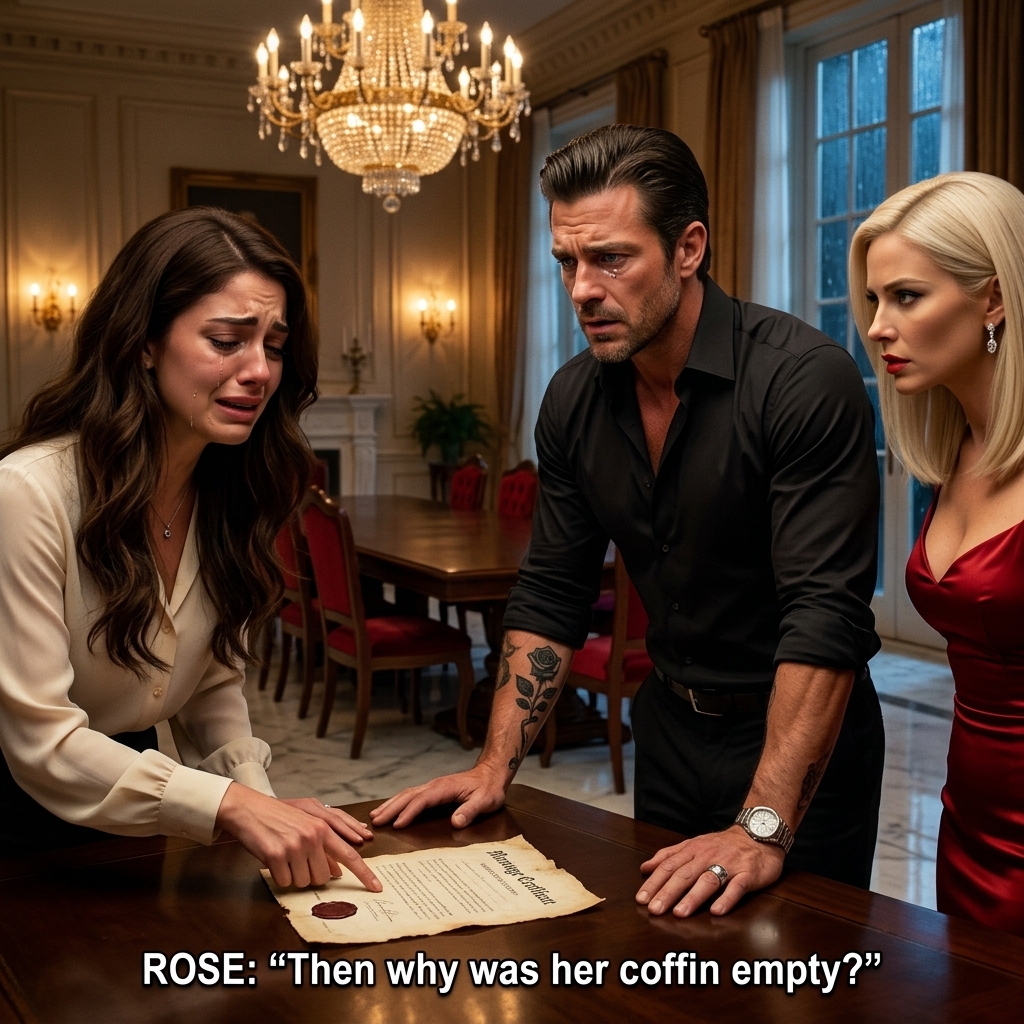
The hospital archive smelled of toner, coffee, and rain-soaked wool. Dr. Naomi Ellis had agreed to review copies, not surrender the originals, and she repeated that distinction twice before Lorenzo entered. Rose appreciated her caution. Too many people in Lorenzo’s world treated an expensive suit as permission to take what they wanted. Ellis opened the dental chart and placed it beside a photograph of the unidentified victim’s records. The dates were close enough to invite confusion and different enough to make the confusion suspicious.
“A name on a form is not a body,” Ellis said. “Neither is a ring.”
Lorenzo remembered smoke, a wedding dress, and a woman’s hand closing around his wrist. The hand had been covered in ash. He had not seen her face clearly. Someone had told him it was Elena before he had even regained consciousness. He had repeated the statement until it felt like memory. Rose watched him absorb that possibility without offering comfort. Her sister had been missing for eight years; she did not owe him relief for discovering uncertainty.
Bianca arrived with a folder she had taken from a locked drawer in the mansion. It contained an attorney’s letter certifying the first marriage was dissolved. Ellis did not pretend to judge its legality. She pointed instead to a date stamped on the death record: the pathologist whose name appeared on it had been attending a conference overseas. The first provable falsehood had nothing to do with family feelings. It was administrative, small, and devastating.
“Who benefits if everyone accepts the easiest explanation?” Lorenzo asked.
The next difficulty was not a gunman or a threat shouted from a car. It was a contradiction between two pieces of paper. Rose compared a dental chart assigned to Elena against the dates already established. One entry could be explained by an error; the next required a person to have acted deliberately. Bianca drew a line beneath the inconsistency and asked whether the original could be obtained without warning whoever had altered the file.
By evening the argument had become personal. Dr. Naomi Ellis accused Bianca of caring more about the signature of a pathologist who had been abroad than about the people who had been hurt. Bianca answered too sharply, then regretted it when Dr. Naomi Ellis looked away. They were both exhausted by the need to be brave in rooms where everyone else seemed to possess a hidden advantage.
Dr. Naomi Ellis folded a hand around the edge of a chair. “I stayed when it was easy to walk away. That should count for something.”
Dr. Ellis arranged three documents on a lighted desk: the death certificate, an emergency transfer log and a dental record made two years before the explosion. The death certificate relied on a hospital identification entered at 2:14 a.m.; the transfer log showed the unidentified woman was not brought to that hospital until 3:06. Lorenzo tried to explain the discrepancy as a clerical error. Ellis made him read the timestamps aloud. “A mistake can happen once,” she said. “This is an identification entered before the patient arrived.” Rose photographed the pages only after the records custodian gave permission. She wanted a clean chain of custody, not another rumor that could be dismissed as a housekeeper’s revenge.
Outside the archive, Bianca was waiting beside a parked car. A pair of reporters had spotted Lorenzo and were approaching with their phones raised. Bianca stepped between them and Rose, not out of kindness but because she recognized the danger of turning a disputed death into public spectacle. One reporter asked whether Lorenzo had married two women at once. He answered that the documents were under review and declined to speculate. Rose hated the careful words until Ellis reminded her that premature certainty would make a future witness afraid to speak. In the car, Lorenzo confessed that the last clear thing he remembered from the explosion was a woman calling his name through smoke. He had never seen her face.
The records custodian called after sunset. Someone using the name of a deceased attorney had requested access to the same file earlier that afternoon. The clerk had refused because the authorization number was invalid. Rose asked for the request to be preserved, including the phone number and exact time, and Lorenzo agreed without demanding the caller’s identity first. It was the first decision they made together that did not require trust. They had the beginnings of an evidentiary trail, but they also had proof that someone else was following it. On the return drive, Bianca kept checking the mirror. The dark sedan behind them turned off twice and appeared again after the bridge.
A memory returned in fragments, not in the clean sequence of a confession. Dr. Naomi Ellis recalled the smell of wet wool, the scrape of shoes on stone, and someone using a name that did not belong in that room. None of it was sufficient evidence. Lorenzo insisted they separate recollection from record. Together they wrote two columns: what someone had seen, and what someone had been told. the remains were registered under an unidentified woman’s case number belonged in only one of those columns until they could verify its origin.
In the library after the visit, Lorenzo spread the records on the floor because the table was too small. He drew a line between what he remembered and what other people had told him. On the left he wrote smoke, a pearl earring, the pressure of a hand and a voice calling for help. On the right he wrote Elena’s name, the hospital’s identification, the funeral and the sealed coffin. Almost everything on the right had arrived through someone else. Bianca stood at the door watching him erase the word certainty from the top of the page. She asked whether he had ever doubted the burial. He said that doubting it had felt like betraying Elena. Rose answered that refusing to doubt might have been the greater betrayal. None of them liked the answer. When Ellis called to confirm that the archive had preserved the original digital entries, Lorenzo asked whether an independent examiner could review them. He did not offer money to accelerate the process. He asked for the ordinary procedure and listened to the explanation. Outside, a reporter had posted a photograph of Rose leaving the archive, calling her an opportunist. Bianca saw the caption first. For one moment she considered leaving it alone. Then she sent a correction through her attorney stating that Rose had presented documents for review and that the allegations against her were unsupported. She did not tell Rose about it. She was not ready to be thanked for doing something she should have done at dinner.
“That’s cruel,” Dr. Naomi Ellis murmured. “To ask a person to doubt the worst night of their life.”
The confrontation with Bianca began badly. Nobody was prepared to be generous, and each person arrived carrying a different version of the same history. Lorenzo placed a courier receipt linking the funeral home to a private clinic where everyone could see it, then stepped back. Bianca reached for it, stopped, and asked permission. That small hesitation surprised them all.
They tested the new lead against the least dramatic explanation first. Could the medical examiner’s archived identification file be a clerical mistake? Could a witness have misremembered the order of events? Could someone have copied a signature without knowing what it authorized? Rose insisted on asking those questions even when the answers might disappoint Bianca. A good story would have accepted the most sensational possibility. They needed a true one.
On the way back through the service corridor, Bianca noticed how easily fear could disguise itself as loyalty. A person could say they were protecting the family while protecting only its most powerful member. A person could claim to be protecting a sister while refusing to let that sister make her own choices. Dr. Naomi Ellis listened as Bianca struggled to say the distinction aloud.
“Then we stop pretending the answer was supposed to do all the work,” Dr. Naomi Ellis said.
Dr. Ellis called Lorenzo back to the archive before he reached the car. She had found the electronic audit trail for the death identification. The first entry was made under a doctor’s credentials while that doctor was overseas; a second entry, six hours later, had replaced the field marked UNKNOWN with Elena Marino. The administrator who approved the change had since resigned and moved to another state. Ellis would not call it proof of murder. She called it proof that the official record had been altered. Rose asked for a certified copy of the audit trail. As the clerk printed the request, the archive’s security officer appeared and asked why a black sedan had been waiting outside the loading entrance since morning. Lorenzo looked through the window. The sedan was gone, but a handwritten note had been left beneath the wiper of Ellis’s car. It contained a single instruction: STOP LOOKING FOR THE WOMAN IN WHITE. Ellis read it without blinking. Then she reached for the phone and called the police.