Chapter 2 – A Name from the Dead
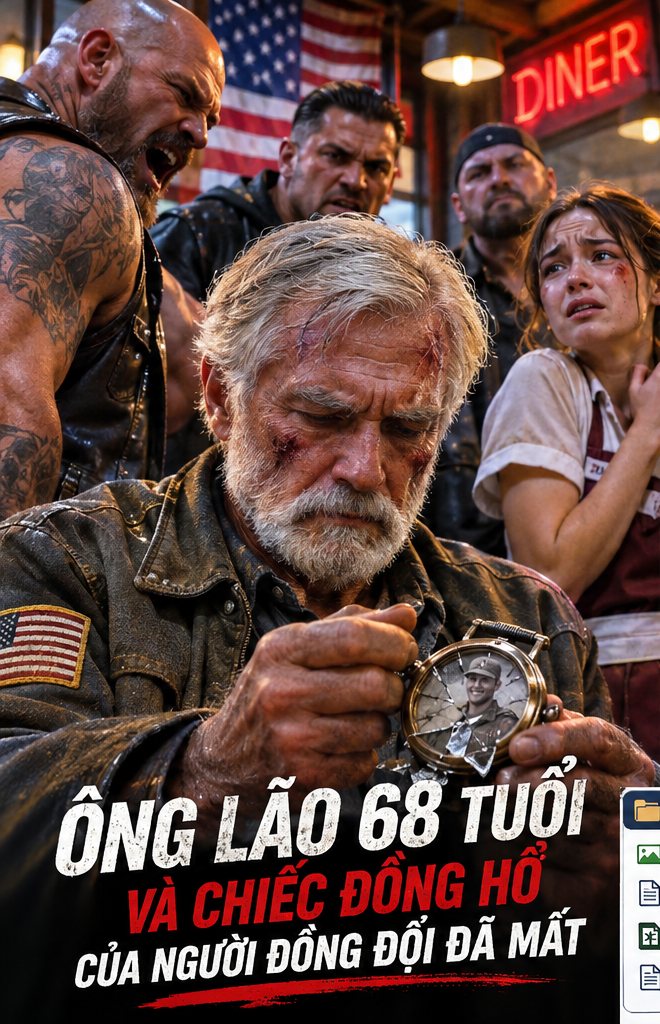
The man in the gray coat did not cross the room. He stood beside the humming refrigerator and watched Robert Hale as if an impossible photograph had begun to move. Vince Rourke reached for the broken watch again. Robert put his hand over it, careful not to cut his palm on the glass.
“Everybody back away from the girl,” Robert said. Vince laughed and took one more step toward Lily. Robert shifted his weight, caught Vince’s reaching wrist, and used the man’s momentum to guide him into an empty chair. It was not the spectacular fight Vince had expected. It was quick, economical, and over before the camera could focus. The phone fell sideways against a napkin dispenser.
At the counter Robert wrapped every piece of glass separately because Thomas had once joked that their watches should outlast them both. Lily found a small paper envelope for the fragments. Robert wrote Thomas’s name on it slowly, unwilling to let a stranger’s cruelty reduce a human life to broken parts.
The silence afterward was not empty. It contained everything nobody was ready to say and every question that could not yet be answered. Some questions belonged to the past: who had known, who had lied, and when the first chance to stop it had been lost. Others concerned the next hour and were more urgent. Was anyone being watched? Could a witness leave safely? Would a frightened friend answer a phone call? In that uncertain space, the difference between a useful plan and an angry impulse became clear. Action had to follow facts rather than replace them. That rule felt painfully slow, especially to people who had already waited too many years, but it was the only way their hard-won evidence could outlast the next confrontation.
June finally completed her call to the police. The gray-coated stranger walked out the way he came. Robert did not chase him. He had learned long ago that the person who ran was often the one meant to be followed. The other two men dragged Vince upright and retreated into the parking lot, promising revenge as their tires threw gravel against the windows.
Vince had practiced intimidation in places where nobody challenged him. The older man’s stillness unsettled him more than anger would have. When Robert guided him into the chair, Vince looked toward the gray-coated observer for approval and found only a cold expression.
Every person present carried a private version of the same question: what would happen if they refused to cooperate with the fear around them? Not everyone could risk the same thing. Age, family, money, health, and history changed the price of speaking. Recognizing those differences did not mean accepting injustice. It meant helping one another shoulder the danger with as much care as possible. The conversation moved through small practical matters as well as larger moral ones, and that was appropriate. Somebody needed to remember a telephone number, another person needed to keep the door clear, and someone had to think ahead to what investigators might need. Courage became a series of ordinary tasks performed when turning away would have been easier.
Lily trembled so badly that she spilled water across the counter. Robert gathered the pieces of the watch in a clean paper napkin. Under its cracked backplate, a thin strip of blue material had appeared where no watchmaker would expect one. He kept his face still. Thomas had never mentioned anything hidden inside.
Deputy Aaron Pike arrived ten minutes later. His first question was why Robert had attacked a customer. His second was why the security camera had stopped working at precisely 7:14 p.m. June insisted it had worked before the strangers entered. Pike took her statement without writing down the detail about the gray coat.
June had bought Mercy Diner after her husband died and kept it open through storms and bad winters. She was proud that the students from the high school could always get a warm meal there. The black SUV outside felt like an insult to everything she had built.
What stayed with them was not merely the discovery but the way it changed familiar faces. A person who had seemed helpless could become decisive; someone thought to be certain could suddenly hesitate. Trust was not a single declaration made once and honored forever. It had to be tested against actions, especially when the truth was inconvenient. That knowledge made the hours feel longer, but it also gave structure to their choices. They could examine claims, protect the vulnerable, and refuse to let intimidation determine the order in which facts were considered. In the years to come they would remember this stretch of time as an exhausting chain of decisions, each imperfect, each made with the hope that the next person would have a fairer chance.
In the kitchen Lily told Robert that Vince had been visiting for three weeks. At first he came with polite questions about June’s brother, a truck mechanic who vanished last winter. Then the questions became threats. Lily had kept a photograph of the man’s truck, taken through the blinds. In its windshield hung a black hawk charm with one missing eye.
Lily kept her photographs sorted by dates because she had been applying for photography scholarships. One blurry frame showed a reflection in the truck’s mirror: the same gray-coated figure standing behind Vince. She had not noticed him until Robert asked her to enlarge the picture.
The people involved were learning to distinguish between revenge and accountability. Revenge would have promised a brief moment of satisfaction and left the underlying danger intact. Accountability required names, evidence, witnesses, and people willing to endure the slow scrutiny of institutions that might fail them. The distinction was especially hard for those who had seen a loved one harmed. Every new fact seemed to invite an immediate response. Yet the moment also showed why restraint could be an active, demanding choice rather than a sign of weakness. Holding to the truth was not a way of avoiding a confrontation. It was the decision to make the eventual confrontation about what really happened instead of what anger wished had happened.
Robert asked for the photograph. The plate was partly obscured by mud, but he recognized the old military procurement sticker on the rear window. His stomach tightened. The truck belonged to a contractor called Blackwing Logistics, officially dissolved after a disastrous overseas mission in 2008.
Pike made an unsuccessful attempt to ask Lily whether she had been threatened, then stopped when his phone lit up with an unknown caller. He stepped outside to answer it. Through the window, Robert saw him lower his head like a man receiving instructions he could not refuse.
There were details in that moment that nobody would ever put into an official report: the uneven light, the scrape of fabric, the slight delay before anyone decided what to say. Those were the things memory preserved after the sharpest words had faded. It was tempting to pretend that dramatic decisions happened in isolation, with a clean distinction between the brave person and the frightened person. In reality, every choice followed dozens of smaller ones, including the decision to look carefully rather than turn away. By the time anyone recognized that the situation had changed, they were already part of it. The consequences would spread farther than the people present could imagine, and some would never know which quiet second had redirected the rest of their lives.
In the parking lot, Pike told him to go home and forget everything. “People your age should know when trouble isn’t worth it.” Robert looked at Pike’s clean boots and noticed the dark blue thread caught in his radio clip. The same blue as the strip inside the watch.
Robert kept Emily’s telephone number in a worn address book, beside birthdays he still remembered. He had promised her mother that he would never disappear from the family’s life. He had tried to keep that promise through awkward visits, long silences, and his own reluctance to tell the truth.
Nothing about the surrounding world had paused to respect the danger. A light continued to burn; a vehicle passed outside; somebody somewhere was preparing dinner without knowing what was happening here. That ordinary continuity made the fear feel strangely private. The people who lived through it would later disagree about the order of small events, but not about the feeling of having to act before they possessed enough information. Waiting for certainty was attractive because it sounded responsible. Yet there were moments when uncertainty was the only condition available, and a person still had to decide whom to protect. What mattered was not a perfect instinct. It was a willingness to reconsider the first impulse and choose the action that caused the least harm.
“Did you know Thomas Ward?” Robert asked.
Pike’s expression flattened. “Never heard of him.”
The blue strip underneath the watch reflected the diner light in a way no cloth would. Robert remembered an Army briefing about flexible waterproof film and felt a sudden pulse of dread. Thomas had given him more than a memento. He had given him an unfinished duty.
A person looking in from a distance might have mistaken this exchange for a minor incident, quickly forgotten once everyone went home. To those inside it, the smallest gesture carried a meaning that did not fit into a headline. There was a difference between being silent because one had surrendered and being silent because one was listening. There was a difference between a warning delivered for show and a warning that cost someone courage to give. Later, as the evidence accumulated and the names became familiar, it would be easy to explain the scene as inevitable. It had not been inevitable. It depended on somebody noticing one detail and refusing to treat the person beside them as expendable.
The deputy drove away without taking the damaged watch as evidence. When Robert checked his old flip phone, a new message waited from an unknown number: YOU WERE SUPPOSED TO DIE WITH WARD. Under the words was a photograph of a woman outside a school—Thomas’s daughter, Emily, now thirty-two, holding the hand of a small boy.
The photograph of Emily and Noah was taken recently enough to include the boy’s new red school backpack. Robert stared at the red strap because it proved someone had followed them this week. He was too late to protect them simply by keeping a secret.
For years the people at the center of this story had tried to make their lives small enough for trouble to pass them by. They learned routines, memorized faces, and made agreements with themselves about what could safely be discussed. Now those habits offered little comfort. The situation demanded something more difficult than a quick show of strength. It demanded patience, accuracy, and an understanding that fear could make otherwise decent people careless. Nobody could undo the past by being reckless in the present. Each step required thinking about the people who would have to live with its aftermath. The most important decisions were often the least cinematic: keeping a record, calling someone trustworthy, checking a door, or refusing to spread an accusation before it could be proved.
The ordinary tasks demanded attention even when larger events threatened to swallow the day. Someone still needed to eat. A tired driver had to stop before fatigue became another danger. A child deserved an explanation that did not terrify him unnecessarily. These details could seem trivial beside the names of powerful men and the weight of old documents, yet they were the reason the investigation mattered. The goal was not merely to win an argument about the past. It was to make enough room for people to live without organizing every hour around fear. That was the promise hidden beneath the practical preparations, and it kept them moving when a simpler impulse would have been to give up.
Robert dialed Emily’s number with hands that no longer felt steady. She answered on the fourth ring, irritated to be called so late. He said only, “Get your son away from the windows.” She began to ask why. A sharp noise interrupted the call, followed by the sound of breaking glass.
“Emily?” Robert shouted. Nobody answered.