Chapter 1 – The Slap at Mercy Diner
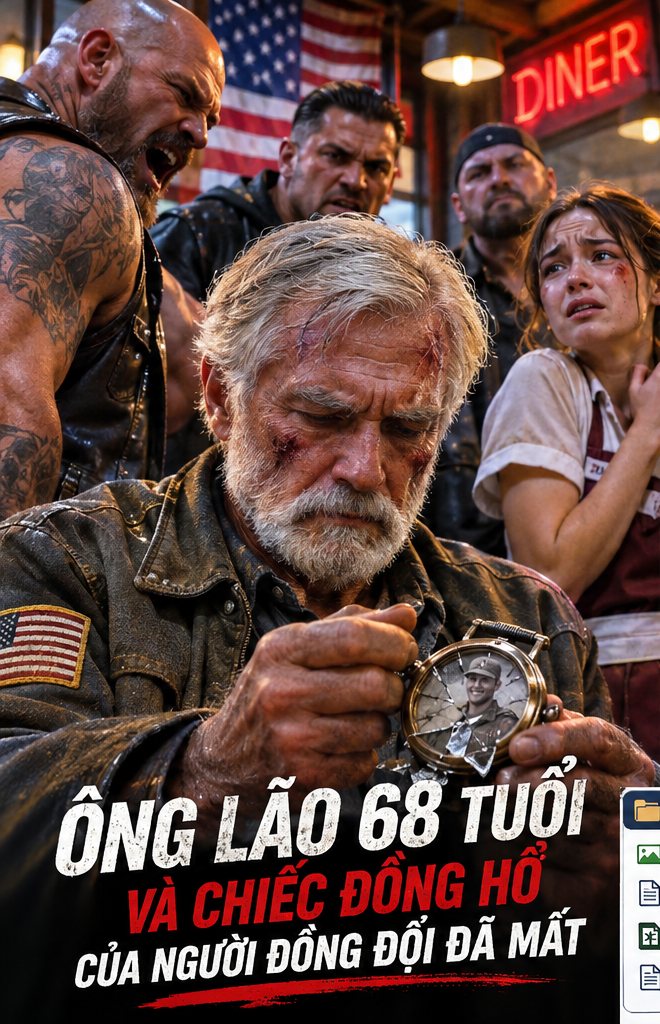
The slap sounded like a gunshot against the windows of Mercy Diner. Every fork stopped. Coffee sloshed over a saucer. And the sixty-eight-year-old man in booth seven slowly turned his face back toward the three strangers standing over him.
Robert Hale tasted blood where his lower lip had struck a tooth. He did not touch it. Across the narrow aisle, seventeen-year-old waitress Lily Mercer stood frozen with a tray pressed against her chest. The broadest stranger, a man with a shaved head and a tattooed neck, smiled as though a crowded restaurant were his private stage.
“Didn’t you hear me, Grandpa?” he said. “Your booth. Our table.”
June had worked the night shift for twenty-seven years and knew the difference between a customer being rude and someone conducting a search. The men checked the ceiling corners before they checked the menu. One asked whether the back door had an alarm. June removed the key from the register drawer without being seen.
For years the people at the center of this story had tried to make their lives small enough for trouble to pass them by. They learned routines, memorized faces, and made agreements with themselves about what could safely be discussed. Now those habits offered little comfort. The situation demanded something more difficult than a quick show of strength. It demanded patience, accuracy, and an understanding that fear could make otherwise decent people careless. Nobody could undo the past by being reckless in the present. Each step required thinking about the people who would have to live with its aftermath. The most important decisions were often the least cinematic: keeping a record, calling someone trustworthy, checking a door, or refusing to spread an accusation before it could be proved.
Robert looked at the man’s companion, who had deliberately blocked the exit, and then at the third, who was filming with his phone. He had entered the diner for black coffee and the Wednesday meatloaf special, not for a confrontation. He slid a five-dollar bill beneath his saucer and started to stand.
Before the strangers arrived, Robert had repaired the loose screw in Lily’s serving tray with a coin from his pocket. He had told her that a person deserved tools that worked and a shift without surprises. She had laughed at the old-fashioned seriousness of the remark. Now the tray shook in her hands.
There was another layer to the scene, one that would be invisible to anyone reading only the final testimony. Pride had to be swallowed. Old arguments returned without warning. Some memories were more reliable than others, and nobody was immune to the relief of accepting an answer that made life easier. The careful choice was to keep asking what could be demonstrated, what had only been assumed, and what remained unknown. That discipline did not make the emotional pain disappear. If anything, it made the pain sharper because it prevented an easy story from taking its place. But it gave the people involved a way forward that did not require becoming like the men who had threatened them.
“Leave the girl alone,” he said quietly.
That was his only demand. He had seen the bruised fear in Lily’s expression when the men arrived, the way she had checked the kitchen door twice as if someone might rescue her. The big man, Vince Rourke, hooked a finger beneath her apron strap. Lily flinched. Robert moved between them before he could consider whether his knees would forgive him.
The smallest thug, Curtis Bell, filmed from behind a sticky soda glass. He asked Vince to move closer to the window where the overhead light was brightest. The violence was not spontaneous entertainment. Someone wanted the footage clear enough to show that Robert had been publicly humiliated.
The surroundings seemed to acquire a different weight once the possibility of danger was spoken aloud. Ordinary objects became reminders of vulnerability or small means of protection. A door was a way out; a window could expose someone; a scrap of paper could preserve something a powerful person wanted destroyed. It was not the knowledge of a secret that made somebody courageous. It was the decision to handle that knowledge without treating other lives as pieces in a game. The people sharing the room came from different generations, with different expectations of authority and safety. They did not agree on every method. What held them together was the simpler understanding that none of them should be asked to pay for another person’s dishonesty alone.
Vince shoved him into the booth and laughed. “You a hero?”
“No,” Robert answered. “I’m a customer asking you to stop.”
A truck driver at the counter started to rise, then froze when he saw the second man holding a wrench under his jacket. Robert saw the calculation in the driver’s face. He did not judge him for staying seated. Every person in that room had a life waiting outside.
The silence afterward was not empty. It contained everything nobody was ready to say and every question that could not yet be answered. Some questions belonged to the past: who had known, who had lied, and when the first chance to stop it had been lost. Others concerned the next hour and were more urgent. Was anyone being watched? Could a witness leave safely? Would a frightened friend answer a phone call? In that uncertain space, the difference between a useful plan and an angry impulse became clear. Action had to follow facts rather than replace them. That rule felt painfully slow, especially to people who had already waited too many years, but it was the only way their hard-won evidence could outlast the next confrontation.
At the counter, owner June Mercer reached for the telephone. The man with the camera pointed toward her. “Put it down. We just want to talk.” June kept her hand near the receiver. There was no one else in the diner willing to cross the room.
Thomas Ward could make a hard night bearable by speaking about the baseball stadium where he planned to take his daughter. Robert remembered the exact sound of his laugh. That memory, preserved against years of doubt, suddenly hurt more than the slap.
Every person present carried a private version of the same question: what would happen if they refused to cooperate with the fear around them? Not everyone could risk the same thing. Age, family, money, health, and history changed the price of speaking. Recognizing those differences did not mean accepting injustice. It meant helping one another shoulder the danger with as much care as possible. The conversation moved through small practical matters as well as larger moral ones, and that was appropriate. Somebody needed to remember a telephone number, another person needed to keep the door clear, and someone had to think ahead to what investigators might need. Courage became a series of ordinary tasks performed when turning away would have been easier.
The thing on Robert’s wrist was an old stainless-steel field watch, too scratched to interest a thief. Its face had a small crack near the six. On the back, inside a worn engraving, were five words: COME HOME FOR BOTH OF US. Robert kept it wound even though it ran two minutes slow. It had belonged to Sergeant Thomas Ward, who died saving him in a valley that the Army’s official report had never named correctly.
Vince noticed Robert protecting the watch when he caught his balance. “What, this junk worth something?” He seized Robert’s wrist. Robert’s voice changed. Not louder. Sharper. “Let go of that.”
June motioned for Lily to hide in the pantry, but Lily kept watching Robert. She knew a person could be endangered simply because everyone else looked away. She set the tray down and asked the men, in a voice almost too low to hear, whether they had mothers who would recognize them now.
What stayed with them was not merely the discovery but the way it changed familiar faces. A person who had seemed helpless could become decisive; someone thought to be certain could suddenly hesitate. Trust was not a single declaration made once and honored forever. It had to be tested against actions, especially when the truth was inconvenient. That knowledge made the hours feel longer, but it also gave structure to their choices. They could examine claims, protect the vulnerable, and refuse to let intimidation determine the order in which facts were considered. In the years to come they would remember this stretch of time as an exhausting chain of decisions, each imperfect, each made with the hope that the next person would have a fairer chance.
Lily took a step forward. “Please. He’s done nothing.” The third man swung his phone toward her, excited to have captured fear on camera. Vince tore the watch off its brittle strap, held it high, and brought it down hard on the edge of the counter. The glass fractured. The second hand stopped.
For one suspended instant, Robert saw not the diner’s cracked tiles but Thomas Ward in the rain, pressing the watch into his palm. He remembered a promise spoken above helicopter blades. Then he saw the broken steel on the counter and something terrible in the reflection: the design stamped onto Vince’s ring. A black hawk with one eye missing. Robert had seen that symbol eighteen years earlier on the last truck to leave the valley.
The black hawk ring had a rough groove through one eye, not an artistic flourish but a crude cut. Robert remembered that symbol carved into a radio case at Lantern Bridge. The memory had always seemed insignificant. Now it had walked into his booth.
The people involved were learning to distinguish between revenge and accountability. Revenge would have promised a brief moment of satisfaction and left the underlying danger intact. Accountability required names, evidence, witnesses, and people willing to endure the slow scrutiny of institutions that might fail them. The distinction was especially hard for those who had seen a loved one harmed. Every new fact seemed to invite an immediate response. Yet the moment also showed why restraint could be an active, demanding choice rather than a sign of weakness. Holding to the truth was not a way of avoiding a confrontation. It was the decision to make the eventual confrontation about what really happened instead of what anger wished had happened.
He raised his eyes. “Where did you get that ring?”
Robert counted the exits, the distance between tables, and the angle of the open kitchen door out of habit, then deliberately looked away. He did not want to turn the diner into a battlefield. His first goal was still to send everyone home alive.
There were details in that moment that nobody would ever put into an official report: the uneven light, the scrape of fabric, the slight delay before anyone decided what to say. Those were the things memory preserved after the sharpest words had faded. It was tempting to pretend that dramatic decisions happened in isolation, with a clean distinction between the brave person and the frightened person. In reality, every choice followed dozens of smaller ones, including the decision to look carefully rather than turn away. By the time anyone recognized that the situation had changed, they were already part of it. The consequences would spread farther than the people present could imagine, and some would never know which quiet second had redirected the rest of their lives.
Vince smiled, but the smallest tremor traveled through his jaw. “Wrong question, old man.”
The diner’s back door opened. A fourth stranger entered wearing a gray coat and spotless shoes. Unlike the others, he did not laugh. He stared at Robert’s face, then at the shattered watch, and whispered into a microphone hidden beneath his collar.
“He’s alive.”