Chapter 3 – The Photograph in the Watch
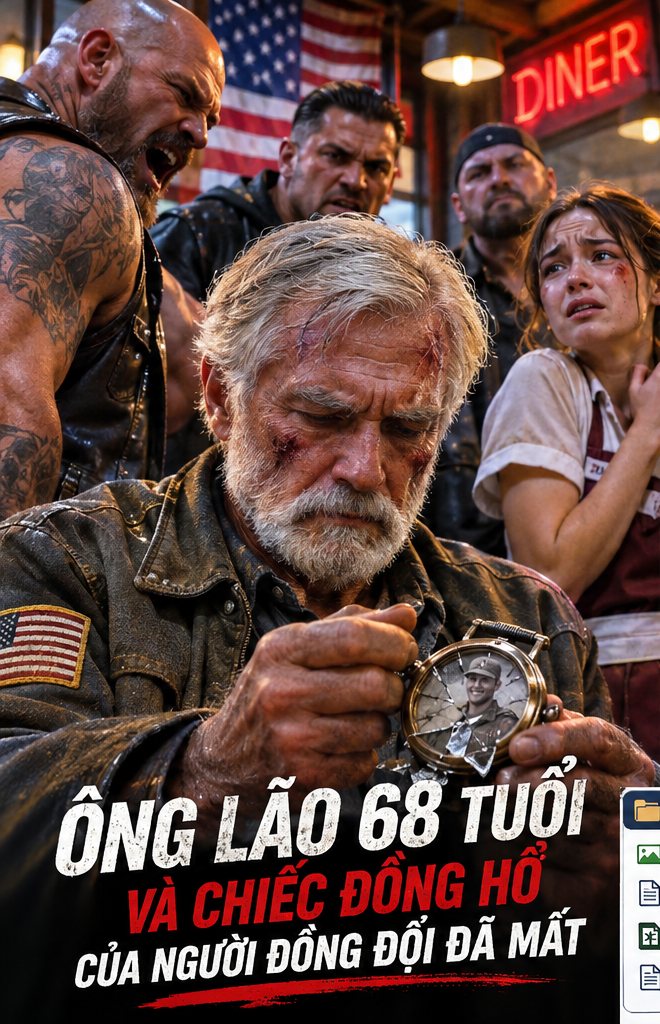
Robert drove through the empty streets without using the highway. He had not moved this quickly in years. At a red light he called Emily Ward again and heard a busy signal that seemed to go on forever. He hated how a stranger’s message had turned an ordinary Wednesday into a road he knew too well: the long drive toward a house where someone might already be dead.
Emily lived above a small bookstore on Sycamore Street. The front window was broken, but the front door was locked. Inside, a ceramic lamp lay shattered on the stairs. Emily’s seven-year-old son Noah crawled from behind the counter when he heard Robert’s voice. He was shaking but unhurt. Emily emerged from the back office with a kitchen flashlight and a small cut on her cheek.
Noah held a plastic dinosaur and asked if his mother would be arrested for breaking the window. The question was so ordinary that it nearly defeated Robert. He knelt, explained that nobody in the family had done anything wrong, and promised not to lie if he was asked a difficult question.
The people involved were learning to distinguish between revenge and accountability. Revenge would have promised a brief moment of satisfaction and left the underlying danger intact. Accountability required names, evidence, witnesses, and people willing to endure the slow scrutiny of institutions that might fail them. The distinction was especially hard for those who had seen a loved one harmed. Every new fact seemed to invite an immediate response. Yet the moment also showed why restraint could be an active, demanding choice rather than a sign of weakness. Holding to the truth was not a way of avoiding a confrontation. It was the decision to make the eventual confrontation about what really happened instead of what anger wished had happened.
“Someone threw a brick,” she said. “Then a man called and asked if I’d received my father’s last gift.”
Robert showed her the fragments of the watch. Emily had not seen it since she was fourteen. She touched the engraving with one fingertip. “He wrote those words in a letter before he went away. Mom kept the letter in a box. I thought it was just something he said.”
Emily kept her father’s letters inside a shoebox beside her college diploma. She had moved houses three times and never allowed the box into a storage unit. Every letter carried evidence of a person whose laugh she could barely remember but whose handwriting she would recognize anywhere.
There were details in that moment that nobody would ever put into an official report: the uneven light, the scrape of fabric, the slight delay before anyone decided what to say. Those were the things memory preserved after the sharpest words had faded. It was tempting to pretend that dramatic decisions happened in isolation, with a clean distinction between the brave person and the frightened person. In reality, every choice followed dozens of smaller ones, including the decision to look carefully rather than turn away. By the time anyone recognized that the situation had changed, they were already part of it. The consequences would spread farther than the people present could imagine, and some would never know which quiet second had redirected the rest of their lives.
They drove to June Mercer’s house, because Emily refused to sleep above the broken shop and Robert did not trust the police station. June made tea while Lily kept Noah busy with a deck of playing cards. At the kitchen table, Robert unfolded the thin blue strip from beneath the watch’s backplate. It was not cloth. It was microfilm inside waterproof wrapping, folded around a tiny photograph of six soldiers in front of a helicopter.
June pulled an extra blanket from the linen closet and cleared the table without asking for explanations. The diner’s owner believed fear became worse when people were treated like strangers. She offered food before questions, and for a few minutes the sound of tea being poured steadied everyone.
Nothing about the surrounding world had paused to respect the danger. A light continued to burn; a vehicle passed outside; somebody somewhere was preparing dinner without knowing what was happening here. That ordinary continuity made the fear feel strangely private. The people who lived through it would later disagree about the order of small events, but not about the feeling of having to act before they possessed enough information. Waiting for certainty was attractive because it sounded responsible. Yet there were moments when uncertainty was the only condition available, and a person still had to decide whom to protect. What mattered was not a perfect instinct. It was a willingness to reconsider the first impulse and choose the action that caused the least harm.
Thomas stood near the center, smiling despite the rain. Robert recognized four faces. The fifth belonged to a younger man in a gray coat. The sixth was hidden beneath a thumb-shaped stain. On the reverse, Thomas had written a date, a location code, and a single sentence: IF I DON’T RETURN, FIND THE MAN WHO NEVER FIRED.
Robert remembered the mission called Lantern Bridge, a covert extraction from a remote border valley. Their team had been sent to rescue an informant and his young daughter. Their coordinates were leaked. Two helicopters were destroyed, the informant disappeared, and Thomas stayed behind to keep a damaged rotorcraft from drawing fire onto Robert’s retreating group. The official report blamed bad intelligence. Robert had spent eighteen years unable to reconcile that report with what he witnessed.
In the old photograph, Thomas held one hand behind his back, a habit he had when something important was hidden in his palm. Robert had assumed it was an injury. Daniel later explained that Thomas often hid copied field notes that way to keep equipment inspectors from noticing.
A person looking in from a distance might have mistaken this exchange for a minor incident, quickly forgotten once everyone went home. To those inside it, the smallest gesture carried a meaning that did not fit into a headline. There was a difference between being silent because one had surrendered and being silent because one was listening. There was a difference between a warning delivered for show and a warning that cost someone courage to give. Later, as the evidence accumulated and the names became familiar, it would be easy to explain the scene as inevitable. It had not been inevitable. It depended on somebody noticing one detail and refusing to treat the person beside them as expendable.
Emily listened, her face hardening. “You told me he was brave. You never told me you thought he was betrayed.”
Rain had made the river roar so loudly that orders were shouted twice. Robert remembered the smell of wet canvas, diesel, and metal heated beyond safety. The team’s maps showed a safe bridge. When they reached it, the bridge was destroyed and someone was already waiting on the opposite bank.
For years the people at the center of this story had tried to make their lives small enough for trouble to pass them by. They learned routines, memorized faces, and made agreements with themselves about what could safely be discussed. Now those habits offered little comfort. The situation demanded something more difficult than a quick show of strength. It demanded patience, accuracy, and an understanding that fear could make otherwise decent people careless. Nobody could undo the past by being reckless in the present. Each step required thinking about the people who would have to live with its aftermath. The most important decisions were often the least cinematic: keeping a record, calling someone trustworthy, checking a door, or refusing to spread an accusation before it could be proved.
“I had suspicion. No proof. And people were threatened when they asked questions.”
“No proof,” she repeated, looking at the photograph that had been hidden against her father’s skin for almost two decades. “Then what do you call this?”
Emily refused to let Robert use her childhood as a reason to keep her uninformed. She told him about every memorial ceremony at which strangers had praised Thomas with words written by someone who was not there. She wanted facts, not another speech about honor.
There was another layer to the scene, one that would be invisible to anyone reading only the final testimony. Pride had to be swallowed. Old arguments returned without warning. Some memories were more reliable than others, and nobody was immune to the relief of accepting an answer that made life easier. The careful choice was to keep asking what could be demonstrated, what had only been assumed, and what remained unknown. That discipline did not make the emotional pain disappear. If anything, it made the pain sharper because it prevented an easy story from taking its place. But it gave the people involved a way forward that did not require becoming like the men who had threatened them.
Lily noticed something on the edge of the film. A second number had been scratched beneath the date. She used her phone to enlarge it and found a row of digits separated by slashes. Not a telephone number. A locker code, maybe, or a route marker. June recognized the final four digits as the old county railway depot designation.
Lily compared the scratches to a county map printed before the railway depot closed. The final digits matched a goods platform, while the first were a reference to a military radio frequency. Someone had placed two destinations in one short code and expected a survivor to understand.
The surroundings seemed to acquire a different weight once the possibility of danger was spoken aloud. Ordinary objects became reminders of vulnerability or small means of protection. A door was a way out; a window could expose someone; a scrap of paper could preserve something a powerful person wanted destroyed. It was not the knowledge of a secret that made somebody courageous. It was the decision to handle that knowledge without treating other lives as pieces in a game. The people sharing the room came from different generations, with different expectations of authority and safety. They did not agree on every method. What held them together was the simpler understanding that none of them should be asked to pay for another person’s dishonesty alone.
Robert made a decision he had delayed since the valley. He would take the evidence to someone outside the county, but first they needed to understand what Thomas had left. He called Daniel Brooks, a retired Army signals officer who had once helped them extract a desperate family from a flooded road. Daniel answered immediately, as though he had expected this call for years.
“Robert,” Daniel whispered, “if the watch has opened, do not take it to the depot.”
Noah noticed headlights pause outside June’s house. Robert extinguished the kitchen light and asked everyone to move into the hallway away from the glass. He made the request gently enough that Noah thought they were playing a quiet game, and Emily understood the cost of that kindness.
The silence afterward was not empty. It contained everything nobody was ready to say and every question that could not yet be answered. Some questions belonged to the past: who had known, who had lied, and when the first chance to stop it had been lost. Others concerned the next hour and were more urgent. Was anyone being watched? Could a witness leave safely? Would a frightened friend answer a phone call? In that uncertain space, the difference between a useful plan and an angry impulse became clear. Action had to follow facts rather than replace them. That rule felt painfully slow, especially to people who had already waited too many years, but it was the only way their hard-won evidence could outlast the next confrontation.
“Why?”
“Because that’s where they buried the second witness.”