Chapter 1 – The Uniform at the Door
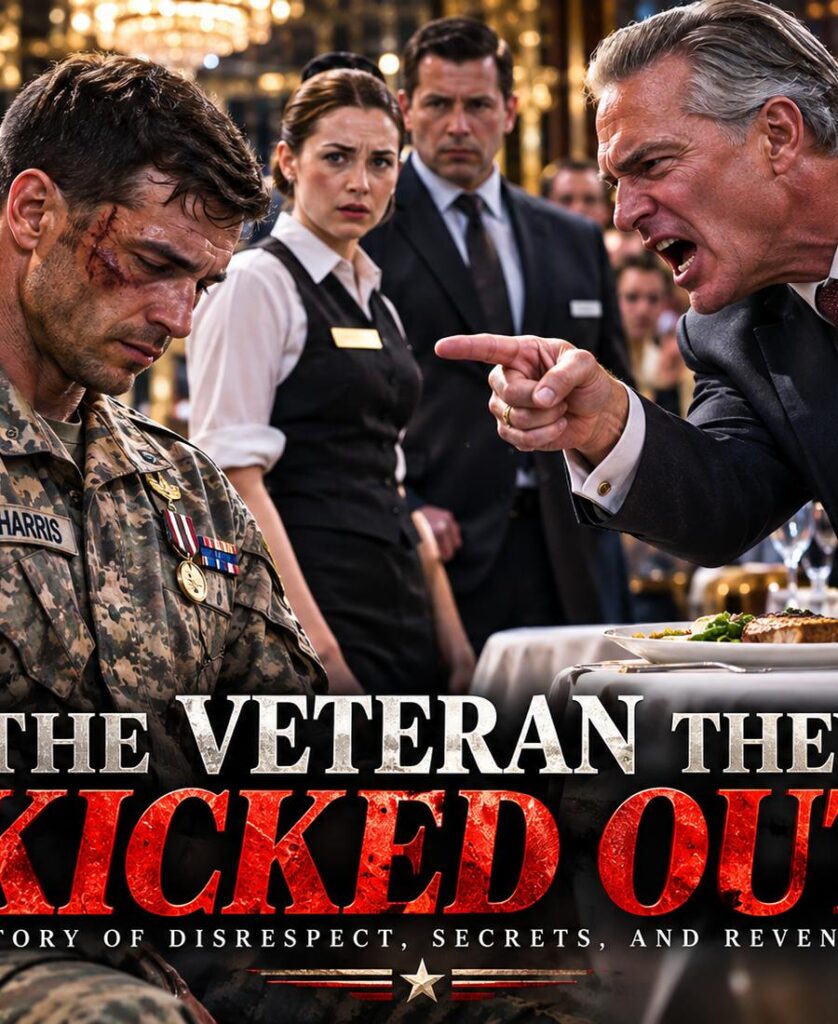
The first sound was breaking glass. Vincent Cross hurled a crystal tumbler against the marble floor of the Lafayette Room, and the sharp report silenced the violinist halfway through a note. Red wine spread across the pale stone like a wound. Cross stood at the center of the most expensive dining room in Washington, D.C., one hand gripping the back of his chair, the other pointing toward the entrance. “Get that filthy uniform out of my sight!” he shouted. A hundred conversations died. The soldier in the doorway did not retreat. Captain Nathan Harris held a folded invitation between two fingers, his dress uniform carefully pressed, his shoes polished, and an old silver watch resting against the inside of his left wrist. He had prepared himself for uncomfortable questions. He had not prepared himself to hear the word filthy used in a room decorated with the photographs of fallen soldiers.
Nathan was thirty-six years old, though there were mornings when the scars under his shirt made him feel twice that age. A faint pale line passed through his right eyebrow, a reminder of flying glass in the desert. His left knee stiffened after long walks, particularly in cold weather. He had spent nineteen minutes outside the restaurant deciding whether to enter. A man with a delivery trolley had politely offered to open the heavy door, and Nathan had nearly thanked him and walked away. But the invitation in his pocket had arrived that morning in a plain envelope without a return address. Its embossed gold letters said HONORING THOSE WHO NEVER CAME HOME. On the back, beneath a list of donors, were six names. The third was Sergeant Thomas Vale. Nathan had promised Thomas that his daughter would one day know the truth. Fourteen years had passed. This was the first invitation that seemed to offer a path toward keeping that promise.
The dining room smelled of expensive perfume, truffle butter, candle wax, and the faint sweetness of fresh flowers. Above the tables hung enormous chandeliers that scattered points of light across silver forks and white linen. Nathan had seen places like this only from the outside. On his way in, a row of luxury cars had occupied the curb, while a veteran selling handmade paper poppies stood near a subway entrance half a block away. Nathan had purchased one and pinned it to his jacket before remembering that this uniform was already covered in signs of service. He slipped the poppy into his pocket instead. None of the people in the restaurant had noticed it. They noticed his boots, his ribbons, and the absence of a wealthy companion. They looked at the man first and decided what the uniform must mean after.
A hostess approached with quick, uncertain steps. She was in her early twenties, with dark hair pulled into a neat bun and a gold name tag that said MIA. “Sir, may I see your reservation?” she asked, speaking softly enough that it almost restored the ordinary atmosphere of a restaurant. Nathan handed over the invitation. She read the seal, glanced at the guest list on her tablet, and frowned. For a moment he thought she might explain the misunderstanding and lead him to a quiet corner. Instead, the floor manager arrived. Derek Sloan was tall and clean-shaven, wearing a fitted charcoal suit and an earpiece. He caught Mia by the elbow and moved her aside with a practiced motion that looked discreet from the tables and felt forceful up close. “We don’t serve charity cases,” he told Nathan, raising his voice. “There’s a shelter three blocks away.” Someone at Cross’s table laughed before seeing whether anyone else would join.
Nathan looked down at the invitation again, not because he doubted its words but because he needed a second to govern his temper. He knew how anger could change a room. He had watched good people become cruel when the crowd rewarded them for it. Years earlier, outside a field hospital, Thomas had warned him that the first person to shout was not necessarily the one with the most power. “Save your voice,” Thomas had said, wiping sand from his teeth. “You’ll need it when somebody actually listens.” The memory made Nathan loosen his jaw. He answered Derek calmly. “I’m here for the memorial dinner. I was invited.” Derek barely glanced at the gold seal. He scanned Nathan’s ribbons as if they were products with suspicious price tags. “You’re not on the list.” Mia opened her mouth, then closed it. Nathan could see that she had found something on her screen. Derek could see it too.
Vincent Cross left his table with deliberate slowness. He was sixty, silver-haired, broad through the shoulders, and dressed in a tuxedo that probably cost more than Nathan’s monthly housing allowance. A television crew had been filming the dinner’s charity speeches, but the cameraman now lowered his equipment. Cross was known for defense contracts, patriotic advertisements, and enormous donations to veterans’ foundations. His face appeared on billboards urging Americans to honor sacrifice. Nathan recognized him from a fundraising broadcast and from a photograph attached to a classified procurement inquiry that had ended abruptly eight years earlier. He had never met Cross in person. Yet the man’s sudden fury seemed personal. Cross stopped a few feet away, close enough for Nathan to smell whiskey on his breath. “This is a private event,” he said. “For real heroes.”
“Then I belong at a table where Thomas Vale’s name is spoken with respect,” Nathan replied. He had not intended to say the name so soon. A few guests turned toward him. Cross’s lips drew into a narrow, almost amused line. “Thomas Vale,” he repeated, testing the sound of it. “A tragedy. A great loss. But this dinner isn’t an open house for every man who bought a costume.” He reached for Nathan’s invitation and shoved it into the center of Nathan’s chest, hard enough to wrinkle the paper. Nathan caught the envelope before it fell. The movement was small, controlled, and exact. He did not touch Cross. He was aware of the cameras above both exits, the phone held at chest height by a woman near the bar, and the security guard shifting his weight beside the coatroom. He wondered who would later explain what the cameras had recorded, and who might decide to erase it.
Mia stepped forward again. “Mr. Sloan, the invitation has the correct event code,” she said. “There may be a private seat reserved—” Derek cut her off. “Back to your station.” His words were quiet this time, a threat designed for one person. Mia glanced at Nathan and moved away, but she did not return to the podium. She stayed near the entrance where she could see him. Nathan noticed this and felt a brief, unexpected gratitude. Most people in the room had already resumed the expressions they wore while waiting for an unpleasant incident to end. A charity chairman was whispering to a donor about the bad optics. A waiter knelt to gather shards of glass from the floor. His hands were trembling. Across the room, an older woman lowered her fork and stared at Nathan’s uniform with an expression that seemed less like judgment than recognition.
Derek gestured toward the front door. “You have ten seconds to leave.” Nathan could have refused. He could have announced his service record, recited the commendations that took up a drawer at home, and demanded an apology. But he had come to find a document, not to win an argument. The private note inside his invitation was more important than the public insult. He turned the envelope over, shielding it from Cross with his palm. In handwriting he knew almost as well as his own, seven words had been written beneath the printed schedule: ASK FOR THE LEDGER BEFORE MIDNIGHT. The capital letters leaned slightly to the right, with the final stroke on the R drawn too long. Thomas had written that way on supply requests and birthday cards. Nathan had kept one of those cards for years. No stranger should have been able to reproduce the handwriting so precisely.
When Nathan had received the envelope, he had called the charity office. A receptionist had confirmed that a memorial dinner was scheduled but refused to discuss individual invitations. He had called an old army contact, who warned him that Cross employed people who still had friends in uniform. He had also placed one unanswered call to a federal investigator who had asked him, six months earlier, to contact her if anything connected to the helicopter appeared again. Then he had driven into the city, parked in a public garage, and spent an hour examining the evidence he carried in a slim leather folder. It was not enough to arrest anyone. It was enough, perhaps, to make somebody nervous. Cross’s reaction proved that possibility was no longer theoretical. Nathan wondered how much the man knew and whether the invitation had been bait all along.
A waiter carrying fresh glasses passed between them. Cross moved aside and suddenly seemed to remember the audience. He smiled with the smoothness of a man accustomed to converting bad behavior into authority. “Ladies and gentlemen,” he said, “forgive the interruption. We must take precautions. Anyone can imitate a uniform these days.” Several people nodded. Someone actually applauded. Nathan turned toward the older woman again and saw that she was crying silently. She wore a small gold pin shaped like a helicopter rotor. He knew the design. Families of the six dead airmen had received identical pins after the crash, engraved on the back with a date that the official report called an accident. When Nathan tried to catch her eye, she lowered her head. Fear, he thought. Not embarrassment. The difference mattered.
“Would you like me to call your commanding officer?” Derek demanded, now holding up his own phone. Nathan took a slow breath. “You can call the installation duty desk, but it won’t tell you anything about a private memorial invitation.” “Convenient,” Derek said. “That’s what all frauds say.” Nathan glanced toward the security guard. The man wore a black jacket and an old military-style haircut. His hands were at his sides, but he watched Nathan with unusual attention. Something in his face suggested that Nathan’s surname had struck a memory. Nathan decided not to approach him yet. The restaurant had become a stage on which every honest movement could be recast as an act of aggression. He wanted witnesses, and he wanted the ledger.
The elderly woman reached into her handbag and removed a photograph. From a distance Nathan saw only the white border and the faded corner of a uniform. She seemed on the verge of standing when Cross snapped his fingers at a waiter and directed him to draw the curtains around her table. “Mrs. Whitcomb needs privacy,” he said. The curtains slid along a brass rail, hiding her from Nathan. The speed of the action chilled him. Cross had noticed the same pin. He did not want her looking at the soldier. Nathan’s first instinct was to cross the room and ask what she knew. But Derek had positioned himself in Nathan’s path, while two guests held their phones ready for another confrontation. Nathan looked for a different angle. There was a service corridor to the left of the bar and a series of photographs above the main dining alcove. Perhaps the ledger was connected to the exhibit.
He began to study the wall. Framed certificates praised Cross Defense Holdings for supporting military families. One photograph showed Cross beside senators beneath a giant flag. Another showed children carrying flowers beside a granite memorial. At the far end hung a picture so dark that Nathan almost passed over it: a transport helicopter in a desert valley, the fuselage burning, one rotor blade lying across the sand. The image had been enlarged and retouched for display. Someone had brightened the smoke and darkened the sky to make it more dramatic. Yet a small white mark near the tail was unchanged. Nathan knew that mark. He had placed it there himself with a field marker the night before the flight, an improvised way to identify the helicopter from a ridge in poor visibility.
His heart began to hammer. The photograph had never been released. Military investigators had classified the crash-site images, and family members had been shown only a diagram. Nathan knew because he had asked repeatedly for the pictures during the formal inquiry. He had been told they were lost or damaged. But here was one of them, displayed over a meal that cost hundreds of dollars per plate. A handwritten caption beneath the frame stated that Vincent Cross had survived the disaster and devoted his life to honoring the dead. Nathan read the caption twice. The photograph itself did not show Cross. Cross had not been aboard the helicopter, had not appeared on the manifest Nathan remembered, and had certainly not pulled anyone from the wreckage. The claim was more than a lie. It was a deliberate theft of a moment in which Nathan had watched his friends die.
For one instant the restaurant disappeared. Nathan remembered diesel smoke, the terrible smell of hot wiring, and the weight of a man whose boots dragged furrows through sand. He remembered Thomas coughing and insisting that another soldier was trapped behind a panel. He remembered pulling until the skin on his palms tore, shouting directions nobody could hear over the fire. He remembered waking in a medical tent three days later and being told the surviving passengers had all been accounted for. Nathan had never believed that the count was complete. There had been a voice behind the smoke after the official evacuation. He had told investigators so. They had attributed it to concussion and shock. In the dining room he found himself holding the edge of a table to steady his knee.
“What is it?” Mia asked. She had approached without Derek noticing. Nathan pointed at the photograph. “Who put this here?” Mia looked puzzled. “It’s part of Mr. Cross’s Heroes of the Sky exhibit. They installed it this afternoon.” “Who supplied the original?” “I don’t know. There were two men from his company, and Mr. Sloan supervised.” She glanced behind her. “Please don’t let him see us talking.” Nathan lowered his voice. “Does this restaurant keep an event ledger? Donations, table assignments, private invoices?” Mia hesitated. The question seemed to confirm something she had worried about already. “There’s a black binder,” she said. “I saw Mr. Sloan carry it into the kitchen. He told us not to touch it.” Nathan felt a cold line of certainty form beneath his ribs. The invitation had sent him to the right building.
A sudden hand clamped around Nathan’s upper arm. Derek had returned with the security guard. “That’s enough,” he said. Nathan looked down at the hand, then calmly up at the manager. “Remove it.” Derek tightened his grip, apparently expecting the soldier to react. Nathan kept his feet planted. The guard shifted closer, ready to intervene, but his expression changed when he read the name on Nathan’s uniform. “Harris?” he said under his breath. “Captain Nathan Harris?” Derek ignored him. “Escort this man out.” The guard did not move. Nathan could see confusion battling recognition in the younger man’s face. He had no idea yet why the name mattered. Another memory from the desert flashed past him: a private soldier running toward a disabled vehicle with no helmet, trying to save a brother he could not reach.
Cross strode back to the entrance, followed by two men in dark suits. “Still here?” he said. “Perhaps you need a lesson in how a respectable place works.” He shoved the invitation again, and this time the folded card slipped from Nathan’s fingers. It landed at the soldier’s feet. A dozen cameras turned toward the moment. Cross smiled at them. “A man who wears medals should know when he isn’t welcome.” Nathan knelt to pick up the card. As he did, he saw reflected in the polished floor the golden frame of the helicopter picture and the false caption beneath it. He made his decision. He would not leave until he knew who had placed that photograph there and where the black binder had gone.
“I only need five minutes,” he said, standing. Cross gave a short, ugly laugh. “Five minutes to beg for a donation?” Nathan slid the invitation into his inside pocket. “Five minutes to ask why you’re claiming to have survived a flight you never boarded.” The words cut through the room more effectively than a shout. Cross’s cheeks lost their color. The cameraman raised his equipment again. Mia drew a sharp breath. At a nearby table, a man in a tuxedo pushed back his chair as if preparing to leave before something dangerous happened. Nathan pointed to the enlarged photograph. “I was there. I carried Sergeant Thomas Vale out of that wreck. I know every man on the flight.”
Cross opened his mouth, then stopped. His eyes flicked toward the service corridor, and Nathan saw calculation replace surprise. “Security,” Cross said, “remove him.” The guard remained motionless. Derek took a step, but a low voice came from behind the curtain surrounding Mrs. Whitcomb’s table. “Ask him about the second manifest.” It was the old woman’s voice, barely above a whisper. Cross spun toward her. Nathan felt the floor tilt beneath him. He had not heard anyone outside his old unit use those words in fourteen years. The second manifest was the missing document that could prove the helicopter had carried something other than medical supplies. Nathan turned toward the curtained table, but Cross had already raised his hand, signaling for the curtains to remain closed. The soldier saw in that small gesture what had been hidden beneath a night of insults: the wealthy man’s fear.
Nathan faced the photograph again. The caption beneath it gleamed in the chandelier light: VINCENT CROSS — SOLE SURVIVOR. Beneath the gold lettering, almost concealed by the frame, somebody had scratched a different message into the wood. Nathan leaned closer and read the words with a sickening recognition. THEY COUNTED SIX. THERE WERE SEVEN. The old woman behind the curtain made a sound like a stifled sob. And somewhere in the service corridor, a phone began to ring.