Chapter 4 – The Fire That Never Ended
Michael Sloane had spent twenty years telling the public that Harbor House burned because of a defective electrical panel.
The blue notebook suggested Thomas Vale had believed something else before the first alarm even sounded.
It did not prove that Sloane was corrupt.
A name in a ledger could be a warning, an appointment, or a question.
Elena repeated this until Nora could hear it in her sleep.
But she agreed that the former investigator deserved a visit.
Sloane lived on the edge of Bridgeport in a low brick house with a tidy hedge and a fading flag.
He had retired from the fire marshal’s office eight years earlier and now taught occasional seminars on building codes.
A person reading his public biography would have imagined him as the kind of official who stopped disasters before they happened.
Elena arranged a formal interview request.
She went with Nora and Mara in daylight, leaving Adrian at the law office to review the ledger with a forensic document examiner.
The examiner had confirmed only that the notebook appeared old and the handwriting was consistent with verified samples.
He had made no claims about the truth of its contents.
Sloane opened the door wearing a checked shirt and carrying a mug.
His expression did not change when Elena introduced herself.
It changed when Nora gave her father’s name.
“I told the state everything I knew,” he said.
“Then this shouldn’t take long,” Elena replied.
He invited them into a room decorated with photographs of firefighters and a glass case containing medals.
Nora studied the pictures while Elena set a recorder on the coffee table and asked permission to use it.
Sloane agreed with a tight smile.
“Do you remember a maintenance order numbered 441?” Elena asked.
“No.”
“Do you remember a report that the east exit was chained?”
“There were rumors after the fire. Traumatic events generate them.”
“Did Thomas Vale raise that concern before the fire?”
Sloane stared at her. “Your father made a lot of complaints. He was a difficult man.”
Nora felt heat rise through her throat.
She had heard versions of that sentence for half her life.
Difficult, they called a person who refused to agree.
Uncooperative, they called someone who asked for evidence.
She thought of her father teaching her to check the second staircase and telling her that being liked was not the same as being useful.
“He was difficult about doors people couldn’t open,” she said.
Sloane placed the mug down carefully. “Miss Vale, the electrical fault was confirmed by a laboratory. The official report is public.”
“The report describes wiring,” Nora said. “It doesn’t explain why people were trapped in a corridor with an exit sign above a locked door.”
The older man’s right hand tightened on the arm of his chair.
Elena saw it.
“The people who survived said the east corridor was blocked,” Elena continued. “Did your office investigate that separately?”
“I don’t recall.”
“Then perhaps your archived notes will help.”
Sloane ended the interview.
He stood, opened the front door, and said he would speak only through counsel.
They left without raising their voices.
Nora was angry enough to slam a door and grateful Elena had not allowed her to.
Nothing would have delighted the Whitmores more than another video of Nora losing control.
Outside, Mara received a call from an unfamiliar number.
She stepped away, listened, and signaled Nora to come closer.
“The man says he’s Daniel Price,” Mara said, holding out the phone. “He saw Nora’s wedding clip and wants to talk.”
A rough male voice answered when Nora said hello. “I saw your dad’s name on the news. If you’re asking about Harbor House, you need to know the chain wasn’t my idea.”
Nora looked at Elena.
The lawyer nodded for her to continue.
“Then whose idea was it?”
“Not on a phone. Meet me at the old ferry yard in an hour. Bring one person, no cops, no cameras.”
The line went dead.
Elena immediately objected.
A witness who insisted on a deserted meeting place might be terrified or might be setting a trap.
Mara argued that Daniel might disappear if they waited for a formal interview.
Nora wanted to race straight to the ferry yard.
They compromised: Elena would call Daniel back from her office using a publicly listed number, and they would meet at his operating workshop during business hours with two people present.
When she reached him, his words were blunt.
“Don’t come here. They’re already watching my place.”
He hung up again.
An hour later, Mara received a photograph showing a brass work order attached to a chain assembly.
Across the metal was stamped 441.
Beneath the image, Daniel had written: I KEPT THE RECEIPT.
IF I DON’T SHOW, ASK THE HARBOR MASTER ABOUT PIER NINE.
Elena forwarded the message to the police contact who was handling Nora’s report and requested a welfare check.
Nora could not shake the fear that a man was about to die because she had asked questions the Whitmores wanted buried.
She insisted on driving near the ferry yard, remaining on a public street, to look for Daniel’s truck.
Elena went with her.
Mara followed in a second car so they would not be stranded together.
Pier Nine stood behind a row of closed warehouses, where gray water slapped pilings under a bruised afternoon sky.
Fishing nets hung from hooks.
Rusted cranes leaned over the channel.
Nora saw Daniel’s marine-welding sign on a low building and, beside it, a faded white pickup with an open driver’s door.
No one was in sight.
Elena called the police again and gave them the location.
Nora watched a forklift move behind the warehouse.
A man’s boot appeared briefly through a gap in the loading doors, then vanished.
She recognized the square-faced man from the business listing, not because she could see him clearly but because he was wearing the same bright orange welding jacket.
“He’s there,” Nora said.
“We wait,” Elena answered.
Nora was still looking when a second figure stepped into the loading bay.
The man wore dark work clothes and a cap.
He seized Daniel by the jacket and slammed him against a shipping crate.
Daniel fought back, knocking loose a coil of rope.
The aggressor drove him toward the open edge of the pier.
The danger changed everything.
Nora did not wait for permission to call emergency services.
She gave her exact location, described the assault, and ran toward the pier with Elena following.
She screamed for the attacker to stop, hoping the sound of approaching witnesses would break his concentration.
He turned.
His face was hidden beneath the cap.
He released Daniel and charged toward Nora, swinging a length of wooden pole that had been lying near the crates.
Nora dodged behind a wheeled net cart.
The pole smashed its wooden frame.
Elena grabbed the cart’s opposite end and shoved it across the man’s path.
He stumbled, caught himself against a bollard, and fled toward the warehouse.
Nora wanted to pursue him.
Daniel was on his knees near the edge, struggling to breathe.
She chose Daniel.
She and Elena helped him move away from the water while Mara, who had parked outside the gate, called the dispatcher with a description of the fleeing man.
“He wanted the receipt,” Daniel gasped.
“Where is it?” Elena asked.
Daniel pulled a battered document tube from inside his jacket.
He kept it against his chest with both hands.
A patrol car turned into the yard minutes later.
Officers secured the warehouse and called for an ambulance.
The attacker was gone through a rear exit, but Mara had photographed his pickup leaving the road, including a partial license plate.
Daniel agreed to give a recorded statement at the hospital.
His nose was bleeding and one wrist was swollen, but he was conscious and furious.
He told the officers that he had installed temporary chain hardware at Harbor House under a written request from Whitmore’s property-management office.
The request was justified as preventing theft during renovations, even though the building remained occupied for private events.
“I told them it was wrong,” Daniel said. “Then they made it sound like I’d lose every contract in the state if I didn’t do the work. I installed what they ordered. When your dad found it, he tore into me in front of the foreman. He wasn’t wrong.”
Nora looked at Daniel’s bruised face.
She wanted to hate him.
Part of her did.
Eleven people besides her father had died, and he had held the tools that helped close their escape route.
Yet here was a man who had kept one receipt for twenty years because he had never convinced himself it was only a job.
“Did you remove the chains after my father complained?” she asked.
“I did. I signed the release. Next day I was told to reinstall them before an investors’ dinner. I refused the second order. Another crew went in.”
“Who authorized the order?”
“The paper has initials and a cost code. There was never a full name. But I met the woman who demanded the deadline. Evelyn Whitmore. She said the entrances needed to look secure for important guests.”
Elena reminded everyone that memory after twenty years required corroboration.
Daniel nodded and produced the brass work-order tag, a carbon invoice, and a copy of a fax requesting the hardware.
The fax header identified Whitmore Harbor Development.
The signature block carried the typed name of a senior facilities manager, a man who had later died of natural causes.
Beneath it were handwritten initials, E.W.
Nora felt her mother’s voice across the years: Your father loved his work, even when work didn’t love him back.
She had never understood the bitterness beneath that sentence.
Now she saw how a corporate decision made for an event could become a locked door, then a fatal mistake, then a story carefully shaped so the company looked like the victim.
That night, Elena arranged for independent storage of Daniel’s documents.
Daniel agreed to speak with state investigators through counsel.
He also confessed that the day after the fire, a stranger in a dark suit had brought him a nondisclosure agreement and a cash offer.
The stranger said taking the money would help his family move on.
Daniel refused, but he had been afraid enough to leave Connecticut for five years.
“Do you remember the stranger’s face?” Mara asked.
“Better than I want to,” Daniel answered. “A little scar on his chin. He was young then. He said he represented a family office.”
Mara opened a public company photograph and showed Daniel a row of executives from 2007.
His finger stopped on a clean-shaven man standing at Henry Whitmore’s side.
“That’s him.”
The name beneath the photograph was Michael Sloane’s.
Nora looked from the image to Elena.
Sloane, the investigator who had publicly blamed an electrical defect, had apparently approached the contractor after the tragedy.
If Daniel’s identification held, the investigation had been compromised from its first days.
Elena sent the new evidence to the appropriate authorities without making a public accusation.
Nora understood the caution, but she also felt time moving.
The Harbor redevelopment transfer was scheduled in less than a week.
Evelyn had survived two decades by controlling which documents were seen first.
Mara searched historical news archives from the fire.
A photograph taken outside Harbor House showed Thomas carrying a small child away from the burning entrance.
Nora enlarged it and recognized a woman reaching toward him: her mother, younger and terrified.
The child was Nora herself.
She had known she was at the site that night.
She had always believed her mother took her away before the fire spread.
The photograph told a different story.
Her father had gone into the building, emerged carrying her, and then returned inside.
Nora pressed her hand against her mouth.
The memory surfaced slowly: heat on her face, someone telling her to close her eyes, a sharp metallic clatter, and her father’s voice saying he had to get the others.
She had buried the rest beneath twenty years of nightmares she couldn’t describe.
“He came back for me,” she whispered.
Mara put a hand on her shoulder. “He did.”
“And then he went back.”
No one argued with that.
For a long minute, the office held only the sound of rain hitting the windows.
Then Elena’s computer chimed.
A new file had arrived from the independent preservation specialist studying the wedding footage.
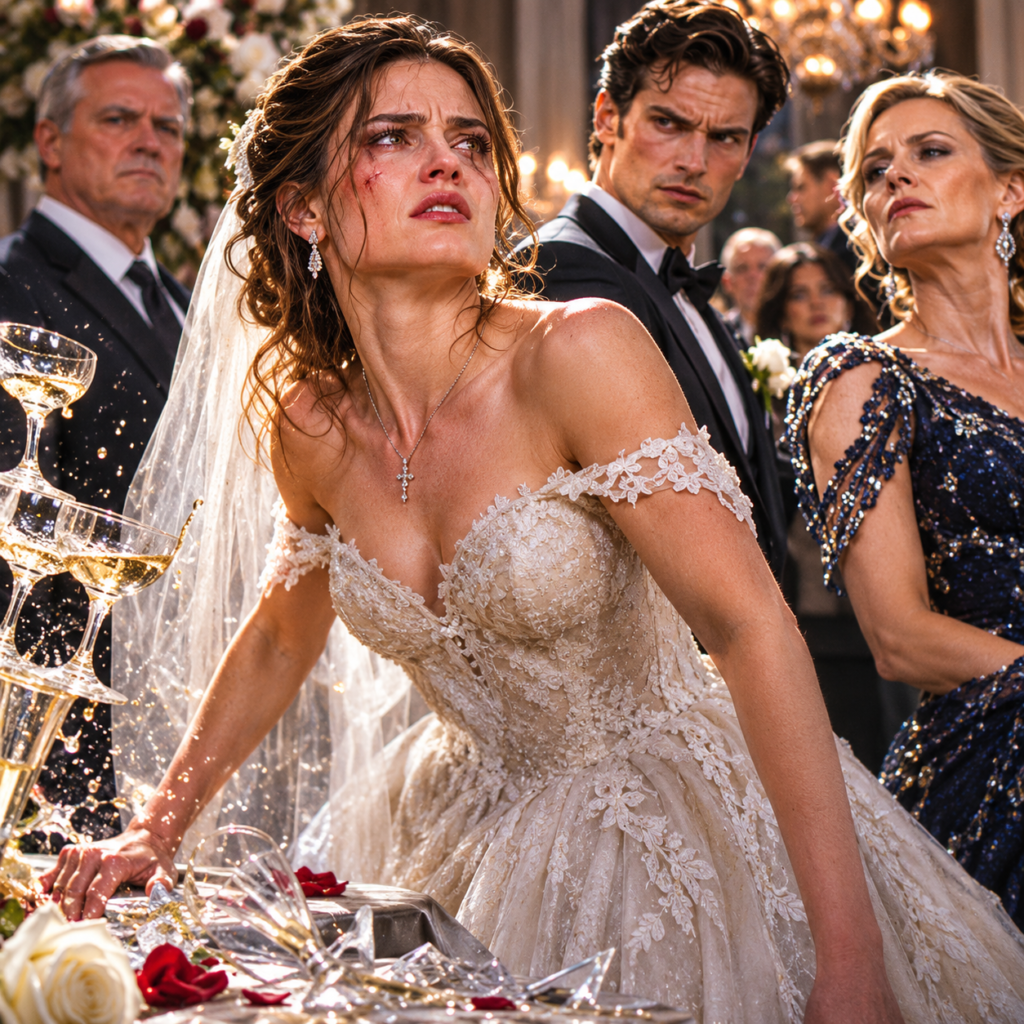
The specialist had located an unedited guest recording showing the first guard grabbing Nora’s wrist before the champagne tower fell.
The frame also captured Serena speaking into a discreet microphone near the altar.
Mara raised the volume.
Under the guests’ voices, a sentence came through in Serena’s clear, impatient tone.
“Now, Evelyn. Tell them to take her before she gets upstairs.”
Nora listened twice.
The word ‘upstairs’ made her go cold.
Serena knew about the envelope in the bridal suite before Voss tried to burn it.
Whatever happened at the wedding had been planned not merely to humiliate her but to stop her from reaching her father’s evidence.
Her phone, now replaced with a cheap prepaid device, rang from an unknown number.
Elena answered it on speaker after noting the time.
A woman spoke quietly, with the strained breath of someone who had been running.
“Nora, it’s Serena. I can’t talk for long. They know I was in the room when the papers were switched.”
Nora stood so quickly that her chair scraped the floor.
“What papers?”
“The papers your fiancé wanted you to sign. They weren’t the real ones. He needs you at the Harbor Tower gala tomorrow night. If you want to know why, come to the freight-elevator lobby at nine.”
Elena cut in. “Serena, this is counsel for Nora Vale. If you’re in danger, tell us where you are. We can arrange a safe meeting.”
Serena made a small choking sound.
In the background a door slammed.
“I didn’t call because I want to be brave,” she whispered. “I called because he just told me I’m next.”
The line went silent.