Chapter 2 – The Woman In The Rain
The black SUV came through the service gate without slowing.
Its headlights washed across the conservatory, turned the falling rain white, and fixed Nora in a bright circle as though the entire wedding had become a stage built for her execution.
Adrian seized the back of her dress and pulled her toward the pickup.
The SUV struck a stack of wooden catering crates where she had been standing half a second earlier.
Crates exploded into splinters.
A metal trolley skidded across the asphalt, throwing sparks.
The driver corrected too hard and clipped a concrete planter.
Nora heard an impact like a cannon shot.
The SUV’s front tire went flat, but it continued moving on the rim.
“Inside!” Adrian shouted.
Mara opened the rear door from within.
Nora flung herself onto the back bench.
Her skirt filled half the vehicle.
Adrian climbed behind the wheel, turned the key, and reversed so abruptly that their tires bounced over a curb.
The SUV angled toward them.
Grant was running across the courtyard, shouting something no one could hear.
Evelyn remained beneath the umbrella, absolutely motionless.
Nora watched the family she had almost married blur behind the rain-streaked window.
Adrian used a narrow maintenance road that curled behind the kitchens and ended at a chain-link service gate.
He knew the property from years of consulting on its old structures.
The gate was supposed to be locked.
It stood open because a delivery truck had left fifteen minutes earlier.
They slipped through and turned onto the coastal road.
No one spoke until the conservatory had vanished behind a line of dark pines.
“That driver aimed at you,” Mara said.
“I noticed.”
Nora had meant the words as a joke.
Instead they came out so flat that Mara leaned forward and touched her shoulder.
“Are you hurt?”
Nora looked down at her wrist.
Four red fingerprints were blooming against her skin.
Blood from a tiny cut had dried along the collarbone where the locket chain had caught.
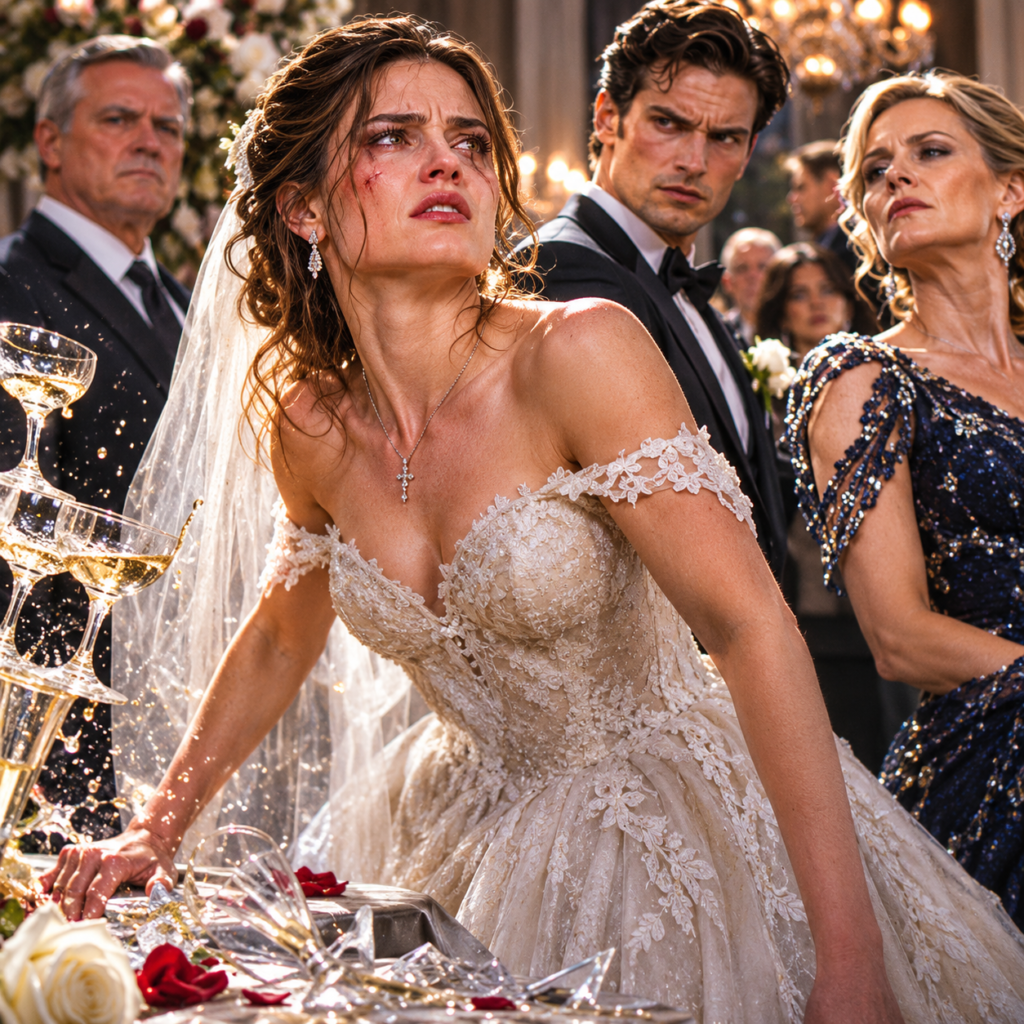
The heavy wedding dress smelled of rain and spilled champagne.
She had lost both shoes, one earring, and every belief she had carried into the conservatory that morning.
“Not enough to explain why I feel like this,” she answered.
Adrian glanced at her in the mirror. “Shock has its own arithmetic.”
Nora almost smiled.
Her father used to say things like that.
The resemblance hurt.
They drove inland toward an industrial district outside New Haven.
Adrian stopped beneath the overhang of a closed auto-parts store, keeping the engine running.
Mara photographed the old site plan with her phone, then the back, then the envelope.
Nora watched the document illuminated by the dashboard light.
The front was a fire-escape layout for Harbor House, dated October 2006.
The east corridor was drawn in blue and marked with a second set of emergency doors.
A handwritten note in red ink ordered the doors to remain unlocked during occupancy.
Three officials had initialed that instruction.
One was Thomas Vale.
The second signature was almost erased, but Nora could make out the letters E.
W.
“Evelyn Whitmore?” she asked.
Adrian did not answer immediately.
“She was executive vice president then,” he said finally. “She signed the acceptance drawings.”
“The building was supposed to be closed for renovation.”
“That was the story.”
“It wasn’t true?”
Adrian rubbed the bridge of his nose. “A private investor dinner was held on the second floor the night of the fire. People were sleeping in the guest wing because the coastal roads flooded. Your father found out the exits had been chained from the inside. He made them reopen the doors. The next day, when he came back, they were chained again.”
Nora could still picture the newspaper photograph taken after the fire: scorched brick, an open roof, a firefighter standing where a window used to be.
She had kept it folded in a drawer until she could no longer stand to look at it.
The official report had blamed a faulty electrical circuit.
Her father, a respected structural engineer, was criticized for failing to enforce the evacuation plan.
The criticism outlived him.
“Why didn’t you tell me?” she asked Adrian.
He stared through the windshield. “I told the investigators. They said the witness statements conflicted. Then the company threatened to sue me for breaking a confidentiality agreement. My wife had just started cancer treatment. I was afraid.”
The admission seemed to cost him more than anger would have.
“And now?” Nora asked.
“My wife is gone. The people who ordered those chains are still raising money beside memorial plaques. I’ve run out of reasons to be quiet.”
Mara studied the back of the site plan. “There’s a number here. HB-17, followed by an archive code. We can trace that.”
“The original archives belong to Whitmore,” Nora said. “They can delete anything they want.”
“Not everything,” Adrian replied. “City records, insurance filings, contractor copies. Your father believed in redundancy. He made duplicate plans because he didn’t trust a single filing cabinet.”
Nora remembered her father teaching her to back up school projects on two disks.
At thirteen, she had complained he was paranoid.
He had answered that a good plan anticipated failure.
Now, twenty years later, she was holding evidence that he had expected someone to destroy.
Her phone buzzed again.
Grant’s name appeared.
Nora stared at it until the screen dimmed, then answered and switched to speaker.
“Where are you?” Grant demanded.
“Far enough away to ask questions.”
“Listen to me. Whoever was driving that SUV wasn’t sent by me.”
“Did you know your mother planned the video?”
Silence.
“Grant.”
“She said there was evidence you were taking company information. I thought she meant to confront you privately.”
“You stood at the altar and called me a thief.”
“I thought it would protect the company.”
“From me?”
“From a fight you don’t understand.”
She looked at Adrian.
His jaw tightened.
Grant continued in a low urgent voice.
“The document you took is dangerous. Philip told my mother it was lost years ago. She isn’t thinking clearly. If you come back, I’ll make sure nobody touches you.”
“You just watched two guards grab me.”
“Nora, please.”
“Who authorized the transfer?”
“What?”
“The four-point-two million dollars. You didn’t seem surprised by the number.”
He exhaled slowly. “I can’t talk on this line.”
“Then we’ll talk somewhere everyone can hear.”
Nora ended the call and blocked his number.
For an instant her chest ached with the old instinct to apologize after a fight.
She had done it so many times: apologized when she asked about Serena, apologized when she missed his mother’s dinner because she had a deadline, apologized for being suspicious of legal language she was qualified to understand.
The habit did not vanish simply because the man had betrayed her.
“We need a lawyer,” Mara said.
Adrian nodded. “And somebody outside Connecticut who can make copies.”
“I’ve got an editor in Boston,” Mara replied. “But if I send her a partial story, Whitmore’s legal team will bury it by morning.”
Nora examined the envelope.
A faint impression along its flap suggested that a second sheet had been removed before she arrived. “Voss was trying to burn more than this. What else did you put in the envelope?”
Adrian looked alarmed. “A letter from your father. And a photograph of the fire-exit door.”
“His letter?”
“He left it with me two days before the fire. Told me to deliver it to your mother if anything happened. I couldn’t bring myself to do it. Your mother was already grieving, and the police said the case was closed.”
Nora turned away.
The dark shop window reflected a woman in a ruined white gown, not the bride she remembered from the mirror.
For twenty years she had held the shape of her father’s absence without knowing that someone living had kept his final message.
Adrian had tried to do the right thing today, but he had not done it when she needed it most.
“What did it say?” she asked.
“I never opened it.”
“Then Philip Voss has something my father wanted my mother to know.”
“I’m sorry, Nora.”
She did not say it was all right.
The truth had been in the world all along, passing from hand to hand while she had grown up around its empty space.
Mara’s phone rang.
It was Aunt Ruth.
Nora snatched the device.
“Ruth? Are you safe?”
“I’m at the hospital,” Ruth said. “No, not for me. Mr. Bell’s friend from the fire department called an ambulance. One of the caterers was hit by the SUV when it took the turn. Her ankle may be broken. The police are asking everyone questions. Evelyn has told them you stole sensitive company records and tried to escape.”
Nora pressed her palm against the dashboard. “They almost ran me over.”
“I saw. I told the officer. They didn’t write it down.”
“Please go home. Lock your doors.”
“Where will you go?”
“Somewhere they can’t reach me.”
Ruth made a sound between a laugh and a sob. “You always did hate being told to hide. Just don’t confuse courage with being alone.”
Nora promised to call her soon.
Mara gave the phone back and studied the road.
A red sedan had passed the store twice in fifteen minutes.
It might have been someone looking for a late-night gas station, but there was no reason to stay and find out.
They abandoned the direct road to Mara’s apartment and drove to a small twenty-four-hour laundromat behind a grocery plaza.
The owner rented a private office to Mara’s cousin who repaired commercial printers; he kept an old desktop computer there and had once told Mara she could use it for an emergency.
They entered through a side door using a code, leaving the pickup around the corner.
Inside, industrial dryers hummed like distant machinery.
Nora changed into a sweatshirt and borrowed jeans from a bag of clothes Mara kept in her car.
The white gown lay on the office floor, impossibly large and sad.
Mara carefully removed the bodice lining where Nora had hidden the document and spread it to dry between paper towels.
“We should preserve the original, not keep handling it,” Mara said.
“Photograph everything first.”
They scanned the plan at high resolution.
Adrian explained each line, identifying the east service door, the stair landing, and the emergency gate that should have opened onto the harbor.
There was an erased pencil notation near the gate.
Under increased contrast the mark revealed a date: NOV 12, 2006.
“The day after the fire,” Nora said.
“No,” Adrian answered. “The night before. The fire was on the thirteenth.”
A second mark appeared beneath the date: WORK ORDER 441.
A simple maintenance reference might unlock the whole story.
Mara entered it into an old contractor registry she had used during an earlier investigation.
The registry returned a company: Norcrest Safety Systems, dissolved in 2007.
An owner: Daniel Price.
A post-office box in Bridgeport.
Adrian went rigid.
“I know Daniel,” he whispered.
“Can we find him?”
“You may not want to. He was the one who installed the chain hardware.”
Mara was already searching public records.
Daniel Price, sixty-one, currently listed as the proprietor of a small marine welding business in an industrial park near the river.
There was a phone number and a photograph of a square-faced man beside a workshop door.
If he had installed the hardware, he might know who ordered it.
Nora leaned close to the screen. “Then we’re going to ask.”
“Not tonight,” Mara said. “Tonight we copy every file, find out who controls that workshop, and sleep somewhere safer than a room we just entered with a keypad.”
Nora knew Mara was right.
She also knew that dawn would make the story public.
Guests had recorded the wedding collapse from every angle.
By morning Nora would be the thief in the white dress, the viral bride who ruined her own ceremony.
Evidence was slower than scandal.
Mara refreshed her news feed.
There it was already: BRIDE EXPOSED IN MILLION-DOLLAR WEDDING HEIST.
A clip showed Nora pushing the glass tower.
The ten seconds before it, when the guard seized her locket, had been cut away.
“They’ve got the first edit out,” Mara said.
Nora watched herself on the screen.
Her face was wild with fear; the camera angle made her look violent.
The caption called her an ‘unstable ex-fiancée.’ Thousands of viewers had already taken sides without knowing a single fact.
She understood then that Evelyn had not simply humiliated her.
She had built a version of Nora that could be accused, dismissed, and eventually silenced.
“If they can edit the wedding,” Nora said, “they can edit the footage from the office.”
Adrian nodded. “That’s what I was afraid of.”
Mara opened the digital properties of the office video she had downloaded from a public post.
It had been exported that afternoon, not three nights earlier.
That did not prove it was fake, but it mattered.
A production watermark was hidden in a corner of a frame, nearly cropped away.
It matched a small commercial studio used by Whitmore’s public-relations division.
Nora felt a cold certainty settle beneath her ribs.
The scheme had a production schedule.
They had not reacted to evidence.
They had staged a wedding as a criminal accusation and relied on the audience to distribute it for free.
“Send that to the lawyer,” she said.
Mara found the contact for Elena Ruiz, an attorney whose firm had represented whistleblowers against developers.
Elena answered on the third ring, sleepy but immediately alert when Mara named the Whitmores.
She instructed them not to contact the company, not to alter the originals, and to meet her at her office at eight in the morning.
She also insisted they call the police from a recorded line to report the SUV attack, with the location and injured witness clearly stated.
Nora made the report.
The dispatcher gave her a reference number.
No officer came that night.
When the calls ended, Adrian stepped outside to check the street.
He returned carrying a folded newspaper from a free rack.
Its weekend insert advertised a Whitmore Harbor redevelopment gala to be held in four days.
The rendering showed a polished glass tower rising above a public waterfront.
Nora recognized the land.
Harbor House had stood there before the fire.
Her father’s name was nowhere in the presentation.
“That’s the site,” she said.
Adrian pointed to the fine print beneath the rendering. “They’re transferring the final parcel next week. After that, it goes into a new holding company.”
“And anything linked to the old ownership becomes harder to trace,” Mara said.
Nora turned the paper over.
On the back was a small community announcement for the unveiling of a memorial plaque honoring the victims of the 2006 fire.
Evelyn Whitmore would preside over the dedication.
Grant would deliver a speech about responsibility and renewal.
Nora stared at her father’s photograph in the memorial ad.
Under his name, a sentence claimed that lessons from the tragedy had inspired the company’s commitment to safety.
She thought of the chained east exit and the letter Philip had tried to burn.
For the first time she understood that uncovering what happened might not merely restore her father’s name.
It might threaten the entire business that had been built over his grave.
A sharp knock came from the office’s side door.
Mara silenced the desktop fan.
Adrian turned off the overhead light.
The dryers continued their low rumble beyond the wall.
“Elena Ruiz?” a man’s voice called. “I’m here because Nora Vale reported an attempted assault.”
It was almost plausible.
Almost.
But Elena’s office appointment was at eight, and Nora had not told the dispatcher where she was.
The handle moved once, carefully.
Then a second voice said, “She’s inside. Her phone is still here.”
Adrian whispered a single word.
“Back.”
Nora looked down at the phone in her hand.
Grant had given it to her for their anniversary.
He had said the family plan offered better security.
She switched it off, too late to undo what it had already revealed.
From the hallway came the metallic scrape of someone fitting a tool into the door lock.