Chapter 6 – What Derek Was Hiding
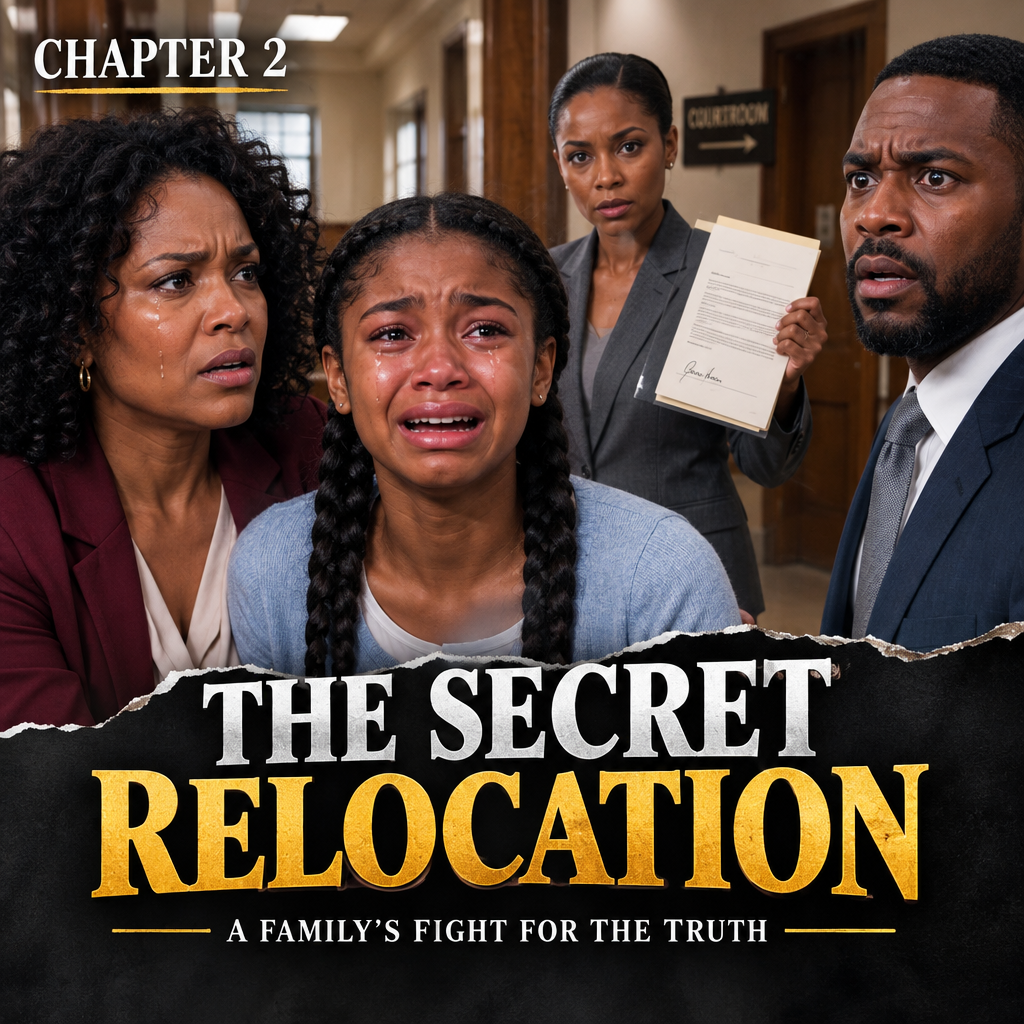
Derek Morgan had spent fourteen years telling himself he was a good father because he never missed a school recital and always paid for the things Brielle needed. He remembered every allergy, every favorite song, every birthday cake she had requested. He had mistaken those details for proof that he could never hurt her.
Derek drove to the old park where he used to take Brielle on Saturday mornings. The swings had been replaced, the basketball court repainted, but the oak tree near the entrance was still there. He sat in his car with both hands on the steering wheel. For years he had told himself that providing for his daughter excused the things he kept from her. He had paid tuition bills, bought winter coats, and memorized her favorite takeout order. None of that explained why she had cried in the courthouse hallway as if the adults who loved her had become strangers.
His phone lit up with a message from Camille: YOU HAVE TO STOP HIDING THINGS. He typed, I’M HANDLING IT, then deleted the words. He had been saying that for years. He called her instead. “I need to know what Evelyn told you,” he said. Camille’s answer came quickly. “You need to tell Renee what you know. I’m not going to be your messenger anymore.” “You don’t understand what happens if this comes out.” “No, Derek. I understand exactly what happens if it doesn’t. Brielle keeps paying for your silence.” She ended the call before he could argue.
At the same time, Tasha was sitting with Brielle at a diner near Renee’s office. The waitress brought two grilled-cheese sandwiches, though neither had much appetite. Brielle tore a corner from her bread and asked, “Did Dad always have secrets?” Tasha considered the question. “He liked to solve problems without asking for help,” she said. “Sometimes that looked like confidence. Sometimes it meant I found out about things too late.” Brielle frowned. “So you knew?” “Not about these papers. But I knew he could shut people out when he was afraid.” Tasha refused to turn the answer into a speech about how terrible Derek had always been. Her daughter needed room for her own memories.
“I still love him,” Brielle said, so softly Tasha almost missed it. “I know.” “Does that make you mad?” Tasha put down her sandwich. “No. He’s your dad. You don’t have to stop loving him to tell the truth about what happened.” Brielle’s eyes filled. “I thought you wanted me to pick you.” Tasha felt her throat close. “I wanted you to know I was still here. I should’ve said that without making you feel like a decision had to come with it.” They sat in silence until Brielle reached across the table for her hand.
Renee spent the afternoon comparing dates rather than personalities. The relocation paperwork had been assembled in stages. A delivery receipt showed one date, a cover letter another, and a witness notation appeared later still. None of the discrepancies proved who had changed the file. Together they justified asking for the original records. Renee called a records custodian, made notes about the response, and resisted the temptation to build a theory from fragments. Her job was to protect the truth from the urgency everyone felt to have an answer.
That evening, Derek went home and opened a drawer he had not touched in months. Inside lay a photograph of Brielle at age five, wearing a paper crown from a restaurant birthday party. On the back, Tasha had written, OUR GIRL, OUR WHOLE WORLD. He held it for a long time. He remembered promising himself that Brielle would never grow up feeling the insecurity he had known as a boy. Somewhere along the way, he had mistaken controlling her circumstances for keeping her safe. Now she was frightened of him, and the realization left him unable to stand.
He sat on the bedroom floor and cried. There was no one there to witness it, no one to forgive him because of it. The tears did not erase the documents, the blocked calls, or the fear he had created. They simply broke through the story he had been telling himself. When his phone buzzed again, he did not reach for it immediately. For the first time, he understood that answering the next question truthfully might cost him everything he had tried to protect.
Now he sat across from Camille in her kitchen and tried to explain how he had become the man whose daughter cried when he entered a room.
‘Before Tasha and I got married, I worked for Evelyn,’ he began. ‘She ran a placement company. We helped families relocate for jobs. Housing, paperwork, school registration. Most of it was legitimate.’
‘Most?’ Camille asked.
Derek stared at the table. ‘A family came to us with a child they were trying to keep away from a violent relative. Evelyn told me we had to move fast. She asked me to backdate a document. I did.’
‘Was the child safe?’
‘I thought so. I never checked.’
Years later, he said, Evelyn had resurfaced with copies of the paperwork. She threatened to expose his role in the false filing unless he helped her complete a new relocation. Derek insisted that the plan involved Brielle only because Evelyn claimed the girl’s name was tied to an old record that could not be corrected without her presence.
Camille listened without interrupting. When he finished, she said, ‘You let somebody threaten you into lying to your own daughter.’
‘I was trying to keep her safe.’
‘You keep saying that. Safe from what?’
Derek could not answer. Evelyn had given him warnings, not explanations. She spoke of records, deadlines, and consequences. Each time he demanded proof, she sent another document that seemed to know more about his family than it should.
Camille pushed back her chair. ‘You have to tell your lawyer. And Tasha.’
‘If I do, Evelyn will release everything.’
‘Then you face what you did. Brielle shouldn’t have to carry it for you.’
Meanwhile Tasha learned that Derek’s company had missed payroll twice. She did not celebrate the discovery. She remembered the pride he took in providing for Brielle, the way he had once worked double shifts to afford a better apartment. Financial trouble could explain his desperation, but it could not excuse his choices.
Renee met with an investigator who had reviewed the Raleigh address. The house had once been leased to a nonprofit placement program, the same organization whose stamp appeared on the anonymous photograph. Its public records were incomplete. Several former employees could not be reached. Evelyn Price had served as a consultant.
‘What does any of this have to do with my daughter?’ Tasha asked.
‘We don’t know yet,’ Renee replied. ‘And we should not assume the worst. But the documents are connected, and someone is trying very hard to keep us from seeing the whole file.’
At home Brielle sat on the floor of her old bedroom, sorting through a box of photographs Tasha had kept after the divorce. There were pictures of Derek teaching her to ride a bike, Derek asleep with a baby bottle balanced on his chest, Derek cheering at a spelling bee. She pressed one picture against her knees and cried quietly.
Tasha sat beside her. ‘You miss him.’
‘Yeah.’
‘It’s okay.’
‘What if he’s scared too?’ Brielle asked.
Tasha considered the question. ‘He might be. Being scared doesn’t make it okay to lie to you.’
Brielle nodded. ‘I want him to tell me the truth. Not a lawyer. Him.’
Renee arranged a carefully supervised conversation in a neutral office. Derek arrived with red-rimmed eyes and no tie. Brielle sat opposite him, hands folded. For a moment neither spoke.
‘I’m sorry about the papers,’ he said.
‘Which part?’ she asked. ‘The part where you lied, or the part where you got caught?’
Derek winced. ‘Both.’
‘Who is Evelyn Price?’
He looked toward Renee, then back at Brielle. ‘Someone I worked with a long time ago.’
‘Why does she know my name?’
‘I don’t know everything she has.’
Brielle leaned forward. ‘Then why were you going to take me to her?’
Derek’s voice broke. ‘Because she told me if I didn’t, she’d destroy our family.’
‘You already did that,’ Brielle whispered.
He covered his face. Tasha, watching from the far side of the room, felt an old instinct to comfort him. She stayed where she was. This was not her pain to fix.
After the meeting, Renee received an email from an address she did not recognize. The subject line was THE ORIGINAL FILE. The message contained a single attachment and a warning: Before you accuse Derek, ask Tasha what happened at St. Anne’s fourteen years ago.
Renee read it twice. Then she looked at Tasha, who had gone suddenly pale.
‘St. Anne’s?’ Renee asked.
Tasha’s hands began to shake. ‘That was the hospital where Brielle was born.’
Renee opened the attachment. On the first page was an old discharge record. At the top, beside a date fourteen years earlier, was a name that made Tasha grip the edge of the desk.
The patient was listed as Brielle Morgan. But the photograph attached to the file was not of Brielle.