Chapter 4 – The House Across State Lines
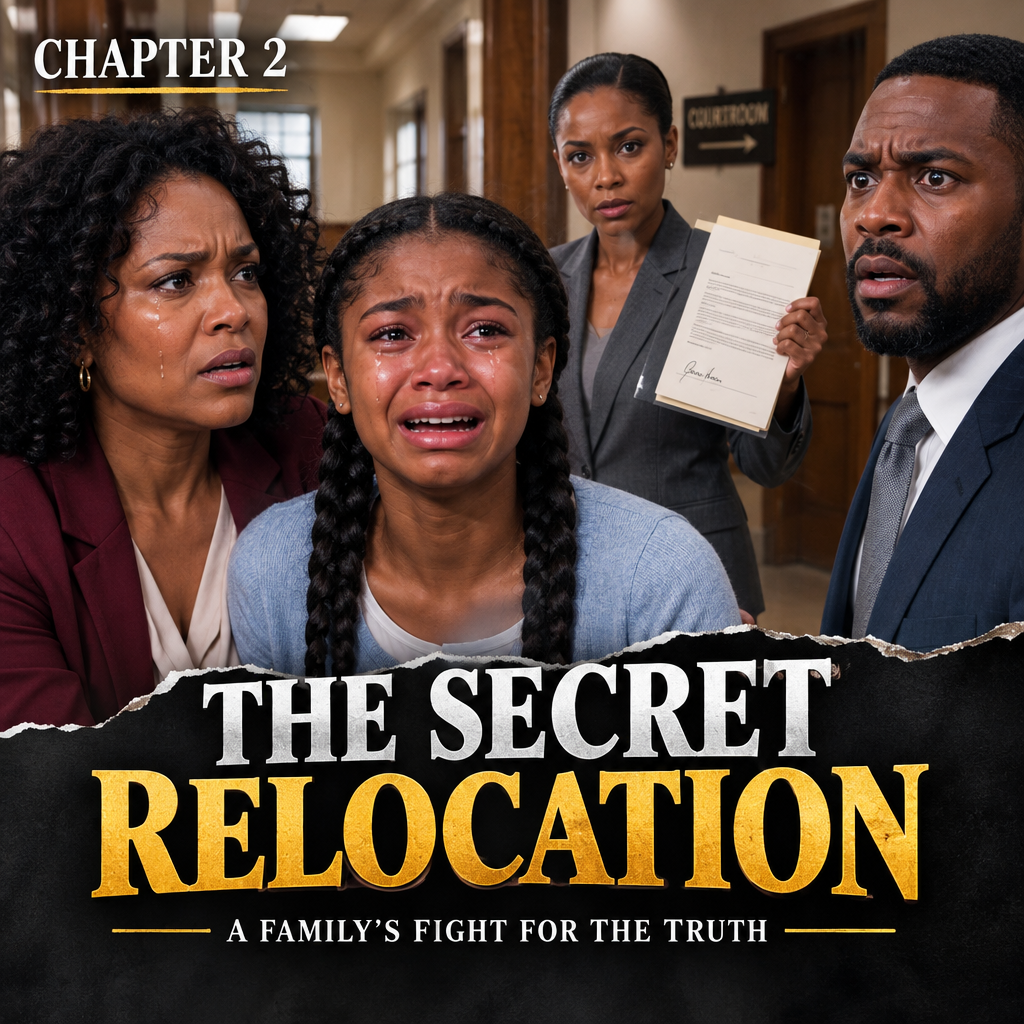
The name on the shipping receipt was Evelyn Price. Tasha had not spoken it aloud in fourteen years. She remembered a woman with silver bracelets and an easy smile who had come to Derek’s office holiday party before Brielle started kindergarten. Derek had introduced her as a business consultant. Two months later, he had insisted they move apartments, and Evelyn vanished from their conversations.
The drive toward the address on the receipt took Tasha past a neighborhood she had never visited with Derek. The houses stood behind clipped hedges and decorative iron gates. Everything looked expensive, orderly, and strangely quiet. Renee had insisted they would not knock on anyone’s door or confront a stranger. They were there only to observe the public street and confirm that the address existed. “I know what you’re thinking,” Renee said as Tasha slowed near the corner. “You’re thinking that if we see a person in the window, we’ll finally understand everything.” Tasha gave a humorless laugh. “I’m thinking I want one thing in my life to make sense.”
The house had pale brick walls, a blue front door, and a porch swing that moved gently in the breeze. A child’s bicycle stood near the garage, though it looked too small for Brielle. Tasha gripped the steering wheel. “Why would he bring her here?” Renee took a photograph of the house number from the public road and put her phone away. “We don’t know that he would. The receipt proves a package was sent here. That’s all.” Tasha nodded, but the image of Brielle stepping through that blue door stayed with her long after they drove away.
At home, Brielle sat cross-legged on her bed, listening to a voicemail Derek had left that morning. “Hey, kiddo. I know things are complicated. I love you. Call when you’re ready.” His voice sounded gentle, almost embarrassed. It would have been easier if he sounded cruel. She played the message twice, then deleted neither it nor the anger it brought. When Lorraine came to check on her, Brielle said, “How can somebody love you and still lie to you?” Lorraine sat at the foot of the bed. “Sometimes people convince themselves a lie is protection. That doesn’t make it protection. It makes it a lie they have to answer for.”
Tasha called her brother Malcolm that evening. They had not spoken much since the divorce because he believed she should stop trying to win every argument with Derek. She almost hung up before he answered. “I need you to tell me something difficult,” she said. “When I was married, did I ignore things everybody else could see?” Malcolm was silent for a moment. “You ignored how scared he was of losing control,” he said. “I don’t mean control of you. I mean control of the story people told about him. If he made a mistake, he needed everyone to believe he had a good reason.” Tasha leaned against the kitchen counter. “Why didn’t you tell me?” “I did. You told me I was judging your husband.” The answer hurt because she remembered the conversation.
Later, Renee arranged a records request through the appropriate channels and explained what would happen next. They would need time, not dramatic visits, to establish ownership, occupancy, and the relationship between the address and the proposed relocation. “You have a daughter who is frightened,” she told Tasha. “If we make this a race to the next confrontation, she pays for it.” Tasha promised she would not go back to the house. She meant it, though the promise felt like trying to hold a door shut against a storm.
That night, Brielle asked her mother to tell her a story from before the divorce. Tasha chose the afternoon they had built a blanket fort in the living room during a thunderstorm. Derek had crawled inside carrying a flashlight and three bowls of popcorn. They had made up ridiculous rules about who could enter the fort and laughed until the power went out. Brielle smiled through tears. “I remember Dad pretending the flashlight was a spaceship.” “He was terrible at sound effects,” Tasha said. They laughed, and then the laughter faded. Neither tried to pretend the memory solved anything. It simply belonged to them, even now.
Before bed, Tasha stood outside Brielle’s room and listened to the soft sounds of her daughter moving around. For months she had imagined what it would feel like to have Brielle close again. She had expected relief. Instead she felt relief and grief together: relief that Brielle was safe tonight, grief for all the nights when the girl had believed she was unwanted. Tasha knocked gently. “You okay?” Brielle answered after a moment. “Not really. But you can come in.” Tasha stepped inside, grateful for the difference between those two sentences.
Renee warned against making the leap Tasha wanted to make. ‘An old acquaintance connected to an address is a lead. It isn’t proof of a conspiracy.’
Tasha knew that. She also knew Derek had once become furious when she asked why Evelyn called him after midnight. He had apologized the next morning, brought flowers, and said the woman was helping him with a complicated contract. Tasha had wanted to believe him. At the time, believing him had felt like protecting their marriage.
Brielle sat on the couch with her knees drawn up. ‘Is she somebody I know?’
‘You met her when you were little,’ Tasha said. ‘But I don’t know why her name is on this receipt.’
‘Is she the person waiting for me?’
‘I don’t know, honey.’ It was the first time Tasha had answered that question without inventing a reassuring explanation.
Renee requested the documents underlying Derek’s proposed move. Through lawful records searches and voluntary inquiries, she found a lease application for a Raleigh property associated with Evelyn’s consulting firm. She could not establish who had signed it. She could establish that the house had three bedrooms and that a local private school had received an inquiry about enrolling a sixteen-year-old student.
The discovery left Tasha cold. She pictured Brielle arriving at a house where every room had already been chosen for her, while Tasha remained hundreds of miles away trying to reach a phone that never answered.
Derek, meanwhile, drove to the edge of town and parked outside a storage facility. He entered a unit he had rented under his own name. Inside were moving boxes, a bicycle Brielle had outgrown, and a suitcase filled with her winter clothes. He sat on the concrete floor and stared at a framed photograph from her eighth birthday.
His phone rang. Evelyn.
‘We have a problem,’ she said without greeting.
‘I know.’
‘Your attorney says the court may review the filing.’
‘Let me handle my family.’
‘Your family is why we’re doing this.’
Derek closed his eyes. ‘Don’t say that.’
‘Then stop pretending you can solve it by waiting.’
When the call ended, he stayed in the storage unit until the motion-sensitive lights clicked off. In the darkness he heard Brielle’s voice from the courthouse: He said it was for school. He had told himself the lie was temporary. He had told himself a better explanation would come when everything was settled. Now even he could not remember when temporary had become the plan.
That weekend Tasha took Brielle to her grandmother Lorraine’s apartment. Lorraine was seventy-one, a retired elementary-school teacher who had survived two knee replacements and could still silence a room with one raised eyebrow. She greeted Brielle with warm cornbread and held her granddaughter so long that Brielle began crying again.
‘You don’t have to explain anything to me,’ Lorraine whispered. ‘You just have to eat.’
At dinner Brielle laughed for the first time in days when Lorraine complained about a neighbor’s terrible trumpet playing. The sound was small and fragile, but Tasha wanted to save it forever.
After Brielle fell asleep, Lorraine found Tasha washing the same plate for the third time. ‘You can’t keep punishing yourself every minute,’ she said.
‘I hit him in front of her.’
‘Yes, you did.’
‘I made everything worse.’
‘You made a mistake. Don’t make the next one by refusing to see your daughter as more than this fight.’
Tasha leaned against the sink and cried silently. Lorraine dried her hands, took her daughter’s face between her palms, and said, ‘Being her mother isn’t something Derek can take away. But you have to show her what it means now.’
On Monday Renee received a response to her document request. Derek’s attorney agreed to produce the original packet for inspection but disputed the allegation of page substitution. A hearing was set for the following week. Then an anonymous envelope arrived at Renee’s office.
Inside was a photograph of the Raleigh house. Someone had drawn a circle around an upstairs window. On the back were six words: ASK WHO USED TO LIVE HERE.
Renee showed the photograph to Tasha, then turned it over. In the corner was a faded stamp from a children’s residential program that had closed more than a decade earlier.
Tasha stared at the stamp. She had seen that symbol before, printed on the folder Derek kept locked in his desk during the first year of their marriage.
She had never asked what was inside.