Chapter 10 – The Truth Beyond the Courthouse
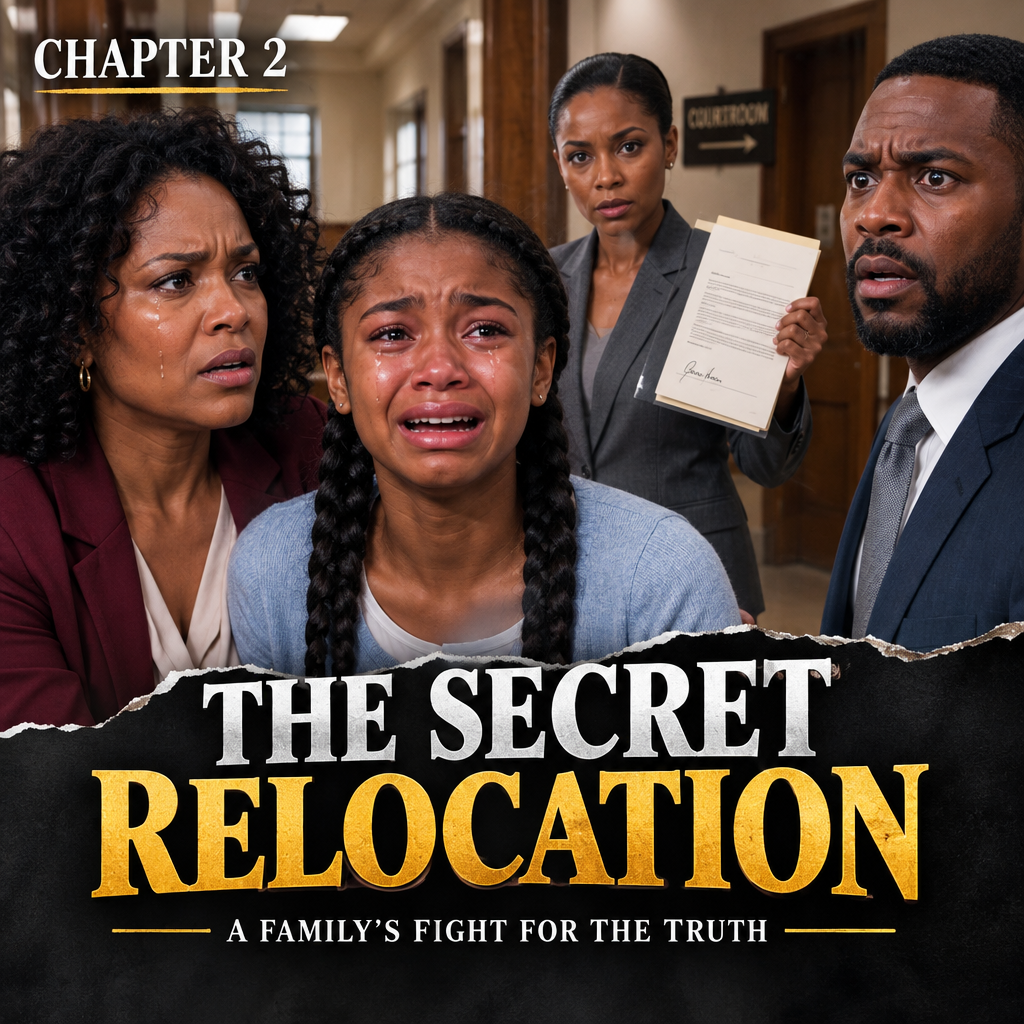
Lena Hart agreed to meet the Morgans in Renee’s office, but only on her terms. She wanted no cameras, no reporters, and no one contacting her relatives. Renee explained the boundaries to everyone in advance. For once, Tasha and Derek agreed without argument.
On the morning of the meeting, Brielle stood in front of her closet for nearly ten minutes. She wanted to look older, as though the right clothes could make her ready for whatever Lena Hart might say. In the end she chose the light-blue cardigan she had worn at the courthouse. It was the same one she had cried into while her mother held her. She had washed it twice since then, but she still thought of it as the day everything changed. Tasha knocked on the door. “You don’t have to come if you’re not ready.” Brielle pulled the cardigan straight. “I want to. I just don’t want anybody to decide what I should feel afterward.”
At Renee’s office, the chairs had been arranged in a loose circle rather than across a conference table. Renee explained that anyone could ask for a break and that no one would be pressured to answer a question about personal history. Brielle appreciated the rules. She had spent months in rooms where adults treated every silence as evidence of something. This room felt different because silence was allowed to be silence.
Derek arrived early and sat near the door. He had not seen Brielle in person for several days. When she entered, he stood instinctively, then stopped himself from moving closer. “Hi, kiddo,” he said. Brielle gave him a small nod. It was not the reunion he wanted. It was a greeting she had chosen to offer, and he tried to accept it without asking for more. Tasha watched the exchange and felt an unexpected ache for all three of them. The family had been broken in ways no single meeting could repair.
Before Lena arrived, Renee asked everyone to remember that old records often reflected the assumptions and errors of the people who created them. “We can listen carefully without deciding everything today,” she said. Derek nodded. Tasha clasped her hands. Brielle opened her notebook and wrote, I am allowed to ask questions. She underlined the sentence twice.
During a break in the conversation, Brielle stepped into the hallway with her mother. “What if I don’t like what we find out?” she asked. Tasha leaned against the wall beside her. “Then you don’t have to like it. You can be angry, confused, sad, relieved, or all of those things. You don’t owe anybody a neat ending.” Brielle studied her face. “Even Dad?” “Especially Dad,” Tasha said gently. “And me. You don’t have to make our feelings easier to carry.” Brielle let out a breath she seemed to have been holding for months.
Later, when Derek was given an opportunity to speak, he did not begin with an explanation of the paperwork. He looked at Brielle and said, “I told you your mother didn’t call when I knew she had. I used your fear of being unwanted to keep you close to me. I was wrong.” The words were plain. They did not undo the harm. Brielle’s eyes filled with tears, but she did not rush to embrace him. “Thank you for saying it,” she answered. “I need time before I know what that means for us.” Derek nodded. It hurt, and he accepted that it was supposed to.
Tasha had her own apology to make. “I hit your father in front of you,” she said. “I let my anger become something you had to witness. I’m sorry.” Brielle looked between them. “I don’t want either of you to do that again.” Tasha agreed. Derek agreed too. For the first time, their promises were not about winning Brielle back. They were about the conduct they owed her, whether or not she forgave them quickly.
After the meeting, the three of them walked into the parking lot under a sky bright with late-afternoon sunlight. Derek stopped beside his car. “Can I call you next week?” he asked Brielle. She thought for a moment. “You can text first. I’ll tell you if I want to talk.” He nodded and did not bargain. Tasha watched him leave, surprised by how much courage it took to allow an ordinary boundary to remain in place. Brielle slipped her hand into her mother’s. “I’m tired,” she said. “Me too,” Tasha answered. They went home without trying to turn the day into a victory.
Lena arrived wearing a simple green coat and carrying a worn leather notebook. She was in her late twenties, with a steady voice that occasionally trembled when she spoke about childhood. Brielle offered her water. Lena accepted and smiled. ‘You’re the one who asked whether anyone had checked on me.’
Brielle nodded. ‘I hope that was okay.’
‘It was more than okay.’
Lena explained that her mother had sought shelter years earlier from a dangerous family member. Evelyn’s agency had helped them relocate, but it had also altered records and used borrowed identities to conceal where they went. Lena had grown up knowing parts of her history were missing. Derek had signed a backdated form, but he had not understood how Evelyn was using the system. His mother Vivian had eventually learned that a child was being moved through false paperwork and tried to intervene.
‘Vivian contacted a woman named Lorraine,’ Lena said, looking toward Tasha. ‘Your mother.’
Tasha felt her breath catch. ‘My mother?’
‘Lorraine was teaching at a school near the temporary residence. She helped my mother enroll me without exposing our location to the person we were escaping. She kept copies of the legitimate records and pushed for the false ones to be corrected.’
Tasha thought of Lorraine’s warning at the kitchen sink: Don’t make the next mistake by refusing to see your daughter. Her mother had known more about the old case than she ever admitted.
‘Why didn’t she tell me?’ Tasha asked.
‘Because my mother asked her not to share our story,’ Lena answered. ‘We were still afraid.’
Derek looked at Lena. ‘And Evelyn? Why did she want Brielle moved to Raleigh?’
Lena opened the notebook. ‘Evelyn was trying to recover an old archive. Your daughter’s name had been used as a placeholder in the records. When the system flagged it during a review, she needed someone with that name and a current address to make the new paperwork appear consistent. She thought she could pressure you into bringing Brielle to a meeting and signing more documents.’
‘You mean she used my daughter to cover up what she did?’ Derek asked.
‘Yes.’
Derek bowed his head. He had wanted to believe he was rescuing his family from a threat. Instead, he had delivered that threat directly to his child.
Renee cautioned that Lena’s account still required independent verification. Some records had already been submitted to investigators, and the appropriate authorities would determine what could be proved. But the essential pattern was clearer now: Evelyn’s old fraud had reached into the present, and Derek’s fear had made him an accomplice to another deception.
Tasha looked at Lena. ‘I’m sorry for what you went through.’
Lena shook her head. ‘You didn’t cause it. But you can help make sure nobody uses another kid’s name like that.’
Brielle leaned forward. ‘What happened to your mom?’
‘We found a safe place. She worked hard. She still worries too much.’ Lena smiled. ‘Some things don’t change.’
The meeting ended without a dramatic embrace or an easy promise that everything would be fine. Lena had her own life to return to. The Morgans had years of broken trust to address. But when she left, she gave Brielle a copy of the letter she had written as a teenager, asking anyone who found it to remember her real name.
Weeks later the court approved a revised interim parenting arrangement after reviewing the evidence and hearing Brielle’s views. Derek’s attempt to relocate her without informed agreement weighed heavily against him. He agreed to counseling and to communicate through a structured co-parenting plan while rebuilding his relationship with his daughter. Tasha also accepted responsibility for the courthouse assault and committed to handling conflict without violence. Neither parent was allowed to pretend the past had disappeared.
On a bright Saturday morning Brielle met Derek at a public park. He arrived early with two coffees, one hot chocolate, and an apology he had rehearsed all week. When Brielle approached, he set the drinks down.
‘I don’t expect you to forgive me today,’ he said.
‘Good,’ she replied. ‘Because I’m not ready.’
He nodded. ‘I’ll be here anyway, as long as you want me here.’
They walked beside the lake and talked about her debate team. It was awkward at first. Then Brielle mentioned a joke from school and Derek laughed, a real laugh that startled them both. The relationship was not healed. It had simply begun again.
That evening Tasha drove Brielle home. They passed the courthouse on the way. Brielle looked out the window at the steps where their family had nearly come apart.
‘Mom?’
‘Yeah?’
‘Do you ever wish you could take back that day?’
Tasha thought of the slap, the shove, her daughter’s tears, and the months of silence that had led them there. ‘I wish I hadn’t hit your father,’ she said. ‘I wish I’d listened sooner. But I don’t wish you had told the truth.’
Brielle watched the courthouse disappear behind them. ‘Me neither.’
At home Lorraine had prepared dinner. Camille came too, carrying flowers and an awkward apology for not speaking up sooner. They ate together, not as a perfect family, but as people willing to sit at the same table and tell the truth. Brielle noticed that no one asked her to choose where to sit.
After everyone left, she found a small package on the porch. Inside was the sunflower notebook Tasha had bought before school started. Derek had kept it after Brielle refused to open the gift. A note lay on top, written in his careful handwriting: Your mother brought this because she loves you. I should have told you that the night it arrived.
Brielle held the notebook against her chest and cried. This time Tasha did not ask her to stop. She sat beside her on the porch and waited until the tears passed.
When Brielle finally opened the first blank page, she wrote a sentence in large letters: I get to tell my own story.
Then she turned the page and began.