Chapter 3 – The Signature on the Second Page
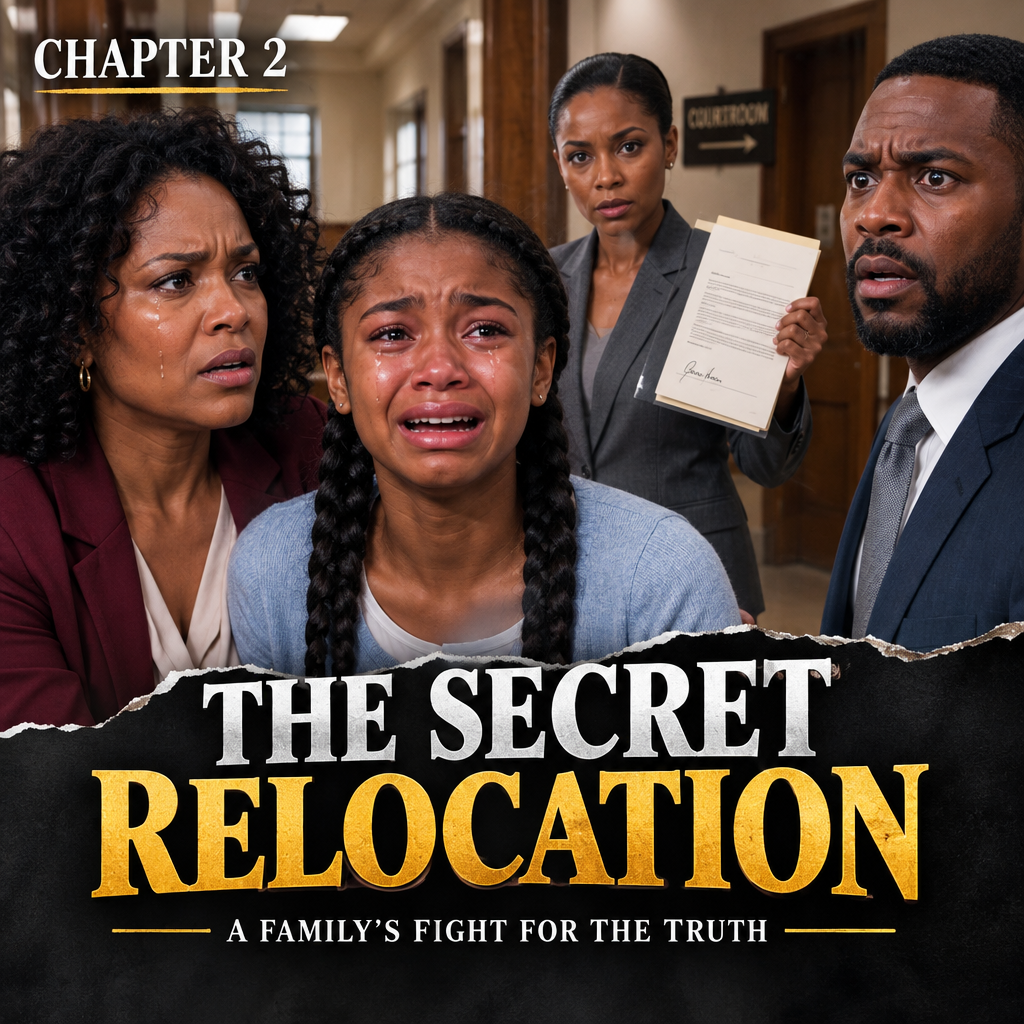
Brielle had always loved the first day of school. The smell of sharpened pencils, the weight of new books, the possibility that a new semester might mean a new beginning. That year, she remembered only the blue folder on her father’s desk.
Renee cleared the conference table before asking Brielle to look at the blue folder again. There were no cameras, no audience, and no one waiting for a dramatic confession. Just a legal pad, a glass of water, and the teenager’s memory. “You can stop whenever you want,” Renee said. “And if you don’t remember something, say that. A guess can turn into a problem later.” Brielle nodded, relieved that for once an adult was not asking her to sound certain.
She remembered the smell of spaghetti sauce coming from the kitchen on the night Derek brought out the papers. The television had been playing a basketball game. Her father was smiling, not shouting. “He told me it was routine,” she said. “He said the district needed updated information because we might move closer to his office.” She remembered the pen slipping on the first page because her hand was greasy from dinner. She remembered Derek placing a second page over the first and pointing to a line. What she did not remember was reading the heading. The admission made her cheeks burn. “I know I should’ve looked.” Renee shook her head. “An adult who asks a child to sign a document has a responsibility to explain it honestly. That’s where we begin.”
Tasha had been sitting near the window, trying not to interrupt. She wanted to ask why Brielle had not called her, why she had not questioned Derek, why she had trusted a man who had already kept them apart. But every version of the question sounded like blame. She remembered her own father handing her bank forms when she was eighteen and telling her where to sign. She had signed them without reading because he was her father. The memory changed the shape of her anger. She could be furious with Derek without turning that fury toward her daughter.
After Brielle stepped outside for air, Renee explained the difference between an apparent signature and an enforceable agreement. “A name on a page doesn’t settle what someone understood, whether a page was substituted, or whether the required approvals exist,” she said. “We need originals, dates, witnesses, and the surrounding communications.” Tasha looked at the copy. “So we can’t just show the judge and say he tricked her?” “We can raise the concern and ask the court to examine it. We don’t get to skip the evidence because the story is upsetting.” Tasha hated the slowness of that answer. She also knew that Derek had counted on her impatience before.
Brielle walked outside into the parking lot with a paper cup of water. A school bus rolled past the intersection, and she watched it until it disappeared. She thought of her friends planning college visits, complaining about teachers, arguing over music. Their biggest worries seemed to belong to another world. She took out her phone and opened a message from her friend Harper: ARE YOU OKAY? Brielle typed yes, erased it, typed no, and finally wrote, I don’t know yet. Harper replied almost immediately: YOU DON’T HAVE TO KNOW. I’M HERE. Brielle cried quietly at the ordinary kindness of it.
When she returned, Renee asked about the printer. Derek’s home office had a small machine with a cracked paper tray. Brielle recalled hearing it jam twice that night. “He got mad because the last page came out crooked,” she said. “He printed it again.” Renee leaned forward. “Did you see him throw the crooked page away?” “I think so. He balled it up and tossed it in the kitchen trash.” Tasha remembered that Derek rarely emptied the office trash himself. His sister Camille sometimes helped with the house while he worked late. The thought made her uneasy, but Renee cautioned her against turning every remembered detail into an accusation.
That evening, Brielle found an old photograph of herself at a school science fair. Derek was kneeling beside her volcano project, grinning so widely his eyes were nearly closed. She had loved that day. She had loved him. She still did, which was the part no one seemed to understand. She could feel betrayed by her father and still miss the person who had once made pancakes shaped like stars. She put the photograph facedown, then turned it over again. “You don’t get to erase the good days,” she whispered, “but you don’t get to use them to excuse the bad ones either.”
In the quiet of Renee’s office, she drew the desk from memory. The lamp was on the right. A family photograph stood beside the computer. The folder had been open to a page with yellow tabs. ‘He said there were three forms,’ she explained. ‘Emergency contact, permission for records, and a school district transfer.’
Renee laid out copies of the papers Derek had submitted. ‘Look carefully. Don’t tell me what you think I want to hear.’
Brielle studied the signature at the bottom of page six. ‘That’s mine.’
Tasha felt a flash of fear. ‘You recognize it?’
‘Yes. But I wrote it on a different page.’ Brielle pointed to a faint crease running through the photocopy. ‘I remember that mark. I spilled juice on the folder and Dad got mad. He said I was making everything harder.’
Renee asked her to stop. ‘That is useful, but we need the original document before we can determine whether pages were substituted. Memory can be honest and still be incomplete.’
The next day Tasha took Brielle to a small diner where they used to share pancakes on Saturdays. They sat in their old booth, the one by the window, and ordered two plates neither could finish. Tasha wanted to ask a hundred questions. Instead she asked about chemistry class.
‘It’s fine,’ Brielle said. Then, after a pause, ‘I got a B on the first exam.’
‘You worked hard for that.’
‘Dad said I should’ve gotten an A.’
Tasha stared at the untouched syrup. ‘I wish I’d known you were having such a hard time.’
Brielle pushed her plate away. ‘I wish you’d asked me instead of asking the lawyers.’
The words hurt because they were true. For months, Tasha had pursued filings, schedules, and messages, and she had begun speaking about her daughter as if Brielle were a missing document instead of a frightened person. ‘You’re right,’ she said. ‘I’m sorry.’
Brielle looked up, startled. ‘You’re not going to tell me why you were right?’
‘No. I should have listened.’
That evening Derek appeared at Camille’s apartment without calling. She let him in because he looked exhausted, then immediately regretted it when he demanded to know whether she had spoken to Tasha.
‘I haven’t,’ Camille said. ‘But maybe you should.’
‘You don’t know what she would do with the truth.’
‘What truth?’
Derek opened his mouth and closed it. Camille had seen him furious, arrogant, and afraid. She had rarely seen him ashamed. ‘There’s an opportunity in Raleigh,’ he said finally. ‘A job. A place for Brielle to go to school. I was trying to get everything lined up.’
‘Without her mother agreeing?’
‘I was going to tell Tasha.’
‘When? After you left?’
Derek turned away. ‘I needed time.’
Camille walked to her kitchen counter, where a sealed envelope sat beneath her keys. It had arrived two days earlier with no return address. She had been afraid to open it. Now she slid it toward him. ‘This came for you.’
Inside was a photocopy of a signed form and a handwritten note: You promised the girl would be here before the deadline. Derek crushed the paper in his fist.
‘Who sent that?’ Camille asked.
‘I don’t know.’
She could tell he was lying.
Meanwhile Renee obtained a court-stamped copy of the relocation filing and a receipt showing it had been submitted electronically at 2:13 a.m. She called Tasha with the update. ‘We have a timestamp, not the identity of the person who uploaded it. I want the original packet and the associated correspondence.’
Tasha listened from her kitchen, where Brielle was doing homework at the table. The girl looked up at the sound of her father’s name.
‘Can I ask something?’ Brielle said when the call ended. ‘If Dad did something wrong, does that mean I have to stop loving him?’
Tasha sat beside her. ‘No. You can love your father and still tell the truth about what happened.’
Brielle nodded, tears gathering at the corners of her eyes. ‘Good. Because I don’t know how to stop.’
Later, as Brielle gathered her books, a folded slip of paper fell from the back of her chemistry notebook. She picked it up and went still. It was a receipt from a shipping store in Raleigh, dated six weeks earlier, with her name printed under recipient.
‘I didn’t order anything,’ she said.
Tasha took the paper, confused. The package description was brief: PERSONAL RECORDS. The recipient address was a house in a neighborhood Brielle had never visited.
Underneath the address, someone had written a second name in pen. Brielle read it aloud, then covered her mouth.
It was the name of the woman she had heard on the phone. Not Camille. A name she had seen once before, on the back of an old family photograph.