Chapter 8 – Who the Story Belonged To
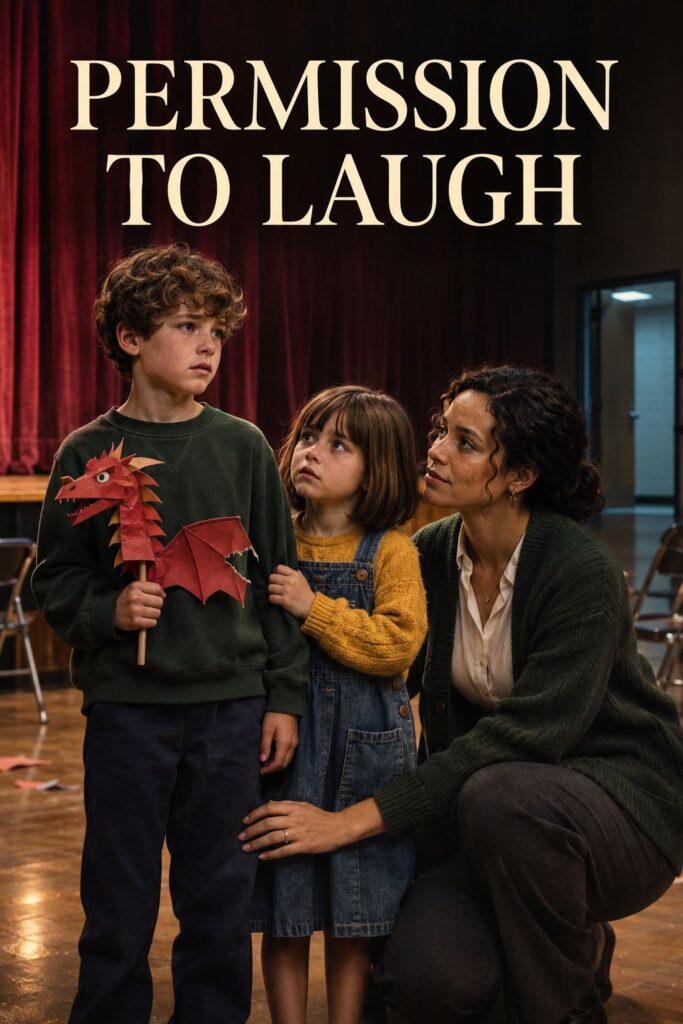
Sam shoved the dragon across the table so hard it struck the yellow mixing bowl.
The bowl rocked. Owen caught it before it fell, then set it back in the center of the table without looking at the puppet.
“I don’t want to finish it,” Sam said.
Owen took his hands away from both objects.
“Okay.”
“You keep saying okay.”
“Because you don’t have to finish it.”
Sam’s face crumpled with sudden anger. “Everybody wants the king to come inside now.”
It was Thursday evening. A short note had arrived from Mrs. Flores offering to help if Sam ever wanted another chance to share his story. She had made no demand and set no date. Owen had shown it to him because concealing it would have meant choosing on his behalf again.
He had not expected the note to hurt.
“Do you think I want you to change the story so I look better?” he asked.
Sam pulled the notebook toward himself.
“Aren’t you?”
Owen sat opposite him. Poppy was making a paper ticket beside the window, listening with the stillness that had become her habit during difficult conversations.
“I want to behave differently,” he said. “You don’t have to write that I’ve done it before you’re sure.”
Sam stared at the broken edge of the dragon’s crown.
“Can he stay outside in the story?”
The question hurt. Owen answered it anyway.
“Yes.”
“Even if you come to watch?”
“Even then.”
Poppy put her pencil down. “Could he knock?”
Sam looked at her.
“He doesn’t get to just come in if the dragon’s still mad,” she said.
Owen almost smiled at the simple justice of it. He kept the smile to himself. The children were working something out that did not need his praise attached to every turn.
“Maybe,” Sam said.
He did not write it down yet.
That morning, Owen had met with the school counselor. He had described his own behavior and the events the children had reported. He asked for help understanding what support the school could provide and how to arrange something outside school for the family. The conversation had not produced a neat explanation for every silence in the house. It had produced names, questions, an appointment, and the unsettling realization that listening would remain work long after he felt sorry.
He had also been reminded to keep adult repairs between adults. Sam did not need to perform a better ending to prove Owen had become a better father. Poppy did not need to hug Diane so the family could call itself healed.
At the kitchen table, he began to understand how easily he might have asked for both without meaning to.
“We can put everything away tonight,” he said. “Or work on it. Or do something else.”
Sam chose something else.
They played a card game Beth had taught them, arguing over a rule nobody remembered properly. Poppy won by placing three cards down at once. Sam objected. Owen found the instructions in the bottom of the box and discovered they had all been playing a different game for years.
That made Sam laugh so suddenly that he tried to swallow it.
Owen stayed at the table and read the ridiculous rule again.
Halfway through the card game, Poppy tried to keep a card Sam knew belonged in the discard pile. He reached for it. She pulled back. The deck scattered across the table, and Sam shouted that she ruined everything.
Poppy began to cry.
Owen put his own cards down. “You can be angry. You can’t shout at her like that.”
Sam’s face closed.
“So now I’m doing it wrong again.”
“You aren’t in trouble for having a feeling. We still have to take care of each other while we have it.”
He asked Poppy to return the card and Sam to give her space. Neither request pleased them. For several minutes, the kitchen contained two annoyed children and a father who wanted very badly to make the whole evening feel successful.
He did not call it a failure. He gathered the fallen cards and waited.
Poppy finally admitted she wanted the picture on the card because it looked like a tiny house. Sam said she could look at it without keeping it. They found a blank scrap of paper and drew another house, with a roof that leaned absurdly to one side.
“That’s worse,” Sam said.
“It’s my house,” Poppy replied.
The game resumed. Nobody had become perfectly patient. Owen had needed to remind Sam to lower his voice and Poppy to wait her turn. He was relieved, unexpectedly, by how ordinary the argument was. Letting the children speak did not mean surrendering every rule. It meant a disagreement could remain a disagreement, instead of becoming evidence that one of them must stop taking up space.
By Friday, Diane had sent a correction to the adults she had misled. She forwarded it to Owen without adding a demand for thanks.
I said Nora encouraged the children to call her their mother. That did not happen. I also said she wrote the play to ridicule Owen. Sam wrote it, with Owen’s approval for the performance. I struck Nora. That was my action, and I was wrong to blame her or the children for it.
Owen read the message three times. It was not everything. It was more than he had expected after the conversation in her kitchen.
He replied that he had received it. He did not promise a visit in return.
There was a second message asking whether she could write a short apology for the children. He said yes, provided it did not ask them to keep secrets, forgive quickly, or take responsibility for her feelings. She sent it the following afternoon.
Owen read the letter first. Then he told Sam and Poppy what it was and asked whether they wanted to hear it now, later, or separately.
Poppy wanted it now. Sam wanted to sit on the rug instead of at the table. Those were small choices. Owen let them matter.
Diane wrote that she should not have hit Nora, that making the play had not caused it, and that she had been wrong to tell them they must keep their memories quiet to protect their father. She said they could remember the funny things about Beth. She said she was sorry.
At the bottom, she had added that she hoped to see them when they were ready.
Poppy asked whether Grandma was still Grandma.
“Yes,” Owen said.
“But she doesn’t get to hit people?”
“No.”
Sam traced the edge of the rug with one finger.
“Does sorry mean she comes over again?”
“Not automatically. We decide what feels safe, and I do the grown-up part of making that happen.”
Sam looked up. “I don’t want her at the play.”
Owen kept his voice ordinary.
“Then she won’t be there.”
Only after he answered did he ask, “Are you thinking about a play again?”
“Maybe a little one.”
They talked about where. Sam did not want the cafeteria. Poppy wanted a stage with a curtain, but the curtain had to be one they could pull themselves. The kitchen table was too high. Two dining chairs and a tablecloth made a surprisingly good theater.
Owen asked whom they wanted to invite. Sam chose Aunt Jo, even if she had to watch by a video call. Poppy chose Nora. Both chose their father. Leah could see it another day if they wanted.
“What if I forget the words?” Poppy asked.
Sam rolled his eyes. “You always forget.”
“Then it’s normal,” Owen said.
Poppy considered this and appeared reassured.
Saturday was Beth’s birthday.
Owen woke early with the old dread waiting for him, but he did not try to work his way around it. He showered, dressed, and went downstairs. The children found him measuring flour into the yellow bowl.
“You started without us,” Poppy said, offended.
“Only the flour.”
She inspected the bowl, then decided he could remain employed as a helper.
They made lopsided pancakes. One fell apart in the pan. Sam wanted to see whether he could flip a small one. Owen showed him how to stand back from the heat, then helped him move the spatula. It landed half folded. Sam declared it a taco.
They put a candle in a stack on a plate. Nobody pretended Beth was waiting somewhere to blow it out. Poppy said she wished Mom could have the biggest one. Sam said she would choose the burnt one and pretend it was the best.
Owen said Beth would complain about his coffee before eating any of them.
The children laughed because he was right.
He cried before breakfast ended. This time, he told them he needed a tissue and wanted to stay at the table. Poppy passed him three tissues, then asked for syrup. The morning held both things without making either child choose which was allowed.
In the afternoon, they called Jo. She had made a small stack of pancakes at her own house, which Poppy found deeply impressive. Sam showed her the theater. When she asked whether she needed a ticket, he held up a paper rectangle with a badly drawn crown.
“Friday,” he said. “After school. But it’s not finished.”
“Then I won’t ask what happens,” Jo said.
Nora returned to work the following Monday under the new arrangement: three afternoons, direct communication with Owen, and a clear finish at six. The other days were Owen’s pickups, with the school program available when needed. Nobody asked her to walk back in as if Friday at the cafeteria had never happened.
Owen met her at the door before leaving for a short afternoon appointment. He showed her the updated schedule and confirmed Diane would not be visiting during work hours. Nora checked the written details, put her bag away, and asked where the children wanted their snack.
Poppy hugged her around the waist. Sam held up the dragon, showing the repairs without speaking.
Nora crouched to inspect the wing.
“That hinge works better now.”
“Dad held it,” Sam said.
“Good teamwork.”
“He didn’t change the shape.”
Nora glanced at Owen, then back at the puppet. “You knew how you wanted it.”
When Sam invited her to Friday’s little performance, she said she would like to come as a guest if she could leave afterward for her evening plans. Poppy immediately began making a ticket with a picture of Nora’s green cardigan. The roles remained ordinary and clear. Nora was someone they liked, with a home and a life elsewhere.
On Tuesday, Owen came home at the promised time and found the children rehearsing. He left his work bag by the door, announced he was there, and asked whether they wanted privacy.
“Don’t watch the new part,” Sam said.
Owen went into the living room. He did not stand secretly in the hallway to hear whether the story had forgiven him yet.
Behind him, the dragon roared. Poppy forgot a line and made up a worse one. Sam laughed, then began explaining why a dragon could not eat a whole school bus.
Owen sat on the sofa with the blue album open beside him. The laughter hurt in a familiar place. He let it hurt. Then he stayed.
On Thursday night, Sam came downstairs carrying the notebook.
“I need a sound,” he said.
“What kind?”
“A knock. But a king knock, not a scary one.”
Owen tapped the table twice.
Sam considered it. “Too office.”
Owen tried again, softer.
“That one,” Sam said.
He wrote two small marks beside the ending and closed the book before Owen could read it.
“You don’t get to see until tomorrow.”
“All right.”
Sam paused in the doorway.
“Dad?”
“Yes?”
“I’m keeping the bit where he left.”
Owen looked at his son, at the red puppet under his arm, at the page the boy no longer hid against his chest.
“I know,” he said. “I’ll be there to hear it.”