Chapter 10 – The Saturday They Kept
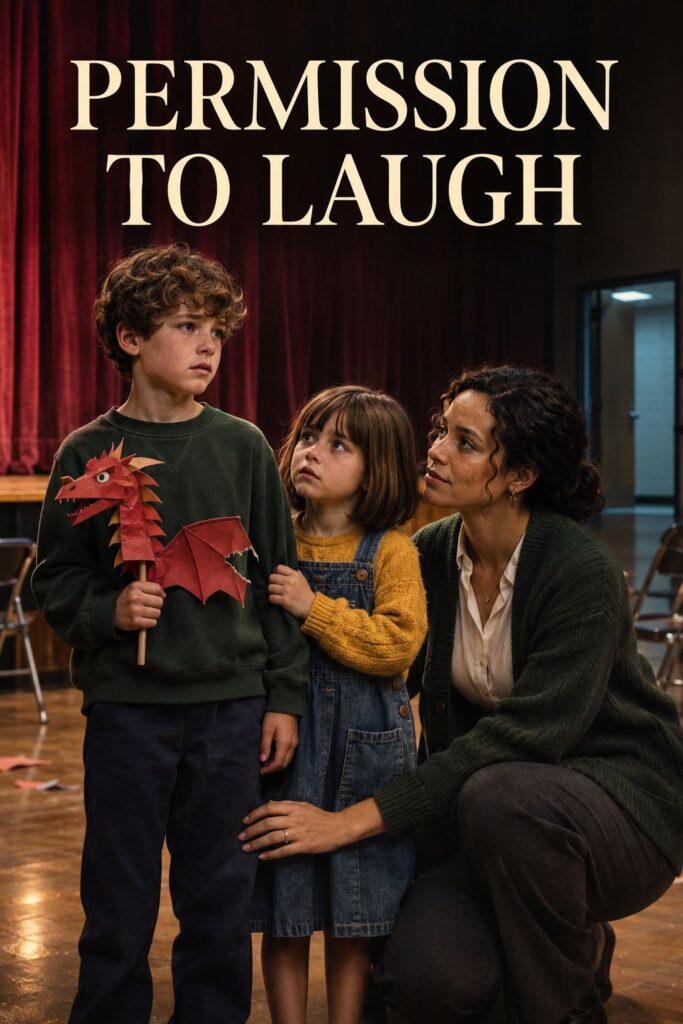
Poppy pulled her hand back when Diane reached toward her.
Her grandmother stopped immediately.
“All right,” she said. “You don’t have to.”
Owen stood beside the park bench with the bag of snacks over one shoulder. Sam remained close enough that their sleeves touched. It had been six weeks since the kitchen performance, and this was the first short visit with Diane that the children had agreed to try.
They had chosen the park because they could walk away from a bench more easily than leave a room. They had chosen fifteen minutes because Poppy understood fifteen minutes from the timer used during her board games. Owen had told Diane those arrangements before they met.
She had arrived without presents.
That had been his request too. There would be no large toy requiring the children to display gratitude before anybody addressed what had happened.
Diane sat with her hands folded around a plain envelope. Her burgundy jacket was buttoned to the throat. She looked at Sam, then at Poppy, without asking them to come closer.
“I wanted to say something,” she began. “If you’re willing to hear it.”
Sam nodded once. Poppy leaned against Owen’s leg.
“I hit Nora because I was angry. She didn’t make me do it. Neither did you. I was wrong.”
The wind lifted one corner of the envelope.
“I also told you things about your dad that weren’t mine to decide. I told you to keep some memories quiet. You should have been able to talk about your mother.”
Sam watched her face.
“Even if she was being silly?”
“Yes.”
“Even if you don’t like the story?”
Diane took a breath.
“You can remember something I don’t remember the same way. I don’t get to cross your version out.”
Owen looked toward the playground rather than rewarding her with visible approval. The conversation belonged to the children. His job was to make sure its limits held.
Poppy pointed at the envelope.
“What’s that?”
“A photograph. Your dad said I could bring it if you wanted to see.”
Owen had checked it beforehand. Diane took out a full copy of the park photograph from the blue album. Beth wore the red rubber nose. Poppy, much younger, held the muddy stick like a royal scepter. Sam was laughing at something outside the frame.
“I had this printed without cutting it,” Diane said.
Sam accepted it. He examined the corners first.
“You didn’t make Mom smaller.”
Diane’s face changed. For a moment, Owen thought she might explain that she had only meant to make the photographs prettier. Then she looked at the full image in the boy’s hands.
“No,” she said quietly. “I didn’t.”
Poppy moved close enough to look without touching her grandmother.
“She said the stick was her boss,” she remembered.
Sam shook his head. “She said the stick was the king.”
“Boss king.”
Diane’s mouth trembled into a small smile. She did not settle the argument. Owen noticed the effort that took and allowed it to remain hers.
When the fifteen minutes ended, he told the children it was time for their walk. Poppy waved. Sam said goodbye. Neither hugged Diane. She stayed on the bench and let them leave without asking whether they loved her.
Halfway to the pond, Sam looked back.
“Was that mean?”
“What?” Owen asked.
“Not hugging.”
“No.”
“She looked sad.”
“She can be sad and still respect your choice.”
Sam considered that, then tucked the photograph into the flat pocket of the snack bag so it would not bend.
The visit had not repaired everything. Owen did not tell the children it had. There would be more short visits if they wanted them, with him present and with the arrangements kept. There would be no return to a system in which Diane’s hurt feelings quietly overruled their own.
On the walk home, Poppy asked whether Grandma could come to a play someday.
“Someday is something we can talk about later,” Owen said.
She seemed satisfied. She was learning that later did not always mean never, and yes did not have to be earned by saying it quickly.
At home, the kitchen looked lived in.
The cream album remained on a shelf, but it no longer stood alone. The blue book sat beside it, and Sam’s notebook lay openly on the side table. Its two ends held different kinds of stories: memories at the front, adventures invented at the back. Poppy sometimes wrote upside down by accident. Sam complained, then found a way to mark the pages with colored ribbons.
The red dragon occupied a place of honor that changed depending on whether the table was needed for homework. One wing carried clear tape. The other had acquired a patch of gold paper after Poppy decided dragons could choose their own repairs.
Owen had made changes that were less visible.
He read school messages before answering. He knew where the hairbrush lived. His work calendar contained the children’s pickups, and his colleagues had learned that an early departure was an arrangement rather than an apology they could negotiate every week.
Sometimes things still went wrong.
A truck stalled on the access road one Thursday, and he realized he would miss his promised arrival by twenty minutes. He called Nora before her finish time, arranged the backup they had discussed, and told the children when to expect him. When he got home, he did not buy sweets as payment for being late. He explained, listened to Sam’s irritation, and kept dinner ordinary.
He was learning to be reliable without pretending reliability meant nothing unexpected could ever happen.
The family had begun meeting with someone who helped them talk, and Owen had his own conversations that did not require his children to witness all of them. There were difficult days. Poppy still asked the same question about the hospital sometimes. Sam still watched the door when a laugh surprised him. Owen answered again. Progress did not make repetition a failure.
Nora worked her three afternoons. Her wages arrived when agreed. She left at six unless a different arrangement had been made beforehand, and she did not have to apologize for having somewhere else to go.
She passed the exam for her course and brought the children a photograph of the small certificate she had earned. Poppy wanted to know whether this meant Nora was now in charge of every book in America. Sam explained that it probably meant only some books. Nora said both estimates were generous.
Owen congratulated her, then asked whether she wanted the schedule adjusted for the next course. The question was practical. It mattered more than a grand gift she would have been obliged to accept politely.
He had asked whether she wished to receive Diane’s written apology through him. Nora agreed to one letter. She read it in her own time and chose not to resume contact. Owen did not ask her to change that decision to make family visits easier. Whatever happened with her report about the assault remained separate from the household’s wish to move forward.
The children missed her when she was not working and enjoyed her when she was. They also spent time with Jo, with friends, and increasingly with their father. Nobody had to become indispensable to prove that they belonged.
That afternoon, after the park, Sam asked whether they could make pancakes for dinner.
“We just had sandwiches,” Owen said.
“That was lunch.”
“A forceful argument.”
Poppy appeared with the yellow bowl held carefully in both hands. “I can be the flour boss.”
Owen checked the time. There was laundry to fold, a bill he had not opened, and a work message that could wait until Monday. Nothing important would improve because he hurried his children past the afternoon.
“All right,” he said. “Pancakes.”
They washed their hands. Sam measured. Poppy counted eggs and demanded a recount when Owen suggested they needed only two. The first pancake was pale. The second stuck. The third came out shaped approximately like a horse, if the horse had no particular interest in anatomy.
Sam insisted it was a dragon.
Owen held the spatula up for inspection. “The royal breakfast is experiencing difficulties.”
“Blame the bread,” Poppy said.
“There isn’t any bread.”
“That’s why it won’t know.”
Sam laughed so hard he had to put down the measuring cup.
Owen laughed too. For a second, the sound brought Beth into the room with such painful clarity that he looked toward the chair where she used to sit. The chair was empty. It would remain empty of her.
He did not need to pretend otherwise to keep laughing with the children who were there.
The next pancake flipped too far and landed on the edge of the stove. Owen turned off the heat and moved the pan aside before rescuing it. Poppy made the dragon roar from a safe distance. Sam announced that this was exactly why the queen had forbidden fire-breathing in the kitchen.
“She was right,” Owen admitted.
“Put that in,” Sam said.
“In what?”
The boy pointed toward the notebook on the side table.
Owen looked at it, surprised. For weeks, they had treated it as a place to recover things threatened by silence. He had not yet thought of it as a place their family could keep growing.
They ate at the table with the bowl between them. Afterward, Sam drew the pancake on the stove. Poppy added a crown to it. Owen wrote the date at Sam’s request and asked which end of the book the story belonged in.
“The real one,” Sam said.
Poppy disagreed because a king pancake sounded invented. They settled it by writing both what happened and what Poppy called it. The difference did not spoil the memory.
When the dishes were done, Owen called Jo for their regular conversation a day early because she had asked to move it for a work shift. He had told the children about the change in advance. Sam carried the notebook to the screen. Poppy demonstrated the failed flip with a folded towel.
Jo laughed. She told them Beth had once dropped an entire omelet and tried to call it a floor picnic before deciding she was not quite that committed to a joke.
Owen remembered the morning. He added that Beth had ordered takeout afterward and complained because the restaurant put parsley on everything.
“Mom hated parsley?” Sam asked, delighted by this new and unnecessary fact.
“With unreasonable determination,” Jo said.
Sam wrote it in the margin.
Before the bedtime routine, Sam slipped the full photograph from the park into the blue album. He did not remove any of the other pictures to make space. Poppy insisted on adding the date of the visit beside it, because the photograph was old but bringing it home was new. Owen found a pen that would not smear and let her make the careful numbers herself.
Later, Owen tucked Poppy into bed. She asked whether tomorrow could be an ordinary day.
“What would an ordinary day have?” he asked.
“Toast. And the park. Not a big feeling thing.”
“We can aim for toast and the park.”
She nodded and handed him the stuffed duck.
“Don’t make him wear pants.”
“I wouldn’t dare.”
In Sam’s room, the notebook rested open on the desk. The original drawing of the king outside the window remained. A later page showed him sitting beside the dragon with a broom across his knees.
“Do you want to change the first picture?” Owen asked, then wished he had not.
Sam considered it without alarm.
“No. That’s where the other part starts.”
Owen nodded.
At the doorway, he heard his son call softly behind him.
“Dad?”
“Yes?”
“You laughed like the cake video today.”
Owen stayed in the doorway long enough to let the words reach him.
“I think I did.”
Sam smiled and pulled the blanket over his shoulder.
Downstairs, the kitchen light shone on the yellow bowl, the repaired dragon, and a book with many blank pages left. Owen turned off his phone, sat at the table, and began making the grocery list for an ordinary Sunday.