Chapter 3 – What He Had Actually Said
The pencil broke when Sam pressed it into the paper.
Owen looked up from the breakfast pan. His son was drawing at the end of the kitchen table, his head lowered over a castle with seven windows. He had been shading one window so heavily that the paper had begun to buckle.
“Need another pencil?” Owen asked.
Sam covered the window with his hand.
“It’s finished.”
It was Saturday. At eight fifteen, Owen would normally have been halfway to the distribution center, supervising the overflow shift that paid for the extras he increasingly regarded as necessities. He had traded the shift with Luis and would cover an early start later in the month. Nothing had collapsed. Two people had rearranged their plans. The world had carried on.
The simplicity of it embarrassed him.
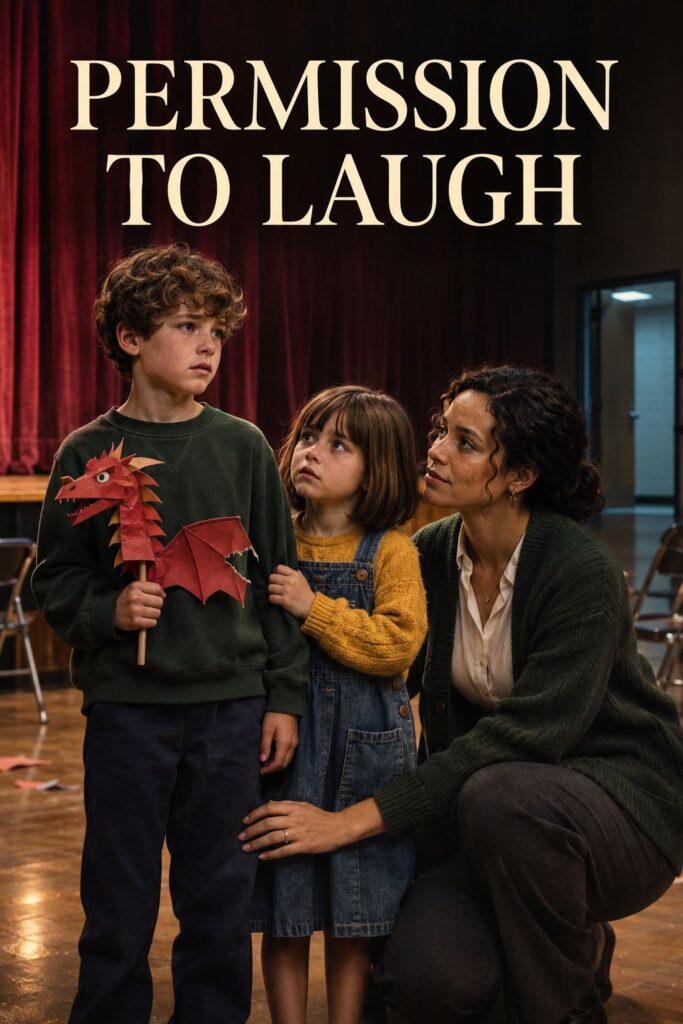
Poppy sat on the floor making a blanket into a sea. The dragon waited on an island of folded towels. Nobody had suggested repairing it yet.
Owen turned off the burner and set a plate of eggs beside Sam. “Can I sit?”
The boy nodded.
“I thought about what you said last night.”
Sam’s shoulders rose slightly.
“About me saying I couldn’t do it anymore. I don’t remember every word I said after Mom died. I remember being overwhelmed. I want to understand which time you remember.”
“You don’t have to,” Sam said immediately.
“I want to hear it. You can stop if you want.”
The broken pencil rolled beneath Sam’s palm.
“It was when Poppy wanted the duck song.”
Owen could see the evening at once.
Six weeks after the funeral. A rainstorm. Beth’s sister Jo had sent a short video in which Beth sang a ridiculous song about a duck who refused to wear pants. Poppy had watched it on Owen’s phone and laughed because Beth kept forgetting the final rhyme.
Owen had been trying to answer an insurance question at the same time. The sound of Beth’s voice had come out of the phone without warning. He remembered reaching for it. He remembered standing so quickly his chair scraped the floor.
“Not again,” he had said. “I can’t do this anymore. Please. I just need some quiet.”
Then he had gone upstairs.
His mother had remained with the children.
“I was talking about how much I was hurting,” he said. “I wasn’t asking you to stop remembering her.”
Sam’s gaze stayed on the drawing.
“You took the phone.”
Owen forced himself not to answer too quickly.
“Yes. I did.”
“And Grandma said we had to help.”
Poppy had stopped moving her blanket sea. Owen could see her listening without looking toward them.
“What did helping mean?” he asked.
“Not making you sad on purpose. Not doing her voices. Not telling the things that made you need the bathroom.”
Owen looked at the shaded window in the castle.
“I should have come back downstairs and explained. I didn’t.”
“You came back for dinner.”
“I know. I mean I should have talked to you.”
Sam picked up a fork, put it down, and finally raised his eyes.
“Were we making you sad on purpose?”
“No.”
Owen said it without qualification. He could explain the complexity to another adult later. His son needed an answer that did not require him to interpret a weary man’s tone.
“You were remembering your mom. I was responsible for telling you what I needed without making you responsible for fixing me.”
Poppy climbed onto the empty chair.
“Can the duck wear pants now?” she asked.
He almost laughed. The sound caught against something painful in his chest, and both children watched his face.
“The duck can wear whatever he wants,” he said. “And I can be sad and still want to hear the song.”
Sam did not immediately reach for a phone. Owen understood. One breakfast could not outweigh fourteen months of practice.
He asked whether they wanted eggs on toast or beside it. Poppy chose beside it so the toast could be a bridge. Sam began eating. The conversation ended because it needed to, rather than because Owen fled it.
After breakfast, Owen took the children to buy glue for the dragon. In the craft aisle, Sam chose clear tape instead. He said glue took too long to dry and the wing needed to bend.
Owen almost explained that they could reinforce it with cardboard. Then he remembered that Sam had built the puppet. He asked to see how the joint worked.
Sam showed him, using two fingers beneath the dragon’s neck to turn its head. Poppy demonstrated the roar, then glanced toward a shopper at the end of the aisle.
The woman smiled and kept choosing yarn.
Nothing terrible followed.
On the drive home, Sam held the tape in his lap. “We don’t have to make another show,” he said.
“No, we don’t.”
“Even if we fix it?”
“You can fix something because you want to keep it.”
Sam turned the small roll over in his hands. Owen saw how carefully he was testing the distance between an adult helping him and an adult deciding what the help must produce. He let the rest of the drive belong to Poppy’s argument that dragons ought to eat windshield wipers.
At ten, Diane arrived without calling first.
Owen saw her car pull into the driveway. He told the children she was there, asked them to stay in the kitchen for a few minutes, and went onto the porch before she reached the door.
“I asked you not to come.”
“You said last night. It’s morning.”
She held a grocery bag with milk, apples, and the cereal Poppy liked. It was such a familiar offering that he instinctively reached to take it. Then he stopped.
“We’ll talk here.”
Diane looked toward the front window. “Are the children watching?”
“They know you’re here. I’m not going to argue in front of them.”
“You let half the school watch you speak to me like a stranger.”
“Half the school watched you hit someone.”
Her mouth tightened. “I lost my temper. That doesn’t make everything she was doing appropriate.”
“What was inappropriate about the pancake story?”
“It wasn’t the sort of memory to put on a stage.”
“Why?”
“Because this family has been through enough without being turned into entertainment.”
Owen thought of the other families performing in the cafeteria. A grandfather’s terrible fishing trip. A child describing how her parents met in a grocery store. Ordinary people, embarrassed and affectionate, letting themselves be remembered imperfectly.
“The evening was for family stories,” he said. “Sam wanted to tell one.”
“Sam is eight. That’s why adults help him choose.”
“Did you tell him remembering Beth’s funny voices would hurt me?”
Diane looked away toward the street.
“You couldn’t bear them. You made that perfectly clear.”
“I said I needed quiet one night. I didn’t ask you to make that a rule for a year.”
“You never complained about the quiet.”
That sentence stopped him because it was true.
He had slept. He had worked. He had praised how well the children were managing. When Diane described a calm afternoon, he had thanked her without asking what had been required to keep it calm.
“I should have noticed,” he said. “That doesn’t make it right.”
She shifted the grocery bag into her other hand.
“So this is all my fault now.”
“No. I’m responsible for the things I said and the things I didn’t ask. You’re responsible for telling them what those things meant. And for hitting Nora.”
“I have been here every day.”
“I know.”
“When you could barely get dressed.”
“I know.”
“When Beth’s sister went back to her own life.”
“Jo lives six hours away. She called. I didn’t answer a lot of those calls.”
He realized how often his mother’s account had become his own simply because she was nearby to repeat it.
Diane placed the groceries on the porch chair with a hard little thump.
“Well. You seem to have answers today.”
“I have questions. I need you to answer them without making the children pay for asking.”
She left the groceries and drove away. Owen watched until her car turned the corner, then carried the bag inside because throwing away useful food would not improve the morning.
Sam looked at the cereal box.
“Is Grandma mad at us?”
“Grandma is upset with me. Grown-ups can be upset without you having to fix it.”
“Did you tell her I said?”
Owen set the milk down.
“I asked her about what happened. I should have told you before I did. I won’t ask you to keep secrets for me, and I won’t promise to keep something private if I need help keeping you safe. But I’ll explain what I’m doing.”
Sam nodded slowly. Trust, Owen was beginning to discover, required more specific promises than love.
That afternoon, he opened the household organizer on the desk beneath the stairs.
He had not touched it in weeks. Diane kept the calendar, the appointment cards, the school notices, and the handwritten lists of things running low. He found everything labeled. There was no villain’s hidden compartment. There was simply the ordinary collection of his children’s lives that he had stopped reading.
In a folder marked SCHOOL, he found a flyer for Family Stories Night. Nora’s printed note about their play was clipped to it. Beneath that lay a worksheet from Sam’s class.
One thing I wish a grown-up knew.
Sam had written: I still like it when Mom is funny.
At the bottom, the teacher had asked whether a parent wanted to discuss the response. Diane’s handwriting said she would speak to Owen. Beside it was a check mark.
Owen photographed the sheet for his own reference and found the original email on his phone. It had been sent to him as well. He had forwarded it to Diane with the message: Can you handle this? Busy week.
There was no comfort in discovering that nobody needed to hide it from him.
He wrote to Mrs. Flores asking for a meeting on Monday and for future questions about Sam to come directly to him. He did the same with Poppy’s teacher. He asked about speaking to the school counselor and, if appropriate, finding outside support for the family. He did not ask a teacher to solve what he had ignored at home.
Then he called Jo.
His sister-in-law answered with a wary hello. They had spoken at Christmas, then exchanged practical birthday messages. He had told himself she was giving him space.
“I need to apologize,” he said.
“For which part?”
There was no cruelty in her question. There were simply several possibilities.
He sat on the bottom stair and told her about the school evening. She listened without interrupting. When he reached the part about the duck song, she was quiet for a long time.
“I thought you didn’t want the videos,” she said. “You stopped replying when I asked.”
“I couldn’t watch them then.”
“I understand that. I didn’t understand whether the children were getting to.”
He looked toward the kitchen, where Sam was showing Poppy how to fold a paper sail.
“They weren’t,” he said.
Jo breathed out slowly.
“I still have them. Nothing disappeared because you weren’t ready.”
They agreed she would send a few at a time, labeled plainly so he would know what he was opening. No surprise messages. No demand that he watch everything in one heroic sitting. He would ask the children what they wanted to see.
Before they hung up, Jo asked whether Sam still did the dragon voice.
“He tried last night.”
“Beth used to say he did it better.”
Owen smiled at the wall, then covered his eyes with one hand. Jo stayed on the line while he cried. For once, the person listening was an adult who could choose to help him carry it.
Later, Sam found him at the kitchen table reading the original script Nora had emailed. The intact page on the screen showed the line the paper version had lost.
Then the king came home and heard the dragon laughing.
Below it, a different line had been crossed out in pencil before Nora took the photograph.
He waited outside until everybody was quiet.
Sam stood beside the table.
“I changed that,” he said.
Owen moved the laptop so the boy could see he was not hiding it.
“Why?”
Sam glanced toward the hall, although Diane was miles away.
“Because it happened,” he said. “And Grandma said people mustn’t know.”