Chapter 7 – The Side Door
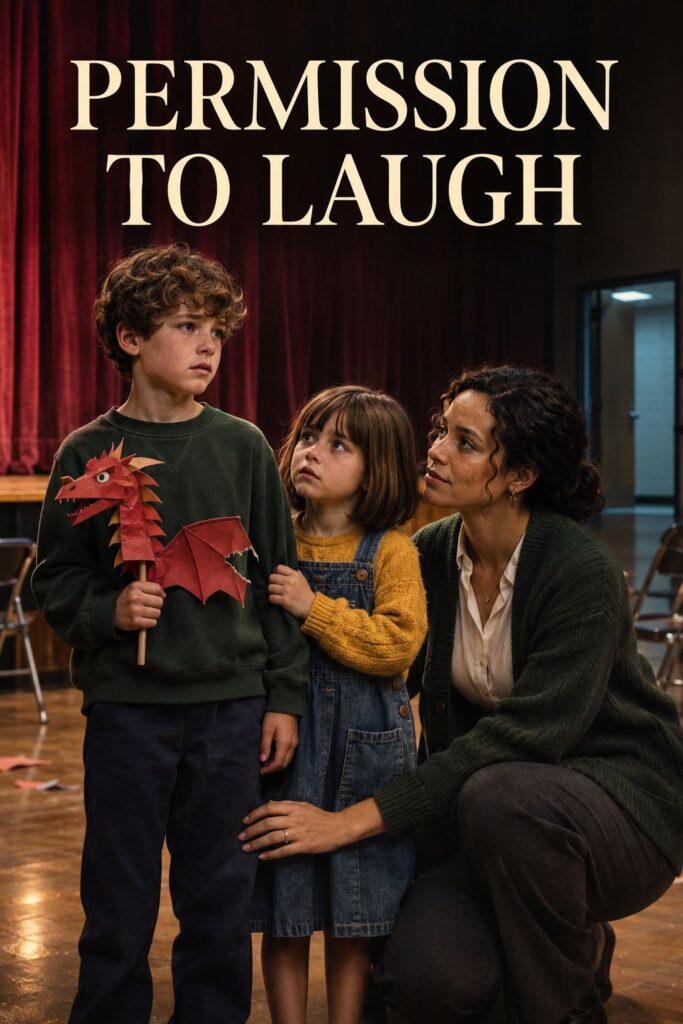
Diane pushed the school office door open with a stack of white cards in her hand.
Owen saw her through the glass before she saw him. He had arrived for Wednesday pickup early, leaving work according to the schedule he had spent two days making possible. Behind the office counter, the secretary was speaking calmly to his mother. Sam and Poppy were not in the room.
That mattered. Whatever happened next would not require them to stand between adults again.
“I’m their grandmother,” Diane was saying. “I’m not a delivery driver asking for an address.”
“And Mr. Reed has given us the current pickup plan,” the secretary replied. “We’re checking with him.”
Owen entered.
“You can check with me now.”
Diane turned, her expression moving quickly from surprise to hurt.
“I only brought their invitations.”
He looked at the cards. Beth’s neat employee photograph filled the front, framed by pale flowers. Beneath it was the date of Saturday’s gathering at the hall.
“The gathering we postponed?”
“A few people still wanted to remember her.”
“You can remember her with them. You can’t arrange a different plan for my children through the school.”
The secretary looked between them. Owen lowered his voice.
“I’m sorry this has become an issue here. The children are leaving with me as arranged.”
She nodded and went to ask Mrs. Flores to send them down. Diane moved toward the corridor. Owen stepped into her path without touching her.
“Not in front of them.”
Her eyes narrowed. “You are behaving as if I’m dangerous.”
“You hit someone in front of them. You haven’t explained that to them without blaming the person you hit.”
“There are two sides to everything.”
“They don’t need to stand between the sides.”
He asked the secretary to give him a minute and walked with Diane outside through the side door. The late-afternoon air was cold. Across the parking lot, children were being helped into coats, cars, and arguments about whose turn it was to choose the music.
Diane looked at the invitations in her hand.
“Do you know how humiliating this is?”
“We can discuss it somewhere private. I’ll call you at four.”
“You have time now.”
“I’m collecting the children.”
He did not wait for her permission to finish the conversation.
Sam was holding Poppy’s backpack when Owen returned. Both children were watching the side door.
“Did Grandma come for us?” Sam asked.
“She came to the office. You’re coming home with me.”
“Are we in trouble?”
“No.”
“Did she say we had to go to the nice thing?” Poppy asked.
Owen crouched beside her. “Saturday is still pancakes. If any grown-up has a different idea, they talk to me.”
Sam breathed out. It was a small sound, but Owen heard it.
At home, they found a message from Ben asking whether the children wanted to play with Leah for an hour. Owen had known Ben since kindergarten pickup began years earlier. The houses were a few blocks apart. He asked Sam and Poppy whether they wanted to go, explained that he would speak with Grandma while they played, and promised to collect them before dinner.
Sam wanted to take the dragon. Poppy wanted her rain boots because Leah had a sandbox. They left cheerfully, then Sam came back to the porch.
“We don’t have to tell you what Grandma said if she gets mad?”
“You don’t have to carry messages between us,” Owen said. “You can always tell me something that worries you.”
The boy considered the difference, then followed Poppy down the path.
At four, Owen called Diane. She said she was home. He asked whether she was willing to talk without the children present and drove over only after she agreed.
Her house smelled of furniture polish and the cinnamon candle she always lit before visitors arrived. Owen had grown up there. The narrow hallway still contained the dent where he had struck the wall with a bicycle handlebar at eleven. Diane had covered it with a framed photograph of his high-school graduation.
She had set out tea.
For a moment, the familiar arrangement nearly undid his resolve. It would be so easy to sit in his old place, accept her account, and let competence close around him again.
He stayed by the table until she sat too.
“Why did you tell them not to make me laugh about Beth?”
Diane looked toward the window.
“I didn’t say not to make you laugh.”
“You told them not to use her voices. Not to watch the funny videos around me. Sam says you told him I might stay away if the house kept reminding me.”
“I said we had to give you a reason to come home.”
There it was, spoken as if it were sensible.
Owen put both feet flat on the floor.
“They’re children. They aren’t responsible for persuading their father to come home.”
“Someone had to think about what you needed. You were walking through rooms like a ghost.”
“Then you could have talked to me. Or asked another adult to help.”
“You wouldn’t talk.”
He accepted the truth without allowing it to excuse the rest.
“I wouldn’t. I should have. That didn’t make Sam the next person responsible.”
Diane stirred tea she had not sweetened.
“You think I don’t know that children need protection?”
Owen looked at the photograph above the hallway dent. His mother stood beside him, smiling with determined pride. There was no picture of his father anywhere on the wall. There had not been one since Owen was nine.
“What did you think happened if we talked about Dad after he left?” he asked.
She put the spoon down.
“This is not the same.”
“I know. Beth died. Dad chose to leave. I’m asking what you thought would happen.”
Diane stared at her cup.
“You would wait for him.”
“I did wait.”
“I wanted you to stop hurting yourself.”
“So we stopped saying his name.”
“You did very well.”
The old praise landed between them. Owen had built much of his life around it. He did well. He did not ask too much. He found work, paid bills, and carried on. When hurt became unbearable, he left the room until he could be useful again.
His mother had taught him how to survive the life she understood. He could recognize that and still see what the lesson had cost.
“I don’t want Sam and Poppy doing well by pretending they don’t miss someone.”
“You act as if I wanted them unhappy.”
“I think you wanted things under control.”
Her eyes filled suddenly. She looked furious with herself for it.
“There was no control. Not when your father left. Not when Beth got sick. You can’t know what it’s like to stand there and be able to fix absolutely nothing.”
“I know what it was like when Beth got sick.”
Diane’s mouth opened, then closed.
For a moment, neither of them spoke.
“I was afraid you would disappear into it,” she said at last. “And then there would be two children and nobody able to keep anything together.”
Owen looked at his hands. He could acknowledge her fear without handing it authority over the children again.
“I need help,” he said. “I’m arranging it. I’ve changed work hours. I’m talking to the school and to someone outside the family. Jo and I have made a plan to stay in touch. You don’t have to be the whole answer.”
“And now I’m no answer at all.”
“That depends on what you choose to do next.”
He laid one of the white invitations on the table. She had placed the remaining cards beside the teapot.
“Who is this for?” he asked.
“For Beth.”
“Beth would have hated that picture. She said it made her look like she was about to explain a parking fine.”
Diane almost smiled. The expression disappeared before it settled.
“It’s a respectful photograph.”
“The children remember a woman who got icing on her nose. They get to keep her too.”
She pushed the invitation away.
“I wanted them to remember the good things.”
“They were good things.”
The clock above the stove ticked through several seconds. Diane looked older without the quick certainty that usually filled every silence.
Owen asked directly about the script. She admitted crossing out the jokes and replacing them with the speech. She said she believed she was improving something a child could not judge for himself. He asked about the parent messages. She admitted Nora had never asked the children to call her Mom.
“I thought it was heading that way,” she said.
“Then you wrote a suspicion as something that happened. Correct it to the people you told.”
“You’ve already made me look terrible.”
“I corrected the claim. You can take responsibility for making it.”
He did not demand an apology in exchange for immediate access to the children. He told her what would be needed before they considered a visit: no more attempts to change school arrangements, no contact with Nora, and a clear explanation to the children that the slap and the silence were not their fault.
“No saying you did it because Sam made you angry,” he added.
Diane’s jaw tightened.
“You’re giving me rules in my own kitchen.”
“I’m telling you what I will allow around my children.”
She folded the invitation in half. It made a small cracking sound along the photograph.
“Perhaps you should go.”
Owen stood. He was not going to force understanding from her by keeping her in a chair until she repeated his words.
At the front door, she spoke again.
“I did love Beth.”
He turned.
“Then let the children love the person she was.”
He collected Sam and Poppy at the promised time. Ben handed him the dragon with a fresh cardboard crown taped between its horns. Nobody asked for a report on the conversation. Leah wanted to know whether dragons could be elected mayor. Poppy said that depended on the dragon.
On the walk home, Sam slipped his hand into Owen’s.
“Did you tell her the story was mine?”
“Yes.”
“Does that mean I can choose the ending?”
Owen looked down at the repaired puppet tucked under the boy’s other arm.
“Yes.”
Sam walked several more steps.
“I don’t know it yet.”
“You don’t have to.”
At home, Poppy asked whether Grandma had eaten all by herself. Sam looked at Owen as though the answer might become another obligation.
“She can make dinner,” Owen said. “And she has people she can call.”
“But she makes our dinner sometimes.”
“She has. We can appreciate that without having to visit when we’re not ready.”
Poppy considered the distinction while taking off her boots. One sock came off inside a boot, and she announced this was a much more urgent problem.
Sam stayed beside Owen while she went to rescue it.
“Can I miss her and still not want to go?” he asked.
“Yes.”
“I liked when she did the dinosaur toast.”
“You can keep liking that.”
The boy seemed relieved that nobody required him to choose between every good afternoon and the bad thing he had seen. He went to the kitchen and asked whether they could make toast with ordinary dinosaur shapes, without turning dinner into a message for anybody. Owen found the cutter. Poppy returned wearing one sock backward and took charge of announcing which pieces looked extinct.
That evening, Nora called. She had considered the proposed work arrangement. She wanted to discuss returning for three afternoons, with the clear limits they had written and a date to review how it was working.
Owen thanked her and said they could make the schedule fit the children rather than telling the children they had to make it succeed.
After the call, he told Sam and Poppy the practical news. Poppy bounced once on her chair, then stopped herself.
“It’s okay to be pleased,” he said.
She bounced again, higher this time.
Sam smiled down at his notebook. At the top of a clean page he had written a new title.
The Dragon Who Wanted the King to Stay.