Chapter 5 – The Birthday Nobody Had Mentioned
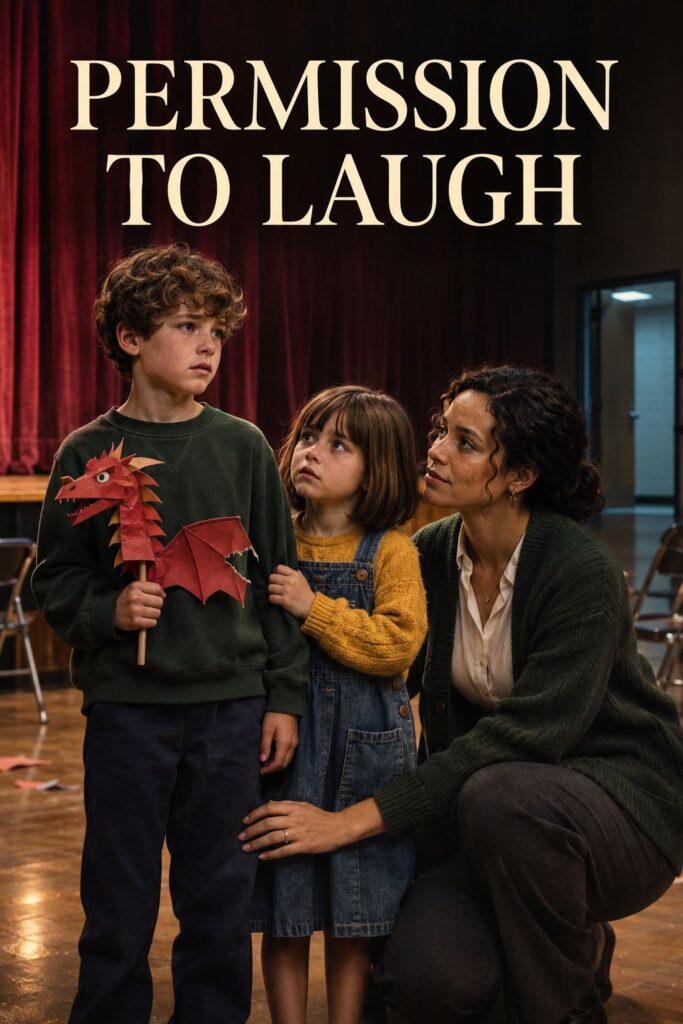
Poppy dragged a kitchen chair across the floor and climbed onto it before Owen could ask what she needed.
“Hold on,” he said, steadying the chair. “Let me reach.”
She pointed to the high cupboard above the refrigerator.
“The yellow bowl.”
He opened the door and found a stack of serving dishes, a cake tin, and the chipped mixing bowl Beth had refused to replace. One side carried the faded outline of a lemon. The handle of her old wooden spoon rested inside it.
“This one?”
Poppy nodded. “Before somebody puts it in another box.”
It was Sunday evening. Jo had gone to collect a takeout dinner, leaving Owen alone with the children for half an hour. The small library key lay on his desk. Nora’s parting words still made him uncomfortable in useful ways.
He set the bowl on the table and lifted Poppy down from the chair.
“Who’s putting it in a box?”
“Grandma said we should stop leaving old things in the way.”
Owen looked into the empty cupboard space. A bowl stored above a refrigerator had not been in anyone’s way. But he remembered Diane asking about clearing some kitchen things the previous winter. He had said to do whatever made it easier. It was becoming a difficult phrase to remember.
Sam came in carrying the small calendar from his bedroom.
“It’s on Saturday,” he said.
Beth’s birthday.
Owen knew the date. He had been approaching it with the private dread of a man watching an appointment he could neither keep nor cancel. He had not mentioned it to the children. He had told himself he was waiting to see whether they remembered.
Of course they remembered. Sam had circled it in orange six weeks earlier.
“What would you like to do?” he asked.
“The bad pancakes,” Poppy said immediately.
“They’re just pancakes,” Sam corrected. “They only get bad when you do the flipping part.”
Owen smiled before he could stop himself.
Poppy watched him, then gave a tiny smile in return.
“We can make them,” he said.
Sam’s finger stayed on the orange circle.
“Grandma said there was a grown-up thing.”
“What grown-up thing?”
“At the church hall. With the nice pictures.”
Owen remembered agreeing to a small gathering for Beth’s birthday. Diane had offered to organize it, and he had been grateful not to choose food, answer questions, or decide how much of his sadness to reveal in front of other people. He had pictured relatives, a meal, and perhaps some stories.
He had not asked what the children thought it would be.
“Did someone tell you you couldn’t make pancakes because of it?”
Sam shrugged. “Not exactly.”
“You can tell me the exact part.”
The boy looked toward the cupboard. “She said we needed to remember Mom properly this year. We weren’t supposed to make a mess and upset you again.”
Owen rested his hands against the table edge.
The previous birthday had arrived two months after the funeral. Jo had brought a cake. Poppy had tried to stick five plastic dinosaurs into the frosting because Beth liked their surprised faces. Owen had seen the cake and thought, with a sudden awful force, of every birthday Beth would never reach. He had left the kitchen. When he returned, the dinosaurs were gone.
He had never asked who removed them.
“The cake didn’t upset me because of the dinosaurs,” he said. “I was sad because I wanted Mom there.”
“We wanted her too,” Sam said.
There it was. No dramatic accusation. Just a fact Owen had somehow allowed to become separate from his own.
“I know,” he said. “I should have stayed and talked to you.”
“You didn’t like the cake after.”
“I didn’t know how to enjoy anything then. That wasn’t because of what you did.”
Poppy took the spoon from the bowl and laid it across the orange circle on Sam’s calendar.
“Can we have our thing first?”
“Yes.”
He said it without waiting to consult Diane. Then he added, “And we can decide together whether we want the other gathering at all.”
Sam looked uncertain. “She ordered food.”
“Then I will deal with the food.”
Jo returned with paper bags fragrant with garlic. When she saw the bowl, she stopped in the doorway.
“The pancake bowl,” she said.
Poppy nodded solemnly. “We’re getting it ready.”
Jo set the bags down. “Your mom once tried to mix brownie batter in that with a fork because she couldn’t find the spoon. She snapped the fork.”
Sam looked delighted and alarmed at once. “Really?”
“Really. She blamed the fork.”
“She blamed the bread too,” Poppy said.
Owen watched the connection form between the children and their aunt. Beth was not being introduced as an example of good behavior. She was being recognized as a person all three of them knew.
They ate around the bowl. Jo told one story, then listened to two from Sam. When Poppy invented a detail about a dragon living behind the dishwasher, Jo asked whether that was something she remembered or something she wanted to add to the story. Poppy considered this distinction and admitted it was an addition.
“It’s a good addition,” Jo said. “We can keep the real parts and the made-up parts in different places.”
Sam went to fetch his notebook.
While he was upstairs, Poppy asked whether all the stories had to be true. Jo asked what she had in mind.
“I want Mom to beat the dragon at arm wrestling.”
“Did she?” Owen asked.
“There wasn’t a dragon.” Poppy gave him a patient look. “It’s pretend.”
He laughed, and she smiled at having caught him being unnecessarily serious.
They decided the notebook could hold remembered stories at one end and invented adventures at the other. Sam came back in time to object that two ends meant Poppy might write upside down. Jo showed him how to turn the book around. The solution impressed Poppy so much that she insisted on demonstrating it to everyone twice.
Owen watched them negotiate the space. Neither child wanted a perfect museum of their mother. They wanted somewhere to keep the parts they knew, and room to make something new without being accused of losing the old.
He found two colored ribbons in the sewing drawer and let them choose which end would be which. Sam chose blue for memories. Poppy chose orange for adventures and immediately began inventing an orange dragon who disliked oranges. Jo asked whether that was a family trait.
After dinner, Owen asked about the videos she had offered to send. Jo opened a small folder on her phone with dates and ordinary descriptions. Garden hose. Grocery list. Birthday cake. Duck song.
There was no last message waiting to repair everything. Beth had not known which sentences her family would eventually need. She had simply lived while people around her sometimes held cameras.
Owen chose the cake.
“Tell me before you start it,” he said.
Jo waited until he nodded.
In the video, Beth stood in their kitchen holding a cake that leaned badly to one side. Sam, much smaller, was chanting that it looked like a mountain. Beth tried to turn the cake so its better side faced the camera and discovered there was no better side.
“A mountain is a perfectly respectable shape,” she said.
Then Poppy, not yet two, poked a finger through the icing. Beth looked down, gasped in theatrical outrage, and announced that the mountain had suffered a geological event.
Owen heard his own laugh behind the camera.
It surprised him more than Beth’s voice.
He had remembered himself as a man who once knew how to be happy. Hearing the evidence was different. The laugh was careless, full, unashamed of how much room it took.
He pressed his thumb against the edge of the table. Jo did not ask whether he was all right. She waited.
Poppy leaned forward. “Play the hole again.”
Owen looked at her. “You want to see it again?”
“She says the big word.”
“Geological?”
Poppy nodded.
He managed a breath. “Yes. Let’s play that part.”
This time, he laughed when Beth said it. The laugh broke halfway through and became a sob. Poppy immediately went still.
“It’s okay,” he said, reaching for a napkin. “I’m sad. I also thought it was funny. You didn’t do anything wrong.”
Sam watched him with the concentration of a child learning a rule that might finally be trustworthy.
“Do you want to stop?” the boy asked.
“For a minute. Then I’d like to hear what you remember about that day.”
He stayed at the table. Jo put a glass of water beside him. His children saw an adult help another adult, and nobody asked them to improve the room.
When he could speak easily again, Sam told them he remembered the icing tasting like oranges. Jo said Beth had put orange extract in it by mistake. Poppy insisted she remembered the mountain, although she probably remembered being told about it. They allowed both the uncertainty and the affection to remain.
Later, while Jo helped Sam find a clean sleeve for the damaged script, Poppy followed Owen to the sink.
“Did Mom know I wasn’t laughing at her?”
He turned off the water.
“When?”
“When she was in the big bed. With the buttons.”
Owen dried his hands slowly. Poppy had visited Beth in the hospital during a good afternoon. Beth had made a stuffed duck fall dramatically off a pillow. Poppy had shrieked with laughter. That evening, Beth had been too tired for another visit.
Owen had forgotten how those two moments might sit beside each other in a small child’s mind.
“She was making you laugh,” he said. “She liked hearing it.”
Poppy picked at the seam of her pinafore.
“After, Grandma said we couldn’t tire her out. And then we couldn’t go.”
He crouched so she did not need to look up.
“Mom was very sick. Laughing with you didn’t cause that. You didn’t make her too sick to see you.”
Poppy was quiet.
He waited instead of trying to fill the silence with five more explanations.
“Can I ask it again if I forget?” she said at last.
“As many times as you need.”
She leaned against his shoulder. He held her without telling her to be brave.
After the children went to bed, Owen sat with Jo beneath the kitchen light. She had to leave in the morning. He wanted to ask her to stay for a month, then understood that wanting help did not create an obligation for the nearest woman to reorganize her life.
“Could we make a regular time to call?” he asked. “Something the children can expect.”
They chose Sunday afternoons, with room for normal interruptions. Jo said she could visit again in a few weeks. He put the call into his own calendar.
Then he called Diane about Saturday.
“The children want to make Beth’s pancakes in the morning,” he said. “I’m doing that with them. We’re going to postpone the gathering at the hall.”
“You can’t be serious.”
“I am.”
“I’ve spoken to people. I’ve had photographs printed. I’ve spent money.”
“Tell me what can’t be canceled. I’ll cover it. I’ll explain the change to the guests myself.”
“Because the housekeeper wants another performance?”
“Nora hasn’t asked for any of this.”
“You are letting a child decide how a whole family remembers someone.”
Owen looked at the yellow bowl drying beside the sink.
“I’m letting my children have memories of their mother that they recognize.”
Diane said nothing for several seconds.
Then, more quietly, “You don’t know what they put in that first ending.”
“I read the photograph Nora sent.”
“Not that one. Before she took it. Sam had another page.”
Owen sat straighter.
“What did it say?”
“Ask him why the king never came inside.”
She ended the call before he could answer.
Owen remained at the table, staring at the dark screen. Upstairs, a floorboard creaked. Sam stood halfway down the stairs in his pajamas, holding the notebook against his chest.
“I didn’t mean never,” he said.
Owen set the phone down.
“Come sit with me.”
Sam stayed on the step.
“Please don’t make me change it again.”