Chapter 2 – The Nice Story
Poppy snapped the family album shut when Owen entered the kitchen.
Her fingers were clear of the cover. That was the first thing he noticed, because his mind could still manage small dangers more easily than large ones. The second was how quickly she slid the book beneath a dish towel.
“I wasn’t doing it anymore,” she said.
Owen stopped beside the refrigerator.
They had been home less than twenty minutes. He had ordered a pizza because he could not remember what was in the freezer. Sam was upstairs changing out of the shirt Diane had insisted he wear beneath his green sweatshirt. Poppy was supposed to be choosing paper plates.
“Doing what?”
“Looking.”
He pulled out the chair opposite hers and sat down.
“You can look at the album.”
Poppy pressed her palm over the towel. “This is the kitchen one.”
He did not know what that meant.
There was a family album on the living-room shelf, a heavy cream book Diane had assembled during the months after Beth died. Owen had thanked her for it without opening it very often. The cover hurt him. Everything attached to Beth hurt him, and he had become skilled at moving through his own house by routes that avoided surprises.
This book was smaller, with a blue fabric spine and a coffee stain on one corner. Beth had bought it from a clearance bin and declared the stain proof that it already belonged to them.
“Can we look together?” he asked.
Poppy searched his face. “Will you have to go upstairs?”
He understood the question before he wanted to.
In the early weeks, he had left rooms without explanation. A song on the radio, a spoon resting across a particular bowl, Poppy trying to say a word Beth used—anything could send him into the upstairs bathroom, where he could lock the door and try to breathe quietly enough that the children would not hear.
He had thought closing the door protected them.
“I might feel sad,” he said. “But I’ll tell you. You don’t have to guess.”
She moved the towel.
The first photograph showed Beth sitting on the kitchen floor in mismatched socks, a pancake stuck to a cabinet behind her. Sam was three, wearing the yellow boots. Owen’s own hand appeared at the edge of the frame, pointing toward the pancake as if the photograph needed help explaining itself.
He remembered the noise Beth had made when it landed. A surprised bark, followed by such helpless laughter that Sam had begun laughing without understanding why.
Poppy touched the photograph carefully.
“Was that bad?”
“The pancake?”
“Mom wasting it.”
“No. We had more batter. We cleaned up.”
“Grandma said Mom didn’t do things like that.”
Owen looked from his daughter to the woman in the photograph. Beth’s hair was tied with a green ribbon she had taken from a gift box. There was flour on the knee of her jeans. She was not dignified. She was alive.
“She did,” he said. “Quite a lot.”
Poppy’s shoulders loosened a little.
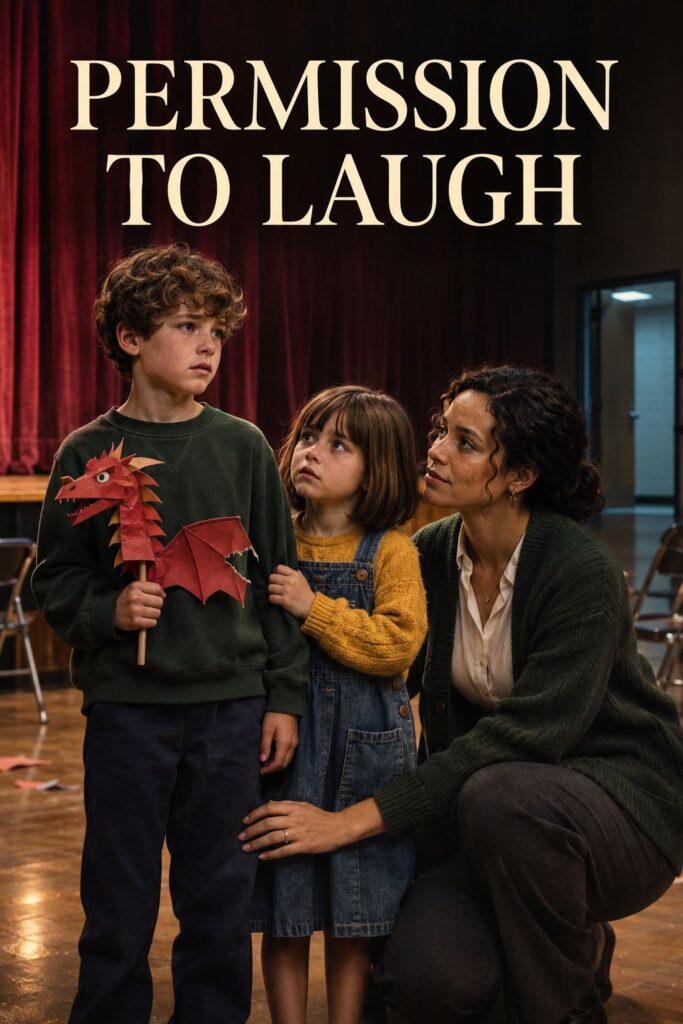
Sam appeared in the doorway carrying the paper dragon. He had set its bent wing between the pages of a comic book to flatten it. Without the wing, the puppet looked less injured than unfinished.
“You found the kitchen book,” he said.
“Where has it been?” Owen asked.
“In the bottom drawer. Under the napkins.”
“Why there?”
Sam glanced at his sister. Owen had seen that look between them before, but he had called it sibling understanding and smiled. Now he recognized a quick consultation about which answer was safe.
“Because Grandma was doing the proper one,” Sam said.
The doorbell rang. Poppy jumped.
“It’s dinner,” Owen told her. He checked through the window anyway before opening the door. Diane had called four times on the drive home. He had sent one message: The children are safe. We will speak tomorrow. Please do not come over.
He paid for the pizza, brought it to the kitchen, and put his phone facedown on top of the refrigerator. If anything at work needed him tonight, Luis knew how to reach the emergency line. Owen had already told him he was unavailable.
The ordinary act of making himself unavailable felt so unfamiliar that he nearly checked the phone again.
Instead, he sat.
“Tell me about the proper book.”
Sam tore a strip from the edge of his paper plate. “It’s not bad. Grandma worked hard on it.”
“I’m not asking you to decide whether Grandma is bad.”
“You sound mad.”
“I am upset about what happened. You can still tell me things.”
Sam considered that. Then he got the cream album from the living room and placed it beside the blue one.
The contrast was worse than Owen expected because nothing in the cream book was obviously cruel. Beth smiled beside a church Christmas tree. Beth stood at a wedding in a pale dress. Beth wore a neat blouse in a photograph Owen remembered taking for an employee badge.
Under each image was a small printed caption: Her kindness. Her strength. Her beautiful spirit.
There were no pancakes. No yellow boots. No photograph of Beth asleep with a plastic tiara crooked over one eye while a tiny Sam decorated her with toy trucks.
There were children in the book, but they stood straight. In several photographs, Owen recognized a larger scene reduced to a careful portrait. The edge of Beth’s birthday cake was gone. So was Sam’s frosting-covered face beside hers.
“Did Grandma cut these?”
“Those are new copies,” Sam said quickly. “The old ones are in the kitchen book. Nora said we could keep both.”
“Nora knew?”
“I showed her.”
Owen turned another page. A photograph of Beth at the park had been cropped above the red rubber nose Poppy had persuaded her to wear. In the blue album, the whole scene remained: Beth pretending to be an offended queen while Poppy presented her with a muddy stick.
“Why did you want that one for the play?” he asked.
Poppy answered before Sam could. “Because Mom was funny.”
It was not an accusation. That made it harder to bear.
They ate slowly. Owen let the books stay open. He asked what sound the pancake dragon made and got two different answers, each child insisting the other had remembered it incorrectly. Their disagreement became louder, then faltered when both looked toward the doorway.
Nobody was there.
Owen kept his hands on the table.
“You can disagree about it,” he said. “She did about four voices in one sentence. You might both be right.”
Sam gave a small smile, then hid it behind his crust.
Before the movie, Poppy asked him to brush a knot from the back of her hair. He found the brush in the wrong bathroom and the detangling spray beneath a pile of washcloths. These were things Diane could produce instantly. Owen had let that difference become a reason to stop looking for them himself.
Poppy sat on the kitchen stool and held her sweater away from the spray.
“Does Nora have to go away because she got hit?” she asked.
“No. She gets to decide what she needs after being hurt.”
“Could she decide it was us?”
He put the brush down so she could see his hands.
“She told you that you didn’t do anything wrong. She meant it.”
Poppy thought about this with the grave attention she gave any rule that might keep someone near her.
“When Mom got sick, everybody kept telling us to be good.”
“I remember.”
“We were good.”
He had to swallow before he could speak.
“Yes. And being good wasn’t something that could make her better. It wasn’t your job to do that.”
She studied the brush, then let him pick it up again.
He worked through the knot slowly, starting at the bottom as Beth had shown him years before. It took longer than he expected. Poppy complained once when he pulled too hard. He apologized and loosened his grip. By the time her hair lay smooth against her sweater, she was leaning back against his chest.
He stayed there until she moved first.
After dinner, Owen called Nora from the back porch while the children watched a familiar movie with the glass door between them. He could see them, and they could see him. He had explained that he would be there for a few minutes. Poppy had checked the porch light herself.
Nora answered on the fourth ring.
“You don’t need to discuss work tonight,” he said. “I wanted to ask whether you got home safely.”
“Yes. My sister picked me up.”
“How are you?”
“Angry.”
“You have every right.”
There was a pause. “Did the children eat?”
“Pizza. And we looked at the albums.”
“Good.”
“Sam told me you knew about the blue one.”
“He wanted to know whether remembering the messy things was disrespectful. I said I didn’t think loving someone required pretending they never spilled anything.”
Owen leaned against the porch post. Through the glass, Poppy was making the damaged dragon nod along to the movie.
“Why didn’t you tell me that was happening?”
Nora was quiet long enough for him to hear his own words clearly.
“I did tell you they were anxious about whether you would approve the story,” she said. “You said your mother knew what they needed.”
He closed his eyes.
“Wednesday. When you came home early to collect a package,” she added. “By the washing machine.”
He remembered. He had a shipping problem, an overtime question, and a voicemail from the mortgage company in his head. Nora had begun a sentence about Sam worrying, and he had offered the nearest competent adult as an answer.
“I remember.”
“I should have been more direct,” she said. “But I also need you to understand the position. I was new. Your mother had already told me that decisions about the children went through her. You had confirmed that to me. I had your approval for the play, and I thought we had time to discuss the rest.”
“You shouldn’t have had to push harder to make me listen.”
“No,” she said. “I shouldn’t.”
He told her he would pay the hours already scheduled for the next week while she considered whether she felt safe returning. There would be no visit from Diane during her work. There would be a direct conversation about responsibilities before any new arrangement.
Nora thanked him for the pay and said she had not made a decision. She wanted to write down her account while it was fresh, and the principal had given her the contact details she requested. Owen said he would not ask her to change or soften it.
When he returned inside, Sam had gathered the loose script pages on the coffee table.
“You don’t have to work on that tonight,” Owen said.
“I want to find the other bit.”
“Which bit?”
“The ending before I fixed it.”
Owen sat on the rug at a distance that allowed Sam to move toward him rather than trapping him in an embrace.
“Did someone ask you to fix it?”
Sam picked a dried spot of glue from the puppet.
“Grandma said people would think you didn’t love us.”
Owen waited.
“Because the king stays in his room,” Sam said. “In the first one.”
The movie continued behind them. On the screen, a cartoon dog fell into a pond. Poppy laughed once and immediately put a hand over her mouth.
“You can laugh,” Owen said gently.
Her hand stayed there.
“Dad,” Sam said, “are you sure?”
“Yes.”
“Even if it reminds you of her?”
His throat tightened. He took the time to breathe before answering. “Even then.”
Sam watched him, weighing a new promise against a long history of closed doors.
“Who told you I couldn’t hear about Mom?” Owen asked.
The boy’s eyes filled, although his voice remained careful.
“You did.”
Owen sat very still.
Sam’s hand went protectively over the torn page, as if he feared his father would deny the words and take that too.
“You said you couldn’t do it anymore,” he whispered. “So we stopped.”