Chapter 1 – The Page in His Hand
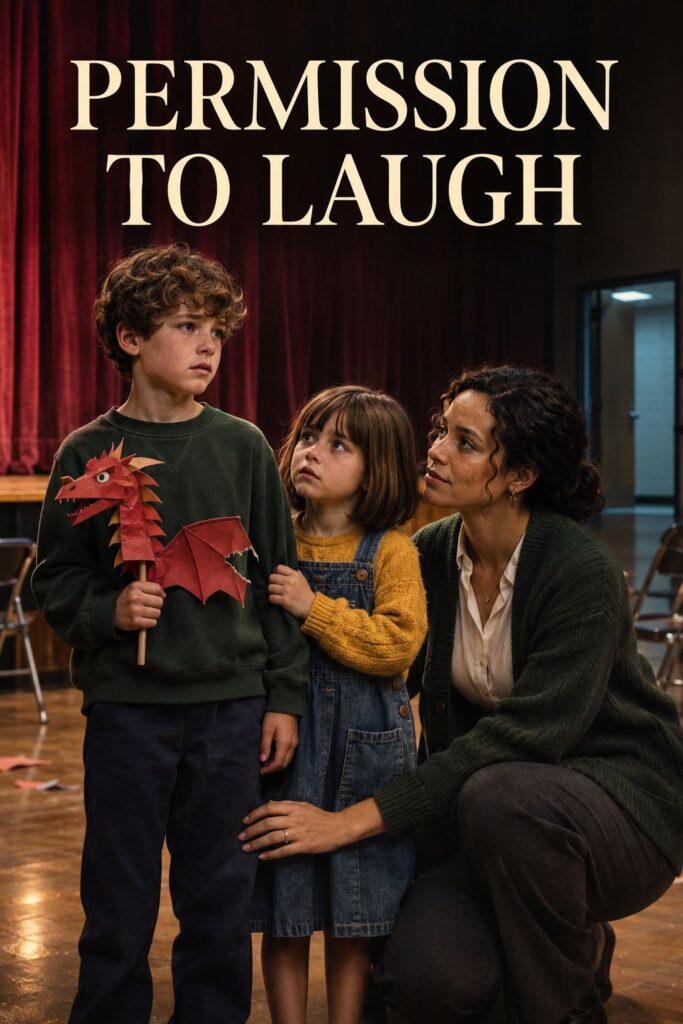
Diane Reed slapped the housekeeper hard enough to knock the paper dragon out of her hands.
The sound cut through the school cafeteria. A dozen conversations stopped. The dragon struck the polished floor, and one red wing folded beneath a chair.
“You will not make a joke out of my son’s dead wife,” Diane said.
Nora Bell stood beside the little stage with her face turned from the blow. For a second she did not move. Then she looked down at the two children beside her, and the hand she had lifted toward her cheek fell quietly to her side.
Eight-year-old Sam Reed stepped in front of his five-year-old sister.
“It was my joke.”
His grandmother did not look at him.
“Go and sit down.”
Sam bent for the puppet. Diane caught the folded script resting on its back and pulled. The top page tore down the middle.
“I said sit down.”
“Mom did the voice wrong on purpose,” Sam said. His own voice was shaking now. “That’s what was funny.”
Owen Reed heard that sentence from the cafeteria doorway.
He had arrived eleven minutes late, wearing his warehouse jacket over the clean shirt he had changed into in his truck. He still held the folded program the woman at the entrance had given him. Across its front, children had printed FAMILY STORIES NIGHT in uneven letters.
He had expected construction-paper trees, microphones that squealed, and the familiar guilt of finding his children already watching for him. He had not expected his mother standing over Nora with a torn page in her fist.
He crossed the room before Diane could speak again.
“Step back.”
“Owen, you don’t understand what she’s been—”
“Step away from them.”
He did not raise his voice. Perhaps that was why she finally heard him. Diane moved back half a pace, her burgundy jacket brushing the edge of the refreshments table.
Nora crouched beside Poppy. “Are you hurt?”
Poppy shook her head. Her small fist had caught a handful of Nora’s green cardigan and would not release it.
“Ms. Bell,” someone said, “come over here with me.”
It was Sam’s teacher, Mrs. Flores. She placed herself between Diane and the children, then asked another staff member to bring the principal. Nobody applauded. Nobody began filming a triumphant confrontation. A father near the back lowered his phone when Mrs. Flores asked for privacy.
Owen knelt beside Sam. A strip of red paper lay across the boy’s shoe.
“Tell me what happened.”
“We weren’t laughing because she died.”
The words hit him so strangely that he needed a moment to answer.
“I didn’t think you were.”
Sam looked past him toward Diane.
“Grandma said you would.”
Behind Owen, his mother made a small, impatient sound. “This is exactly the sort of confusion I’ve been trying to prevent.”
Mrs. Flores turned. “Mrs. Reed, please come with Mr. Hanley. We’ll speak separately.”
Diane looked at Owen, waiting for him to object to the separation. He stayed on his knees beside his son.
Only then did she follow the principal into the corridor.
Nora gently loosened Poppy’s fingers from her cardigan, one at a time. There was a red mark across her cheek. Owen looked at it and felt a cold, simple certainty settle beneath his confusion.
“She had no right to do that,” he said.
Nora nodded once. “The children need somewhere quiet.”
Mrs. Flores took them into an empty classroom. She brought water and a box of crayons, although nobody used either at first. Through the closed door came the cautious sound of chairs moving as the school tried to let the other families continue their evening.
Nora sat near the door. Sam kept the damaged dragon in his lap. Poppy climbed into Owen’s arms and tucked her face into his neck with the urgency of someone trying to disappear inside a familiar place.
“Did Grandma hit you before?” Owen asked Nora quietly.
“No.”
“Has she threatened you?”
Nora glanced at the children. “We should have that conversation without them.”
He accepted the correction. It was the first useful thing he managed that evening.
For fourteen months, people had called him a good father because his children arrived at school in clean clothes. Because the bills were paid. Because after Beth died, he had kept the house and his job and most of his promises about practical things.
His mother had made much of that possible. She lived twelve minutes away. She knew which lunch containers leaked, which child disliked peas, and how to order replacement furnace filters without asking him six questions. When he had been unable to face a room, she had entered it. When he had forgotten an appointment, she had remembered.
He had mistaken that competence for an answer to everything else.
Nora had joined them only three weeks earlier. Four afternoons a week, she picked up the children, helped with snacks and ordinary homework, and kept the downstairs rooms from disappearing beneath laundry. She wore her own clothes, brought her lunch in a dented metal tin, and left at six. Owen had met her twice before she started and approved the schedule himself.
There had been no mysterious history with Beth. No miraculous skill he had hired because he knew his children needed it. Mrs. Flores had recommended a reliable person looking for additional afternoon work, and he had been relieved to solve another problem.
Now his daughter was clinging to him as if the solution had been the only person keeping something precious from being taken away.
Sam pushed the torn script toward him.
“We can do the other one.”
“What other one?”
“The nice one.”
Owen unfolded the page. Across the top, in thick pencil, Sam had written THE DRAGON WHO BURNED THE PANCAKES. Below it was a drawing of a round dragon wearing boots much too small for its feet.
He remembered those boots.
Beth had bought a pair of yellow rain boots for Sam when he was three. He had refused to take them off, even for bed. She had made up a dragon who stole them and discovered that breathing fire was a terrible way to cook breakfast. The dragon’s voice had been absurdly high. Half the time Beth had forgotten it and started speaking like a tired bus driver instead.
Owen had laughed until coffee came out of his nose.
He looked at his son.
“I know this story.”
Sam’s mouth tightened. “I know.”
The torn page ended halfway through a sentence. Owen could make out the beginning: Then the king came home and—
Something beneath that line had been erased so hard the paper had thinned.
“What happens there?” he asked.
Sam took the page back.
“We didn’t get that far.”
Mrs. Flores quietly offered to stay with the children while Owen spoke with Nora in the adjoining coat area. He asked Sam first. The boy looked toward the connecting doorway, checked that it would remain open, and nodded.
Nora stood with her arms folded loosely across her middle. She looked more tired than frightened now. Owen realized she had probably been holding herself together for the children’s sake since the cafeteria.
“I’m sorry,” he said. “For what she did. And for arriving late.”
“Those are different things.”
“I know.”
She studied him, deciding whether he meant it.
“Sam asked to tell a story about his mother,” she said. “Not a speech about losing her. Something he remembered doing with her. Poppy wanted to be the dragon. They made the puppet after homework. I helped with the scissors and the tape.”
“My mother said you were teaching them something cruel.”
“Your mother wanted a different reading.”
“Did you know she’d object like that?”
“I knew she disliked it. I didn’t know she would hit me.”
He heard the danger in his own question. As if Nora should have anticipated violence and worked around it better.
“That’s not your responsibility,” he said.
She let out a breath. “I sent you the plan on Monday. You replied with a thumbs-up. I understood that to mean you had read it.”
Owen took out his phone.
The message was there. A photograph of the dragon, a brief explanation of the story, the time of the event. His own yellow thumb beneath it. He remembered answering while a delivery driver waited for him to sign a damaged-pallet report.
He had approved something he had not bothered to understand.
“I should have read it.”
“Yes,” Nora said.
She did not soften the word for him. He was grateful for that later.
The principal came to the outer doorway. He asked Nora whether she wanted assistance contacting the police or seeking medical attention. She said she wanted a few minutes to decide, and he gave her those minutes. Owen did not offer to make the decision for her. He gave Mr. Hanley his number and agreed to provide what he had actually witnessed, which began after the slap.
Diane was waiting in the corridor with her handbag pressed against her chest.
“We need to take the children home,” she said. “This has become embarrassing enough.”
“I’m taking them home.”
“I’ll follow you.”
“Not tonight.”
She stared at him.
“You are going to shut me out because a woman you’ve known three weeks has filled their heads with—”
“You hit her.”
“She was encouraging them to mock their mother.”
“Tell me the joke.”
Diane blinked. “What?”
“The one that made you hit her. Tell me exactly what it was.”
His mother glanced at the classroom door. For the first time that evening, she seemed unsure where to put her hands.
“It was the tone,” she said.
“Then we’ll talk about the tone tomorrow. You aren’t coming to the house tonight.”
He returned to the classroom before the conversation could become a negotiation conducted through the children’s frightened faces.
Nora had found the dragon’s missing wing. She placed it beside Sam without making a show of repairing it. “You can decide what to do with it later.”
“Will you come Monday?” Poppy asked.
Nora’s eyes moved briefly to Owen.
“Your dad and I have some grown-up things to work out first,” she said. “You haven’t done anything wrong.”
“We can be quiet,” Poppy offered.
Owen felt his daughter’s words more sharply than anything Diane had said.
Nora shook her head. “You don’t have to fix this.”
Outside, the air smelled of damp leaves and the exhaust from cars warming in the parking lot. Owen strapped Poppy into her seat. Sam stood beside the open back door, the puppet tucked under one arm and the torn page under the other.
Sam stood outside the car even after Owen moved aside to let him in. Across the parking lot, a classmate was showing his father a painted volcano. The man bent to inspect it, solemnly asked whether the family dog should be evacuated, and made the boy howl with laughter.
Sam watched for a moment before looking down at his own puppet.
Owen wanted to gather him up, to make the evening a single terrible incident that could be repaired by one firm decision. But his son’s watchful stillness had begun before tonight. He could see that now. It had been there at breakfast, at birthdays, in the little pause before answering questions about school.
He had called Sam mature.
He had even been proud of how little the boy asked of him.
“I’m not going back to work tonight,” he said.
Sam’s fingers tightened around the paper.
“There’s something you need to finish?”
“No. I mean I’m staying with you.”
“Okay.”
It was a cautious answer. Owen would have to learn to hear those answers without treating them as reassurance. A child could say okay simply because he did not know which other word an adult wanted.
He opened his own jacket and draped it around Sam’s shoulders. The boy accepted it without letting go of the dragon.
“What did you mean about the nice story?” Owen asked.
Sam looked at the brightly lit school windows. Inside, another family’s laughter rose and fell.
“The one where Mom was always brave,” he said. “And nobody gets silly.”
“Your mom was brave. She was silly too.”
“Are we allowed to say both?”
Owen crouched beside the car. “Yes.”
Sam did not look relieved.
“Then why did Grandma cross the funny parts out?”
He opened the script to show a second sheet, still intact beneath the tear. Several lines had been covered in heavy black strokes. A different handwriting filled the margins with neat replacements.
At the bottom, in Sam’s small pencil letters, was a question no adult had answered.
Which part of Mom do I have to forget?