Chapter 7 – The Daughter Who Finally Spoke
Brielle was sixteen, old enough to understand that grown-ups could lie and young enough to keep hoping they would stop. She stared at the photograph on Renee’s laptop and tried to make sense of it. The girl in the old record had dark eyes and braided hair, but she was not Brielle. The hospital name matched the place where Brielle had been born. The date, however, was wrong by nearly two years.
Brielle asked Renee whether she could write down what she wanted to say before speaking to anyone else. Renee handed her a plain notebook and told her she could use it however she liked. “You don’t have to write a speech,” she said. “You can write questions. You can write what you’re afraid of. And you can leave pages blank.” Brielle carried the notebook to Lorraine’s porch, where the afternoon sun fell across the wooden steps. She wrote three sentences and crossed out two. The one she kept was: I want the adults to stop deciding what I remember.
She had spent so much time watching her parents’ faces that she had forgotten what her own feelings sounded like. When Tasha looked wounded, Brielle wanted to comfort her. When Derek sounded lonely, she wanted to reassure him. Even Renee’s careful questions made her want to produce the perfect answer. She understood now that the truth could disappoint people without becoming less true. She wrote about the blue folder, the locked office, and the nights she waited for her mother’s call. She also wrote about her father’s pancakes and the way he sat through her terrible middle-school orchestra concert without once looking at his phone.
That evening Derek asked to speak with her through an arrangement Renee had discussed with the family. Brielle agreed to a short conversation with Lorraine nearby. Derek arrived without his briefcase. He looked at the notebook in her lap. “Are you writing about me?” he asked. “I’m writing about me,” she answered. The words surprised them both. Derek sat in the chair across from her. “I know I’ve made mistakes.” Brielle held up a hand. “Please don’t start with that. I need to ask you something first.” He nodded.
“When you told me Mom didn’t want to see me, did you know it wasn’t true?” Derek’s face tightened. “I thought she was making things harder.” “That’s not what I asked.” He looked down. “I knew she was trying to contact you.” Brielle felt a sharp, cold sadness. “Then you let me think she wasn’t.” Derek started to explain the arguments, the lawyers, the late-night calls. Brielle shook her head. “You can tell me why later. Right now I need you to admit what happened.” After a long silence, he did. “I let you believe something that wasn’t true.” Her eyes filled, but she did not look away.
Lorraine listened from the doorway, fighting the instinct to step in. She had spent years protecting people with advice they had not asked for. Watching Brielle speak for herself required a different kind of love. When Derek began to cry, Lorraine felt sympathy for him, but she did not allow that sympathy to pull attention away from the girl. Brielle offered him a tissue and said, “I don’t want you to be hurt. I just need you to hear me.” Derek accepted it without asking her to make him feel better.
Later, Brielle called her friend Harper. They talked about school, a chemistry assignment, and a ridiculous video from the marching-band rehearsal. For ten minutes, Brielle laughed without thinking about court papers. When Harper asked whether things were getting better, Brielle considered the question. “They’re getting more honest,” she said. “I think that’s different.” Harper agreed. “Maybe better starts there.” Brielle liked that answer because it did not promise an easy ending.
Before going to sleep, she opened the notebook again. Under the first sentence she added another: I can love my family without carrying their secrets. She looked at the words for a long time. Tomorrow might bring another hearing, another document, another terrible surprise. But the page belonged to her. No one could tell her what to put on it unless she let them.
‘Is that supposed to be me?’ she asked.
Renee closed the laptop halfway. ‘We don’t know what this record represents. It could be misfiled or altered. We will verify it before drawing conclusions.’
Brielle nodded, then surprised them both. ‘I don’t want to hear about it from people whispering in the next room. If it’s about me, tell me what you actually know.’
Tasha felt ashamed. She had been trying to shield her daughter from fear, but silence had begun to look too much like the secrecy that started the whole crisis. She pulled up a chair. ‘We know someone sent us a document. We don’t know whether it’s real. We know your dad tried to arrange a move without being honest with us. That’s what we can say today.’
‘And what are you afraid of?’ Brielle asked.
Tasha took a long breath. ‘That someone used you to hurt your father. That your father let them. And that I’ve spent so much time fighting him that I haven’t asked what you need.’
Brielle reached for her hand. ‘I need you to stop deciding things without me.’
At school Brielle began writing down her own account. Not the polished statement her father’s attorney had suggested, and not the angry version Tasha might have wanted. She wrote about the blue folder, the charging station, the nights she had cried because she believed her mother stopped loving her. She also wrote about good memories with Derek: teaching her to drive in an empty parking lot, cooking terrible pancakes, sitting beside her after she failed a math quiz.
Her counselor, Ms. Alvarez, read the pages with Brielle’s permission. ‘This is your voice,’ she said. ‘You don’t have to make either parent into a monster to describe what happened.’
Brielle reread that sentence on the bus home. She had spent months believing that loving one parent meant betraying the other. For the first time she could imagine another possibility: telling the truth, even if both of them hated hearing it.
Derek met with Martin Vale and admitted that the relocation packet had not been presented to Brielle accurately. Martin’s expression hardened. ‘I cannot defend a statement you now tell me is false. We need to correct the record.’
At school, Brielle’s English teacher asked the class to write about a moment when someone changed their mind. Brielle wrote about herself. She had changed her mind about what courage looked like. It was not always shouting in a hallway or producing a shocking piece of paper. Sometimes it was saying, “I don’t remember,” when everyone wanted certainty. Sometimes it was telling a parent, “I love you, but I’m not ready.” She turned in the assignment without showing it to either parent. The words belonged to her first.
Derek nodded. ‘Will I lose her?’
‘You may face serious consequences. What happens next depends on the facts and on Brielle’s welfare. But continuing to conceal this will not help.’
For once Derek did not argue.
Camille, meanwhile, found a former employee of Evelyn’s placement program. His name was Paul Denning, and he lived in a small coastal town. He agreed to speak only after Camille explained that a teenager was being pulled into an old dispute. Paul remembered a case involving a young mother who had sought protection from an abusive relative. He remembered Derek signing a backdated form, and Evelyn taking the file away. He did not remember Brielle.
‘Then why would Evelyn have a record with her name?’ Camille asked.
Paul was quiet. ‘Because Evelyn used to recycle identities in her paperwork. Names, dates, addresses. She called them placeholders. I left when I realized what that meant.’
Camille took notes, her stomach turning. ‘Do you have proof?’
‘I kept one box. I never opened it again.’
He promised to look.
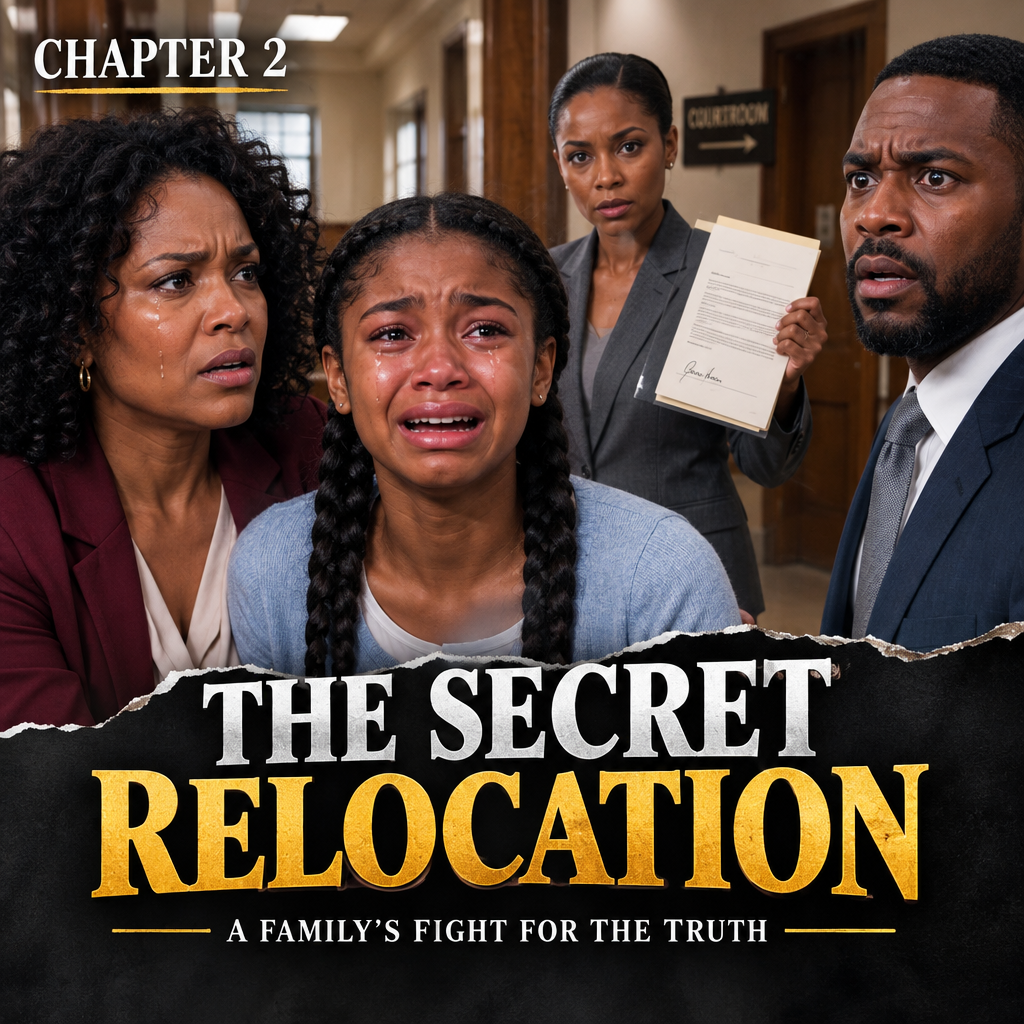
The next morning Brielle prepared to speak with the court-appointed professional responsible for gathering her views. She wore her light-blue cardigan because it made her feel like herself. Tasha waited outside the room, resisting the urge to coach her. Derek sat on the opposite bench, hands clasped. Neither parent spoke.
Before going in, Brielle stopped between them. ‘I love you both,’ she said. ‘But I’m not going to say what either of you wants. I’m going to say what happened.’
Tasha’s eyes filled with tears. Derek nodded without looking up.
Brielle went inside and told her story. She described the papers, the messages, the fear, and the love she still felt for her father. When asked what she wanted, she said she needed a stable home, honest communication, and time to rebuild trust without pressure.
Afterward she walked out exhausted but relieved. Tasha stood to embrace her. Brielle hugged her, then crossed the hallway and hugged Derek too. He began crying against her shoulder.
‘I’m sorry,’ he whispered.
‘I know,’ she said. ‘But sorry isn’t the same as fixed.’
That evening Paul called Camille. He had found the box. Inside was a list of names used in Evelyn’s old relocation files, including a version of Brielle’s name entered years before she was born.
Camille stared at the photograph Paul sent. At the bottom of the page was a second signature beside Derek’s.
It belonged to Tasha Morgan.