Chapter 10 – A Wedding With No Bride
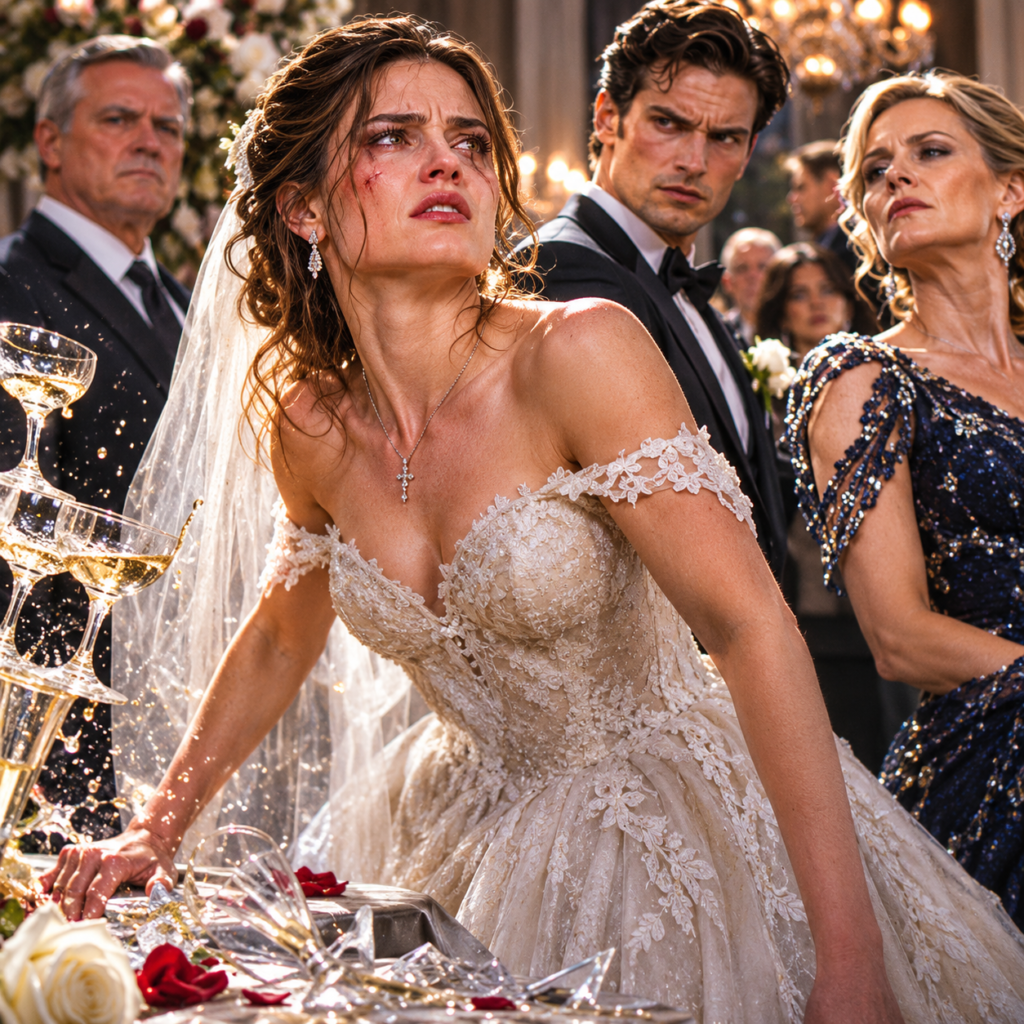
Fourteen months after the wedding, Nora Vale returned to the Glencove Conservatory.
She arrived in a dark coat and flat shoes, carrying a folder beneath one arm.
The building looked smaller than it had on the day of the disaster.
The orchids were gone.
The shattered champagne tower had been replaced by a plain reception desk, and the staff moved around the lobby with the ordinary efficiency of people who had hosted hundreds of events since one particular afternoon changed everything.
Nora had not come to see Grant.
The conservatory’s management had invited her to inspect a proposed renovation after a public dispute about emergency exits.
She had agreed because she was a structural engineer who knew what locked doors could cost, and because she was tired of allowing the place where she had been humiliated to own a piece of her life.
She stood in the empty ballroom while a facilities supervisor explained the new evacuation routes and showed her the independent inspection reports.
“You know what happened here,” he said awkwardly.
“I do.”
“We should have handled the security response differently.”
“You should have asked why your guards were touching somebody who hadn’t committed a crime.”
He looked ashamed.
Nora was not there to offer absolution in exchange for discomfort.
She took notes, checked the plans, and recommended two changes to the way the side doors were marked.
Work was work, even in a room full of ghosts.
Outside, the shoreline glittered beneath a pale spring sun.
Nora stood by the same service courtyard where an SUV had tried to strike her.
A planter had been replaced.
The catering entrance had been repainted.
There was no visible trace of the night that lived in her memory.
For a moment she felt angry about that.
Then she realized that a place did not owe her a permanent scar.
She had enough scars of her own.
The legal cases had moved slowly and unevenly, as Elena had predicted.
The court had accepted the authenticity of the old partnership agreement and had ruled that the disputed trust amendment could not be relied upon to extinguish Nora’s inherited interest.
Additional proceedings established the scope of that interest and blocked the earlier redevelopment transfer.
The family-owned company had been required to negotiate with the valid trust representatives rather than pretend Nora had never existed.
The criminal investigations were separate.
Evelyn Whitmore, Philip Voss, and Michael Sloane had been charged in connection with alleged fraud and obstruction; all disputed at least parts of the allegations.
The assaults, financial transfers, fire evidence, and witness intimidation were being handled through separate proceedings.
Nora had given statements, reviewed transcripts, and sat through days when the law appeared to move an inch while her memories moved a mile.
She had learned not to confuse a charge with a conviction, or a public apology with accountability.
The recovered Harbor House video had transformed the historical inquiry.
Experts confirmed the recording’s origin and traced the security system used at the property.
Fire investigators revised important findings about the blocked exit and the building’s occupancy, while prosecutors examined who had ordered what and when.
The record did not prove every fear Nora had ever held.
It did establish that Thomas Vale had repeatedly tried to reopen the emergency route and had helped people escape when the building caught fire.
The revised report mattered more to Nora than any headline about the Whitmore family.
For years she had watched people describe her father as careless.
Now an official document acknowledged the specific danger he had warned about.
It could not give him another day.
But it restored a truth she had needed since she was thirteen: he had not ignored the door.
He had fought to open it.
Grant had resigned from his executive role and provided documents to investigators under advice of counsel.
His own actions remained subject to scrutiny.
He sent Nora three letters over the year.
She read the first with Elena present, left the second unopened for months, and finally returned the third.
None of them asked her to forgive him.
That was perhaps the most honest thing he could still offer.
The first letter admitted he had approved a transfer that was later used to accuse her.
It admitted he had ignored her objections to the prenuptial language, participated in the staged wedding confrontation, and prioritized his standing in the family above her reputation.
He wrote that he had told himself these decisions were small because he expected the outcome to be temporary.
The words made Nora angrier than an elaborate excuse would have.
He had thought the destruction of her name was a temporary inconvenience.
She never replied.
Serena, who had cooperated with the investigation, met Nora once in a public café.
She did not wear red.
Her hair was tied back, and she looked younger without the certainty she had carried at the wedding.
She apologized for helping stage the confrontation, for allowing the reenactment footage to be used as authentic evidence, and for hoping that Nora would simply vanish from the company story.
“I thought I was protecting my career,” Serena said. “Then I realized I was helping people who would sacrifice anybody.”
Nora stirred her coffee. “You knew about Grant and me.”
“I did.”
“You knew I was planning a marriage. You let me stand up there.”
Serena looked down. “Yes.”
“I can’t make that better for you.”
“I know. I didn’t come for that. I wanted to say it without hiding behind a lawyer.”
Nora appreciated the direct answer.
She did not feel friendship or forgiveness.
She felt the strange relief of hearing the truth from someone who had finally stopped decorating it.
They finished their coffees and left by separate doors.
Mara’s reporting won a regional investigative journalism award.
At the ceremony she thanked the sources who had risked their safety to bring documents into the light, then added that a viral clip was often the least reliable version of a person’s life.
She said she hoped people would remember that before sharing the next stranger’s worst moment as entertainment.
Nora sat in the audience with Ruth and laughed when Mara nearly forgot to thank her editor.
Adrian moved into a small apartment near the coast.
He had grown slower over the year, but he still insisted on walking to the harbor every morning.
Sometimes Nora joined him.
They did not speak about the fire every time.
They discussed coffee, gulls, the strange price of parking, and whether the city had chosen the correct material for its newest retaining wall.
The ordinary conversations were their own form of recovery.
One afternoon Adrian stopped beside a bench and told Nora he wished he had delivered Thomas’s letter twenty years earlier.
“You were afraid,” Nora said.
“I was.”
“I wish you hadn’t been.”
“So do I.”
She considered the distance between an apology and the years it could not restore. “But you told me now. You stayed. And you helped me find the truth.”
Adrian nodded, his eyes bright, and they continued walking.
Forgiveness did not need to erase the mistake to be real.
Sometimes it simply meant that a person was allowed to walk beside you while remembering what happened.
The money was the part that confused strangers most.
Nora’s claim to the Harbor House interest meant she could have pursued a lucrative private arrangement.
Developers approached her with offers wrapped in carefully chosen compliments.
One proposed a luxury residence bearing her father’s name.
Another offered a generous payment if she would approve the existing project unchanged.
A third suggested that a charitable foundation might benefit from a decorative memorial plaque and a private event space.
They all assumed she wanted to win by becoming the person Evelyn had pretended to be: someone whose success was measured by how many doors could be closed to everyone else.
Nora worked with the trust’s other representatives, independent planners, and the city to negotiate a different redevelopment arrangement.
It was neither simple nor purely charitable.
The existing company retained portions of the project under new oversight and financial terms.
The disputed parcel was restructured to preserve a public walkway, community access to the harbor, and safety standards independently reviewed and enforced.
A victims’ memorial fund was established with clear governance rather than a family name on every page.
Nora insisted that the east walkway have two accessible exits, visible from the main path, with no locked gate blocking public evacuation during operating hours.
She asked that the plans be published for community review.
She did not demand statues of her father.
She demanded doors that worked.
The first public meeting was difficult.
Residents were skeptical of every developer who promised access.
Some remembered the original Harbor House disaster.
Others feared rents would rise and small businesses would disappear.
Nora listened to them rather than preparing a speech about her good intentions.
The city revised parts of the plan after hearing concerns about lighting, access for people with disabilities, and the risk of another private operator controlling a public route.
“You’re losing money by agreeing to these changes,” a consultant told her.
“I’m not buying a city,” Nora replied. “I’m trying to leave a place where people can get home safely.”
The consultant shook his head, but he revised the plans.
Nora had discovered that refusing to become powerful in the old way did not mean refusing power altogether.
It meant deciding exactly what the power was for.
The day before the walkway opened, Ruth brought her a small velvet box.
Inside lay the silver locket that the guard had tried to remove at the wedding.
Elena had kept it with other documented personal effects until the legal team confirmed it no longer needed to be held for evidence.
The clasp had been repaired by an independent jeweler.
The scratch along its edge remained.
“I thought you might want this tomorrow,” Ruth said.
Nora opened the locket.
Inside was a tiny photograph of Thomas standing beside her on the beach, both wearing ridiculous paper hats.
She laughed when she saw the crooked angle of the picture.
Her father had always hated being photographed, and in that moment he was laughing harder than anyone.
“I used to think this was the last thing I had of him,” Nora said.
“You had his whole way of seeing the world. You just didn’t know how much.”
Nora put the locket around her neck.
It lay against the same place where a guard’s fingers had once bruised her skin.
The metal felt cool and familiar, but it no longer felt like an object she had to defend from everyone.
It was hers.
That should never have been a question.
On the morning of the opening, the sky was clear.
A crowd gathered along the harbor promenade, not nearly as formal as the wedding guests and much more alive.
Children chased each other under the watchful eyes of parents.
A group of retired dockworkers inspected the railing with expressions of professional skepticism.
Food trucks served coffee and sandwiches near the entrance.
A local band tuned instruments beside a temporary stage, their notes floating over the water.
Nora wore navy trousers, a white shirt, and the repaired locket.
Mara held a camera but promised not to point it at Nora during the first ten minutes.
Ruth carried a folding chair.
Adrian wore his best jacket, which had a stubborn crease down one sleeve.
Elena arrived late because a judge had kept her waiting on another case, and everyone cheered as though she were a celebrity.
The mayor offered Nora the ceremonial ribbon-cutting scissors.
She declined the grand gesture and asked that the first crossing belong to the families of the people who died in the fire.
They walked together from the city side to the harbor side, some holding photographs, others simply holding hands.
Nora stood near the edge and watched them pass.
She had imagined this moment hundreds of times, and none of those imagined versions had prepared her for how quiet it would feel.
When the last family member reached the far end, Nora followed.
Her shoes made a soft sound against the new deck.
She could see the water through the gaps beyond the railing, the old harbor buildings, and the place where Harbor House had stood.
The memorial plaque was simple.
It named every victim without placing the Whitmores above them.
Beside Thomas Vale’s name, it included a brief line about his efforts to help people escape.
Nora read it once and found that she did not need to read it twice.
Mara joined her near the eastern exit.
“Remember when you told me you thought Grant loved you?” she asked.
Nora gave a small embarrassed smile. “That was a very expensive misunderstanding.”
“I was wrong about something too.”
“What?”
“I thought you needed me to get you out of that wedding. But you were already getting yourself out.”
Nora looked at the crowd. “I needed you. I needed all of you. That’s not a weakness.”
Mara set down her camera and hugged her.
For a few minutes they watched the water, letting the celebration move around them without needing to explain what it meant.
Later, Nora gave a short speech.
She did not mention Grant or Evelyn.
Their choices had shaped the struggle, but they would not own the ending.
She spoke about public spaces, responsible engineering, and the people whose lives had been changed by one blocked exit.
She thanked the investigators, the witnesses, the legal team, and every family that had insisted their loved ones were more than numbers in a report.
“My father believed a building should make people safer,” she said. “Today we get to keep that promise, not because one person won, but because enough people refused to look away.”
The applause rose gently, then gathered strength.
Nora stepped down before she began to cry.
She had spent too many years crying in rooms where someone else controlled the doors.
Today she could leave whenever she wanted, and she had nowhere else she needed to be.
That evening, after the crowd thinned, Grant appeared at the public entrance.
He stood beyond the plaque with his hands in his coat pockets.
Nora saw him before he approached.
He looked at the open walkway, the families talking near the benches, and the harbor lights turning gold above the water.
“It’s beautiful,” he said from a respectful distance.
“It’s open,” Nora answered. “That’s what matters.”
He nodded.
He did not ask for forgiveness, an explanation, or another chance.
He said he hoped the remaining court proceedings would bring answers to the families.
Nora said she hoped the same.
After a moment he turned and walked away.
She watched him go without feeling that any part of her future had left with him.
The next morning there would be bills, legal correspondence, design meetings, and ordinary frustrations.
The cases had not made the world perfect.
People could still lie.
Buildings could still fail.
Powerful families could still try to bend the rules.
But Nora no longer believed that one family’s version of events had to be the one everyone accepted.
She stayed until the last light faded.
Wind passed through the railings, carrying the smell of salt and new timber.
At the east end of the path, a mother and her daughter approached the exit together.
The daughter ran ahead, reached the door, and pushed the release bar with one small hand.
It swung outward easily.
Nora looked at the open passage and thought of Thomas carrying her through smoke, then returning for strangers.
She thought of the blue notebook, the letters, the hard work of people who had kept asking questions when silence would have been easier.
She touched the silver locket once, then let her hand fall.
For the first time in twenty years, the east door opened from the inside.