Chapter 7 – The Man Behind the Medication
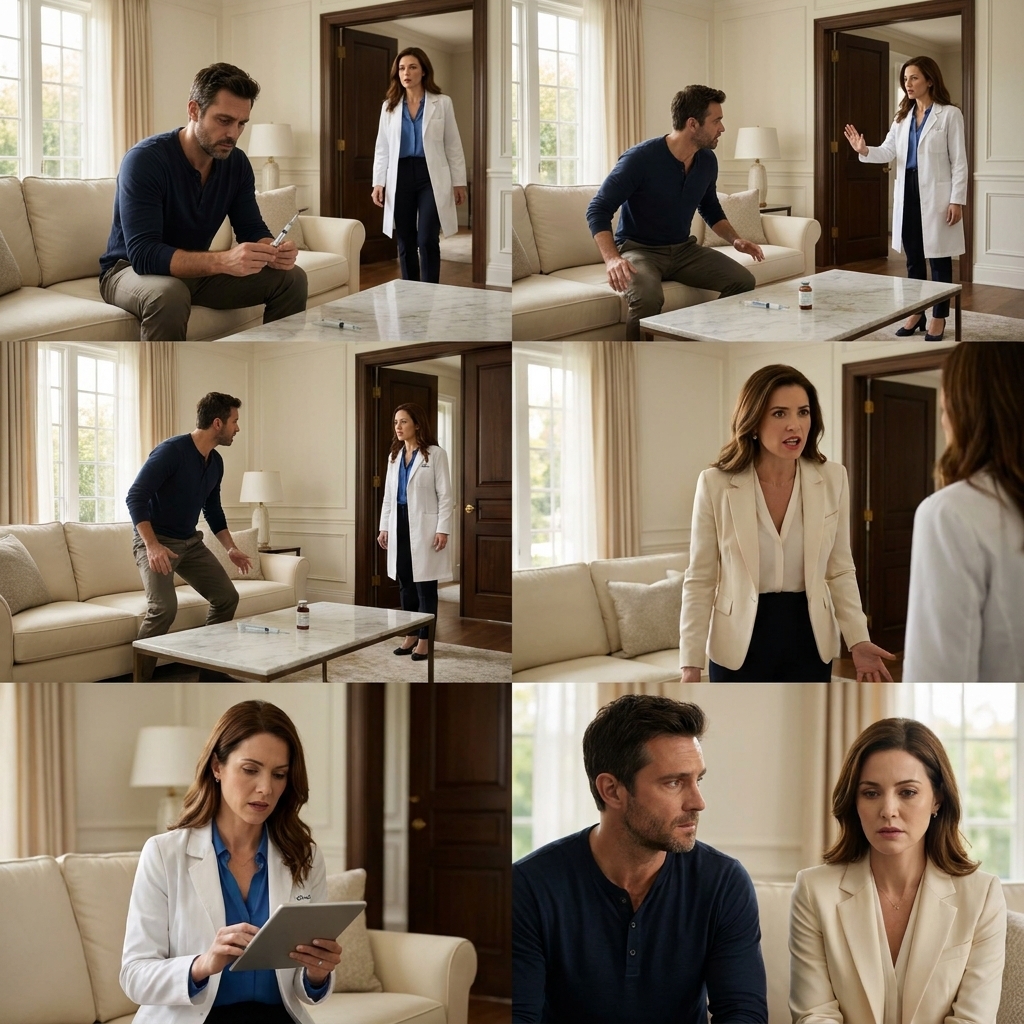
Martin Keene arrived at the hospital wearing a charcoal coat and carrying a lawyer’s card. He had not been summoned by police. The compliance office had invited Meridian Patient Support to explain why its systems contained portions of Ethan Reed’s protected medical record. Keene accepted the invitation only after his lawyer confirmed that the meeting would be documented.
Lena Morales attended as the patient advocate. An investigator named Paul Mercer led the questions. Keene began with a prepared statement about continuity of care and patient support. He described Meridian as a service that helped families navigate difficult treatment transitions.
“Did Meridian have Ethan Reed’s authorization to receive his medical information?” Mercer asked.
Keene produced a scanned consent form. It bore Ethan’s disputed initials.
“We have reason to question the authenticity of that document,” Mercer said.
“Then that’s a matter for the hospital,” Keene replied. “We relied on what was provided.”
“Who provided it?”
“I don’t recall.”
Mercer placed a dated email on the table. It showed the form being sent from an account assigned to Hale’s research office. Keene looked at the document without reaching for it.
“I would need to review our records,” he said.
Across town, Ethan and Sophia were meeting David Sloane to discuss the forged signature. David warned them not to treat the hospital investigation as a substitute for independent legal advice. He also urged Ethan to focus on what could be proved.
“A forged form is serious,” David said. “An unauthorized record transfer is serious. Neither tells us automatically what was in the vial or why it reached your house.”
Ethan rubbed his temples. “I keep wanting one answer that explains everything.”
“Most complicated cases have several answers,” David said. “Some are mistakes. Some are decisions. Some are people trying to hide the first two.”
Sophia unfolded a copy of the Meridian contract. She pointed to a clause that allowed the company to coordinate medication access through third-party providers. David examined it carefully.
“This is broad language,” he said. “It doesn’t give anyone permission to misrepresent a prescription. We’ll need the underlying transactions.”
Ethan asked Sophia whether Keene had ever delivered medication personally. She hesitated.
“Once,” she said. “He left a package at the gate. He said it was an emergency bridge supply.”
“Did it have my name on it?”
“It had a label. I didn’t check the details.”
Ethan closed his eyes. He remembered finding the package in the kitchen and assuming Sophia had arranged a legitimate refill. He had not asked questions because he was exhausted and grateful. He had been responsible for asking what he took, but he had also trusted a system that appeared to speak with medical authority.
“I should have checked,” he said.
“So should I,” Sophia replied.
They did not argue about whose failure mattered more. David asked them to write down exactly what each remembered, separately, before comparing accounts. Memory could change when people tried too hard to agree.
At Westbridge, Noah Kim and Dr. Miriam Cho reviewed the retired study inventory under formal authorization. The batch prefix from the vial matched a category of medication containers used during the old program, but the last characters did not match any documented dispensing event to Ethan.
“Could someone have reused an old label?” Cho asked.
“Yes. Or copied the format. We need laboratory verification of the retained sample and the supply trail. The label alone isn’t enough.”
The investigators arranged for appropriate testing and chain-of-custody documentation. Olivia received an update that the medication source remained unconfirmed. She called Ethan to explain that the uncertainty was real, not a bureaucratic excuse.
“So you still don’t know whether it was the pain medicine Sophia said it was,” Ethan replied.
“Correct. And we don’t know whether it was appropriate for you even if it was a pain medication. Those are separate questions.”
“I understand.”
He was surprised to discover that he did. The first afternoon, he had wanted Olivia to declare him innocent. Now he wanted her to be accurate.
Keene’s lawyer ended the compliance interview after Mercer asked about a payment to an individual who had witnessed Ethan’s car accident. Keene denied any improper purpose, then refused to answer further questions without reviewing the records.
When he left the building, he called Hale from the parking garage.
“They have the email,” Keene said.
Hale was silent for several seconds. “Which email?”
“The one with the consent form. And they’re asking about the driver.”
“You told me that matter was closed.”
“I told you the settlement was complete. Those aren’t the same thing.”
Hale’s voice became hard. “Do not call this number again.”
Keene stared at the phone after the call ended. He had worked for Hale for years, first as a coordinator, then as the owner of Meridian. He had convinced himself that he was helping patients who would otherwise fall through the cracks. The payments had been generous. The questions had been discouraged. He had learned not to distinguish between efficiency and concealment.
That evening a news report about hospital research oversight appeared online. It did not name Ethan. It mentioned that Westbridge was reviewing historical record-handling practices. Sophia read it at the kitchen table while Ethan prepared a simple dinner.
“People are going to guess,” she said.
“Let them guess. We know what we’re asking.”
“Your old employer might see it.”
“I left that job because I couldn’t work full days. If they call, I’ll decide what to tell them.”
Sophia watched him cut vegetables slowly, resting between movements. His hands still trembled occasionally, but he no longer tried to hide the tremor from her. She offered to finish cooking. This time he accepted.
After dinner, Ethan’s mother called to invite them to a small family gathering. Ethan declined the gathering but asked if she would come by on Sunday. He wanted to speak to her without a room full of relatives interpreting his face.
Olivia spent the evening preparing a clinical summary for Ethan’s independent pain specialist. She documented his reported symptoms, current medications, history of dependence, and the unresolved concern about unverified supplies. She avoided language that suggested guilt. The report described a person in need of care, not a scandal.
Before she sent it, her email chimed. The hospital’s compliance office had scheduled a formal interview with Hale. Grace’s incident report was now part of the inquiry. Olivia felt a surge of relief, followed by caution. A hearing was not a verdict.
In the mansion, Sophia found Ethan standing before the wedding photograph. He looked at their younger faces and smiled sadly.
“We thought we’d be brave together,” he said.
“We were brave about the wrong things,” Sophia answered. “We thought being brave meant never admitting we were scared.”
Noah Kim reviewed the inventory discrepancies with a junior pharmacist named Tessa. She asked why the old study codes mattered if the medication had already been identified. Noah explained that knowing the contents of a vial did not establish who had supplied it or whether it had been stored and handled correctly.
“So the label could be accurate and the supply still improper,” Tessa said.
“Exactly. And a label could be misleading. That’s why we need the other records.”
They compared shipping dates with the study’s closure timeline. One delivery appeared after the program had stopped enrolling patients. Tessa noticed that the receiving signature belonged to a Meridian employee rather than a hospital staff member.
“Could that be normal?” she asked.
“It depends on the agreement and the authorization. We should ask compliance, not assume.”
Noah documented the finding and sent it through the approved channel. He resisted the temptation to call Olivia with a dramatic update. She had been careful to keep clinical care separate from the investigation, and he wanted to respect that boundary.
Later Tessa asked whether the case had changed the way he thought about pharmacy work. Noah considered the question.
“Most of our job is quiet,” he said. “Checking numbers, asking why a date doesn’t fit, making sure a patient gets the right information. Nobody makes a movie about that part. But if we skip it, somebody can get hurt.”
Tessa returned to her station and checked a routine order with new attention. The Reed case had become a reminder that safety depended not on one heroic discovery but on many people being willing to notice when ordinary details failed to match. The next morning she asked a senior colleague to review an ambiguous order rather than guessing, and thanked him for explaining the discrepancy.
Ethan took her hand for the first time in days. It was not forgiveness. It was an agreement to remain in the same room while the truth was still being found.
A message arrived from David: The witness had identified Keene in a sworn statement. Ethan read it aloud. Sophia squeezed his fingers once, then released them. The story of the medicine was connected to the story of the crash, but they still did not know how. That unanswered connection would become the center of the next day’s investigation.