Chapter 8 – The Truth Buried at Midnight
The camera feed returned to show Helen seated on the dock beside a paramedic. She was shaken but unharmed. Victor lay facedown several yards away with officers securing his hands; he had reached for a phone, not a weapon, and the sudden movement had triggered the response.
Emily felt her knees weaken with relief. Sarah began crying silently, both hands pressed against her mouth. The negotiator confirmed that Victor was in custody and that the officers had recovered a small encrypted drive from his coat.
Helen had refused to leave the pier until she knew her daughters were safe. Emily watched her mother look directly into the camera, as if she understood that somewhere her children were watching. For a moment Emily saw not the woman who had signed fraudulent documents or permitted a false funeral, but the mother who had stayed awake through childhood fevers.
Then she remembered that both versions were real. Love did not erase responsibility. The next morning Helen gave a formal statement with her attorney present.
She described how Richard had used her original misconduct to blackmail her, and how Victor had enforced the threats. She admitted that fear of disgrace had led her to betray the trust of her daughters. She also identified the blue metal box from their father’s study as the place where she had hidden copies of correspondence before Richard took control of the foundation.
The box had remained in a storage unit under her maiden name. Investigators obtained it through the proper process. Inside were handwritten ledgers, bank letters, and a notebook in their father’s careful script.
Emily held the notebook only after it had been documented and copied. She recognized the way he crossed his sevens, a small ordinary detail that made her ache.
The notebook told a story less simple than Richard’s threats or Sarah’s suspicions. Their father had approved early transfers while trying to keep the family foundation solvent, believing the money would be repaid. When he discovered that the accounts were being used for unauthorized payments, he demanded an audit.
His health declined before he could complete it. He had recorded concerns about Helen’s judgment and Richard’s influence, but there was no evidence in the recovered materials that his medication had been deliberately altered. A medical review later found no substantiated basis for that accusation.
Emily was grateful the investigators had insisted on evidence rather than rumor. She could mourn her father without inventing a murder to explain his death. The blue box also contained letters from Helen, written but never mailed, describing her fear that Richard would expose the family’s financial failures and leave her daughters penniless.
Emily read them with a mixture of pity and anger. Helen had convinced herself that protecting the family’s name was the same as protecting the family. That confusion had opened the door to every later betrayal.
Sarah sat beside Emily as they reviewed the documents. “I spent three years trying to prove Mom was a monster,” she said.
“And?”
Emily asked. Sarah looked at the letters.
“She’s a person who did terrible things and kept doing them because she couldn’t bear to admit the first one.”
Emily nodded. The explanation did not absolve Helen. It did, however, make the tragedy understandable without turning anyone into a cartoon villain.
With the archive drive, the blue box, and the witnesses’ statements, investigators built a documented case against Richard and the financial network. Victor’s seized phone provided messages showing the surveillance arrangements and threats against the sisters. Richard’s own communications linked him to the false trust and the manufactured funeral records.
The death certificate had been created through fraudulent paperwork, not a legitimate identification of remains. Authorities began the process of correcting the records and notifying the agencies involved. Sarah had to reclaim her legal identity through a series of exhausting interviews and applications.
Every form demanded proof that she was alive, an absurd burden after years spent hiding from people who knew she was. Emily accompanied her whenever permitted. Richard was arrested after investigators secured the relevant evidence, and the public allegations against Emily began to unravel under scrutiny.
The legal proceedings would take months, perhaps years. Priya warned them that testimony, document reviews, and possible civil claims lay ahead. Emily understood that the story would not end with a single courtroom speech.
Still, the central truth was no longer confined to secret rooms and frightened phone calls. Sarah was alive. The trust was fraudulent.
Richard had directed the scheme. Helen and Daniel had participated in the concealment through choices for which they would have to answer. The facts were finally strong enough to exist without anyone’s permission.
Emily walked out of Priya’s office into bright afternoon sunlight and realized she had not checked over her shoulder for several minutes.
Daniel asked Emily to meet him at a public park. She chose a bench near a busy walking path, not because she believed he would hurt her but because she wanted the conversation to belong to the present rather than the haunted rooms of their house. He arrived carrying no flowers, no gifts, and no prepared speech.
He told her he had given a complete statement about the false funeral and the evidence he had concealed. His attorneys had warned him that cooperation did not guarantee he would avoid consequences. “I know,” he said.
Emily watched a couple pass with a dog tugging at its leash. Ordinary life had continued while hers was coming apart. Daniel said he still loved her and would accept whatever she decided.
Emily believed him. She also knew love had not prevented him from lying beside her for years. “You didn’t trust me with my own grief,” she said.
“You decided I was too fragile to know my sister was alive.”
Daniel lowered his head.
“I was afraid.”
“So was I. I was afraid every day after she disappeared. But you let me think fear was all I had.”
She told him she wanted a separation and time to rebuild a life that did not depend on his explanations. Daniel did not argue. He asked whether she would ever forgive him.
Emily considered the question. “Maybe,” she said.
“But forgiveness isn’t the same as coming home.”
He nodded, and they sat for a moment in a silence that was no longer a weapon. When he left, Emily cried. She had not stopped loving him on command.
She had simply stopped letting love decide what she could tolerate.
Helen’s reckoning was slower and more painful. She cooperated with the investigation, accepted legal representation, and faced the consequences of the documents she had signed. Emily and Sarah visited her together once, in a quiet meeting room.
Helen apologized without asking them to forget what she had done. She told them she had spent years confusing shame with danger and had allowed Richard to make every decision feel impossible. “I wanted you to have a good life,” she said.
Sarah replied, “We wanted a truthful one.”
Helen nodded and began to cry. Emily did not reach across the table immediately. She let the apology stand on its own, neither accepted nor rejected.
Later, outside the building, Sarah asked whether they could ever become a family again. Emily looked at the clouds gathering over the street. “Not the family we were,” she said.
“Maybe something more honest.”
Sarah smiled sadly. The sisters began making small plans. They would take a weekend trip to the coast where they had once built their disastrous raft.
They would visit their father’s grave and bring the notebook so they could read his words together. They would have dinner without phones, passwords, or coded warnings. Emily knew those plans sounded ordinary.
That was what made them precious. For three years she had measured life in anniversaries of loss. Now she could measure it in future dates that belonged to living people.
The first dinner was awkward, full of pauses and sudden tears. It was also the first time Sarah had sat at Emily’s table without looking toward the window.
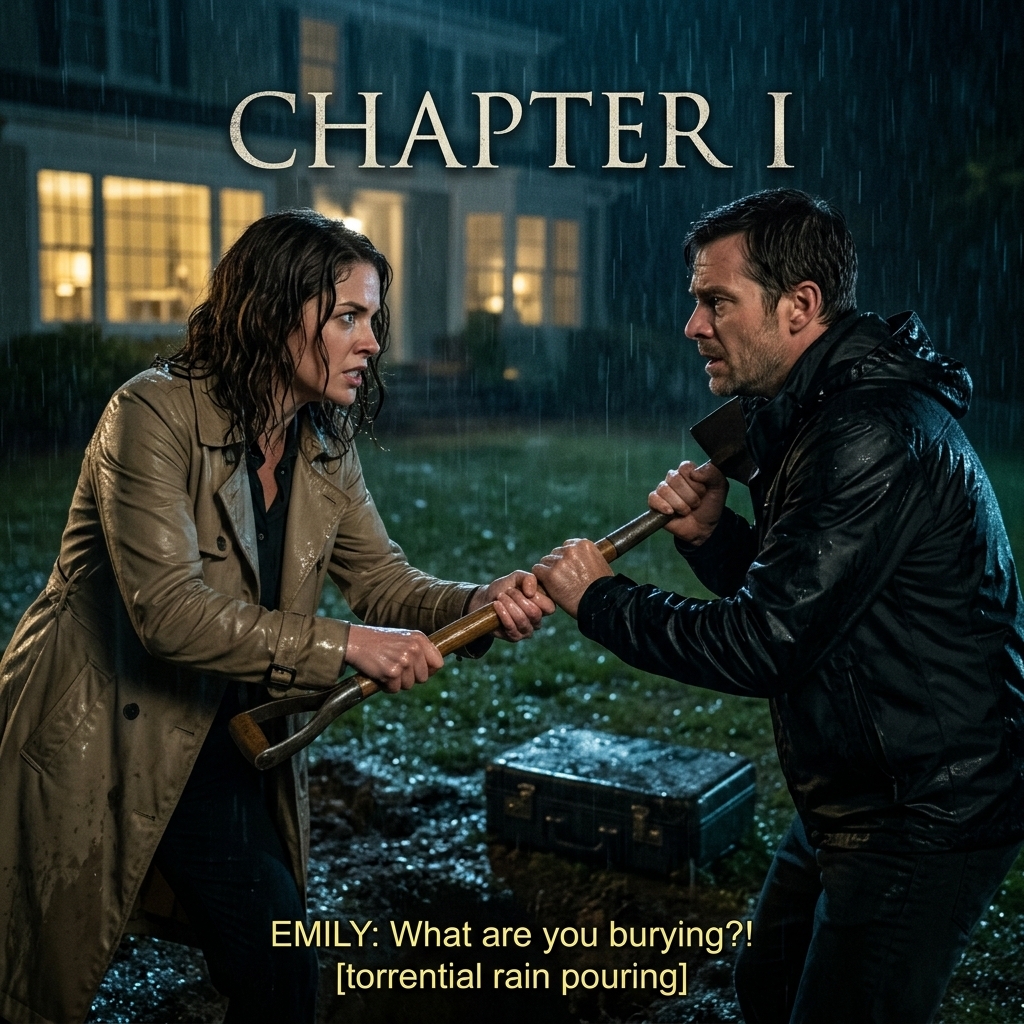
Six months after the night in the rain, Emily returned to the backyard of the Carter mansion. She had decided to sell the house. The garden had been repaired, the security system replaced, and the shallow hole filled long ago.
Yet she could still see where Daniel had knelt with the shovel, trying to bury a suitcase that contained the beginning of the truth. She stood beside the hydrangeas and remembered the first words she had shouted: What are you burying? At the time she thought she was asking about an object.
She had really been asking what their marriage, her family, and her own memories had concealed. Sarah joined her carrying two mugs of coffee. She wore a navy blouse and had cut her hair to her shoulders.
“You don’t have to sell it because of me,” she said. Emily smiled. “I’m not selling it because of you. I’m selling it because I want to choose where I live.”
They sat on the back steps, listening to birds instead of rain. Sarah asked what Emily would do next. Emily said she had accepted a position with a nonprofit that helped people recover from identity theft and financial fraud.
She wanted to turn the knowledge she had gained into something useful. Sarah planned to testify when required and eventually return to forensic accounting, though she would never again conduct an investigation alone. They made a promise to tell each other when they were afraid, rather than turn fear into a secret.
It sounded simple. They knew it would take practice. As the afternoon light moved across the lawn, Emily realized she no longer needed the mystery to define her.
The suitcase had been opened. The truth had survived. What remained was the harder, quieter work of living.