Chapter 4 – The House with No Windows
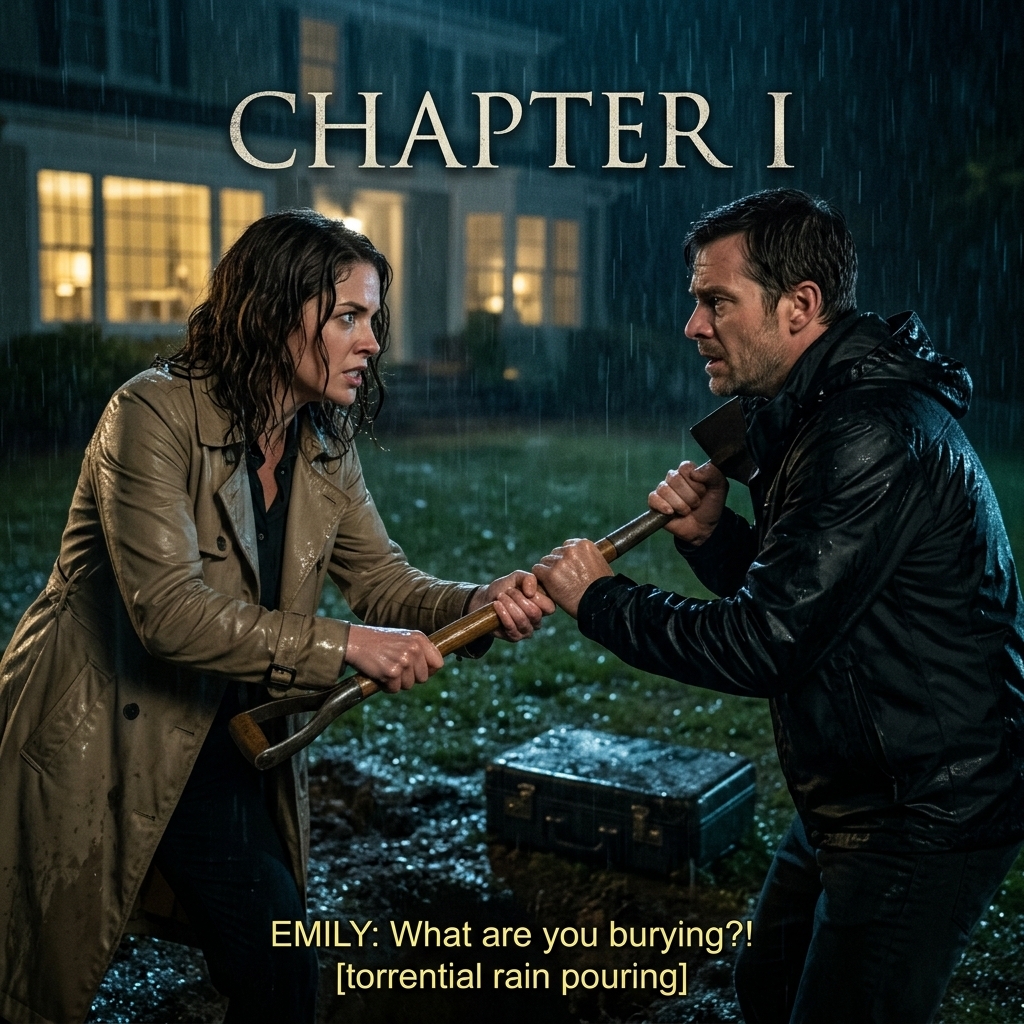
The Vermont address led to a property hidden behind a line of pines, two miles from the nearest marked road. Emily did not go alone. Nora drove an unremarkable rental car, and Priya arranged for a colleague to know their route and check in at regular intervals.
Daniel had provided statements and bank records to the investigators but was not told where Emily was going. She needed distance from him to think clearly, and she needed him to learn that help was not the same thing as control. The house was a low concrete structure built into a hillside, with a single steel door and no visible windows.
A rusted mailbox stood at the turnoff, though no postal service appeared to reach it. Nora parked where they could see the entrance and called the authorities with their location before approaching. Emily noticed a narrow groove in the dirt, as if a heavy vehicle had been dragged across the drive recently.
The steel door had no handle on the outside. Beside it, a keypad glowed green. Emily entered the date of Sarah’s birthday, then her father’s.
Neither worked. She almost laughed at the absurdity of trying family memories against a machine. Then she remembered the phrase Sarah had written in a childhood notebook: Truth first, fear second.
Sarah had used the initials TFFS as a password for everything until Emily teased her out of the habit. Four letters were too simple for this keypad, but the numeric equivalents worked. The door clicked open.
Nora looked at Emily. “She wanted you to find it,” she said. Emily felt hope and dread rise together.
A place designed to hide could also be a place designed to trap.
Inside, the air smelled of dust, disinfectant, and old paper. Emergency lights glowed along the floor. The first room contained a narrow bed, a sink, and a shelf of canned food.
A faded navy blouse hung behind the door. Emily recognized the small repair Sarah had made near the cuff with yellow thread. She touched it, remembering the afternoon they had sat together sewing buttons while their mother complained about the mess.
On the table was a paperback novel Sarah had loved, its spine cracked at the same page she always reread. Emily’s breath caught. Nora photographed everything before allowing her to move objects.
A second room held a desk, two monitors, and a wall covered in printed account charts. One diagram connected Meridian Harbor to the trust in Emily’s name. Another showed charitable grants moving through a foundation named after their father.
On the wall, Sarah had pinned a note: MONEY IS ONLY THE LEASH. FIND WHO HOLDS IT. Emily read the words aloud.
Nora explained that the transactions might be part of a larger system of coercion, not merely theft. People whose identities had been used could be threatened with prosecution unless they remained silent. Sarah had been tracing how the network created leverage over witnesses.
Emily saw photographs of strangers, some with handwritten dates beside their faces. She wondered how many lives had been rearranged without permission. In a desk drawer they found a medical bracelet from a hospital in Hartford and a receipt for antibiotics dated four months earlier.
Sarah had been here recently. She might have slept in this bed while Emily mourned her every anniversary.
A noise came from the hallway: the soft scrape of a shoe against concrete. Nora raised a hand for silence. Emily held her breath.
The door to the first room opened and a young man stepped in carrying a paper bag. He froze when he saw them. His name was Aaron Pike, and he claimed to be a caretaker hired to bring supplies once a week.
Nora kept her voice level and asked who paid him. Aaron said the money arrived in an envelope at a gas station. He had never met his employer.
He knew a woman stayed in the house sometimes but had been told not to speak to her.
“Was she here last night?”
Emily asked. Aaron glanced toward the door.
“She left before dawn yesterday.”
He described a woman with chestnut hair and a scar beneath her chin. Emily had to grip the table. Aaron said the woman had been frightened, not of him but of a visitor who arrived in a silver sedan.
She called the visitor “the collector.”
The visitor had come three times in the past month, always carrying a black briefcase. Aaron did not know his name. Nora showed him Victor Hale’s photograph.
Aaron nodded immediately.
“That’s him.”
He then pointed toward the rear corridor. “There’s another room. She said if someone came looking, I was supposed to give them this.”
He handed Emily a small brass key attached to a strip of blue ribbon. Emily recognized the ribbon from a birthday gift she had given Sarah when they were teenagers. She wanted to hug Aaron and interrogate him at the same time.
Instead she asked him to stay with Nora while she opened the door.
The rear room was lined with filing cabinets and a recording console. On the wall hung photographs of the Mitchell family at weddings, graduations, and holidays. Emily saw herself at sixteen, smiling in a red dress.
She saw Sarah holding a diploma. She saw their father in his hospital bed, with Helen sitting beside him. Each photograph bore a date and a notation in Sarah’s handwriting.
Under their father’s photograph Sarah had written: ASK WHO CONTROLLED THE MEDICATION. Emily sat down abruptly. Her father’s death had been attributed to complications from heart disease.
He had been frail, but she had never questioned the medical decisions because Helen managed them. Nora joined her and read the note. “A question isn’t proof,” she said gently.
Emily knew that. Still, the possibility rearranged every memory of her father’s final months. In the cabinet they found correspondence between Helen and a private healthcare administrator who had approved unusual changes to his prescriptions.
The correspondence was suggestive, not conclusive. Nora copied the records and said medical experts would need to examine them. Another folder contained letters Sarah had written to Emily but never sent.
One began, I keep choosing your safety over your right to know, and I hate what that makes me. Emily read it three times. She had spent years imagining Sarah’s last thoughts, never considering that Sarah might have spent those same years imagining Emily’s anger.
She folded the letter carefully and put it back where she found it. If Sarah was alive, Emily wanted to hear the apology from her own mouth.
The recording console held a series of video files. Most showed Sarah speaking into a fixed camera, documenting financial transactions and meetings with Victor. She looked tired and older than Emily remembered, but unmistakably alive.
In one recording she said Helen had originally helped establish Meridian Harbor’s charitable accounts and later become trapped when Victor expanded the operation. Sarah believed her mother had made choices that endangered others, yet she also believed Victor had been threatening her for years. “I don’t know whether Mom is protecting us or protecting herself,” Sarah said into the camera.
“Sometimes those things look identical until somebody gets hurt.”
The final file was dated two nights earlier. Sarah looked directly at the lens. “Emily, if you found this place, the phone worked. Daniel may have lied to you, but he didn’t invent the threat. I made him promise not to tell you until I could prove who was moving the money.”
She paused, tears bright in her eyes. “That promise was wrong. I should have trusted you.”
A door slammed off camera. Sarah turned toward the sound.
A man’s voice said, “Time to go.”
Sarah whispered, “The person you need to fear isn’t Victor.”
The recording ended. Emily stared at the blank screen. Nora replayed the last seconds and isolated the voice.
It sounded familiar, but the audio was distorted. Emily asked whether it might be Daniel. Nora refused to guess.
They saved the file and documented the timestamp. Outside, an engine started. Aaron was no longer in the first room.
Nora hurried toward the entrance, but the steel door had locked itself. The keypad blinked red. Emily heard a vehicle driving away, tires throwing gravel against the wall.
The emergency lights dimmed. A recorded message announced that the ventilation system would shut down for maintenance. Nora found a manual release behind a metal panel, but the lever had been deliberately disabled.
Emily searched the desk for a way to override the lock. Sarah’s notes contained a rough floor plan and a penciled arrow marked SERVICE. Behind a shelving unit they found a maintenance hatch just wide enough for a person to crawl through.
Nora called for assistance using the satellite communicator she carried. Emily moved the shelf while Nora loosened the hatch bolts. They emerged through a drainage outlet behind the hill, soaked and scraped but unharmed.
A local deputy arrived minutes later. Aaron’s supply bag lay abandoned beside the road. Inside was a receipt for gasoline and a folded photograph of Helen standing with Victor Hale.
On the back, someone had written, THE DAUGHTER WILL COME NEXT. Emily looked toward the dark tree line. She no longer knew whether Aaron had been frightened into fleeing or had led them into a trap.
As the deputy secured the scene, her prepaid phone vibrated. A message from an unknown number appeared: YOU FOUND MY ROOM. NOW FIND ME BEFORE MOM DOES.
Beneath it was a photograph taken that morning. Sarah stood beside a roadside motel sign, holding a newspaper with today’s date.