Chapter 3 – The Husband’s First Lie
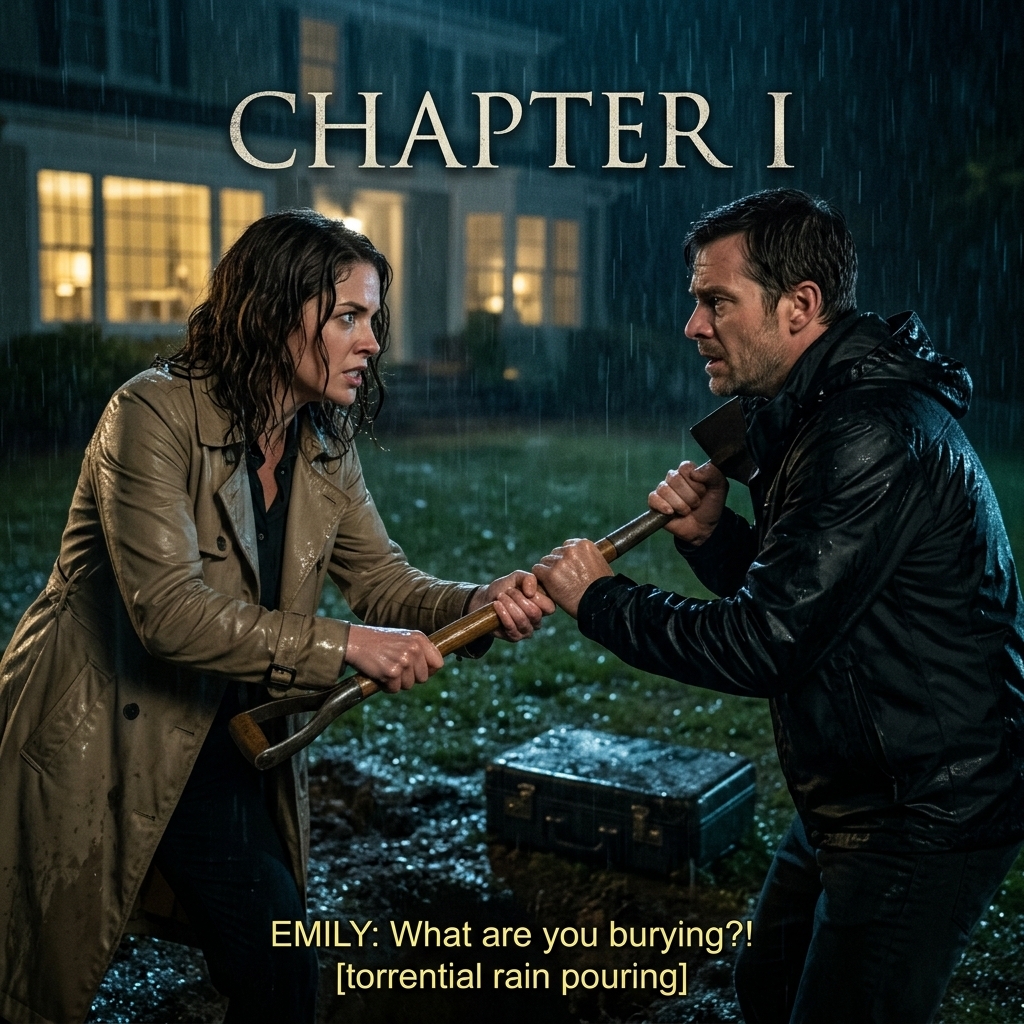
Daniel denied taking the photograph. He did not deny owning the jacket. That distinction mattered to Emily, who had begun measuring every answer by the space around it.
Priya asked him where he had been at 11:58 p.m. Daniel said he was driving home from a meeting with an anonymous courier. He had entered the backyard at twelve ten.
Emily checked the house alarm log and discovered that the back door had opened at eleven fifty-seven. Daniel stared at the screen, then said the log must be wrong. Priya folded her hands.
“You cannot keep asking us to accept your memory whenever the records disagree,” she told him. Daniel rubbed his face. At last he admitted that he had been home earlier and had gone back out to retrieve the suitcase after receiving a message.
He had concealed that trip because someone had warned him not to involve Emily. “You told me you found it on the porch,” Emily said.
“I did.”
“After you were already home?”
He nodded. The deception seemed almost trivial compared with the possibility of Sarah’s survival, but Emily knew the smallest lie could conceal the most important hour. She told Daniel to leave Priya’s office.
He looked at her as if she had withdrawn the last solid ground beneath him. “I want to help,” he said.
“Then start by telling the truth to someone who can verify it.”
He left without another word. Emily watched through the blinds as he stood beside his car, unable to decide whether to get in. She felt grief for a marriage that still existed on paper and perhaps nowhere else.
Priya introduced Emily to Nora Ellis, a former federal financial investigator who now worked on complex fraud cases. Nora had a patient voice and an unromantic attitude toward evidence. She reviewed the ledger, the trust records, and Sarah’s audio file.
“The trust in your name is a problem,” she said.
“If money was laundered through it, someone may have arranged for you to look responsible.”
Emily asked who could establish a trust without her consent. Nora explained that forged identification and compromised signatures were possible, especially if someone close had access to personal records. The trust administrator was a small firm in Hartford.
Its listed director had resigned two years earlier and could not be located. Nora also identified the office building in Sarah’s photographs: an old Meridian Harbor subsidiary called Larchmont Data Services. The company had closed after a fire, but the land records showed the property had been sold to a holding company controlled by Helen Mitchell.
Emily stared at the name. Her mother had spent decades telling everyone she was a retired school administrator with little interest in money.
“Could there be another Helen Mitchell?” she asked.
Nora checked the date of birth. It matched. Emily remembered her mother insisting that Sarah stop asking questions about their father’s estate.
At the time she had thought it was grief. Now she wondered whether the family fortune had never been modest at all. Nora suggested a simple next step: request certified trust documents and examine who had witnessed the signatures.
Emily agreed, though she feared every answer would remove another person from the short list of people she could love without suspicion.
Daniel called from a pay phone that afternoon. Emily almost hung up. He said someone had broken into his car and taken the prepaid phone from the glove compartment.
“You were supposed to keep that with you,” she said.
“I know.”
He sounded more ashamed than frightened. He told her that Sarah had first approached him three years earlier with evidence that Meridian Harbor was moving money through charitable foundations. She had found the transactions while examining their father’s old accounts.
Daniel had agreed to help because his employer had handled some of the transfers. They met in secret to avoid alerting the company.
“Why didn’t Sarah tell me?”
Emily asked.
“She said you would confront your mother immediately.”
Emily hated how plausible that sounded. She had always been the sister who demanded explanations at the dinner table; Sarah had been the one who gathered proof first. Daniel said he had arranged a temporary safe apartment for Sarah after someone followed her home.
Then she vanished from that apartment, leaving behind a note that told him to protect Emily. He had received photographs over the years as proof she was alive, but no direct contact. “You let me go to a funeral,” Emily said.
“I didn’t arrange it.”
“You stood beside me.”
“I know.”
His voice broke. Emily closed her eyes. An apology could acknowledge harm without repairing it.
She told him to send Nora every message and photograph he had kept. He agreed immediately, and for the first time she believed his willingness to be useful more than his words.
Nora obtained the trust’s formation documents by late afternoon. The signature resembling Emily’s was dated the week after Sarah’s disappearance. The notary stamp belonged to a woman who had died five years earlier.
The witness was listed as David Mitchell, Emily’s father, who had died eleven months before the document was signed. Nora did not need to explain the implication. The forgery was deliberate and crude in ways that suggested its creator had expected nobody to examine the papers closely.
Priya contacted the appropriate authorities and began preparing a formal report. Emily studied the photocopy of her father’s signature. She remembered him teaching her to ride a bicycle, running beside her until she stopped wobbling.
She remembered his last illness and the way Helen had managed every hospital visit. Her father had been gentle, distracted, and afraid of conflict. Could he have known about the money before he died?
Sarah’s audio had suggested she was following a trail through his estate. Emily opened the family photograph album on her phone and found an image from her father’s birthday, taken months before his death. Helen stood behind him with one hand on his shoulder.
Sarah was beside them, unsmiling. In the background a man with a scar above his eyebrow held a wineglass. Emily had never noticed him before.
She sent the image to Nora. The investigator replied with a single line: THAT IS VICTOR HALE. Emily looked again.
The man who was supposed to have died in a car accident had been visiting her parents long before Sarah vanished.
At sunset Emily drove to the old office building with Nora, who insisted they stay on public property. Larchmont Data Services had been boarded up after the fire. Weeds grew through cracks in the parking lot, and a rusted sign hung from one screw.
Emily saw fresh tire tracks in the dust near a side entrance. Nora photographed them. A security camera above the door appeared dead, but a small red light blinked behind the housing.
“Someone still wants to know who comes here,” Nora said. Emily remembered Sarah’s habit of hiding memory cards behind picture frames and wondered what else she might have left. They walked around the perimeter and found a narrow window with soot on the inside.
Beyond it was a hallway lined with filing cabinets. Emily pressed her palm to the glass. A flash of memory came to her: Sarah telling her, shortly before disappearing, that she had discovered a house with no windows.
Emily had assumed it was a metaphor for their mother’s refusal to discuss the past. Now she wondered whether Sarah meant a literal place. Nora called an associate to research nearby properties.
A truck passed slowly on the road, then turned around at the next intersection. They returned to the car. Before Nora could start the engine, a man stepped from behind the building.
He wore a baseball cap and held an envelope. Emily recognized the scar above his eyebrow. Victor Hale lifted two fingers in a casual greeting, then placed the envelope on the pavement and walked away.
Nora waited until Victor had driven off before retrieving the envelope with a pair of gloves. Inside was a photograph of Emily sleeping in her bedroom, taken from the angle of the hidden camera. Beneath it lay a handwritten note: YOUR HUSBAND ISN’T THE ONLY LIAR.
The photograph had been printed that morning. Emily felt the nausea of realizing someone had watched her sleep while she believed herself alone. Nora documented the evidence and urged her to stay somewhere secure.
Emily refused to hide without understanding the threat. “That’s what everyone has done for three years,” she said.
“They decide what I can bear and call it protection.”
Nora did not argue. Instead she asked where Emily would go if she had to disappear for one night. Emily named an old friend in Boston.
Nora wrote it down but warned her not to contact the friend yet. Back at Priya’s office, a new email waited in the secure inbox Emily had created. The sender had attached a scan of a driver’s license bearing Emily’s photograph, a different surname, and an address in rural Vermont.
The license looked professionally made. Underneath it was a message: IF YOU WANT SARAH, COME TO THE HOUSE WITHOUT WINDOWS. COME ALONE.
Emily showed Nora. Nora zoomed in on the address and shook her head. “That property doesn’t exist on any public map,” she said.
Then Daniel called, breathless, and told Emily he had just found a second bank account in her name. The most recent withdrawal had been made that morning.