Chapter 9 – The Court of the Living
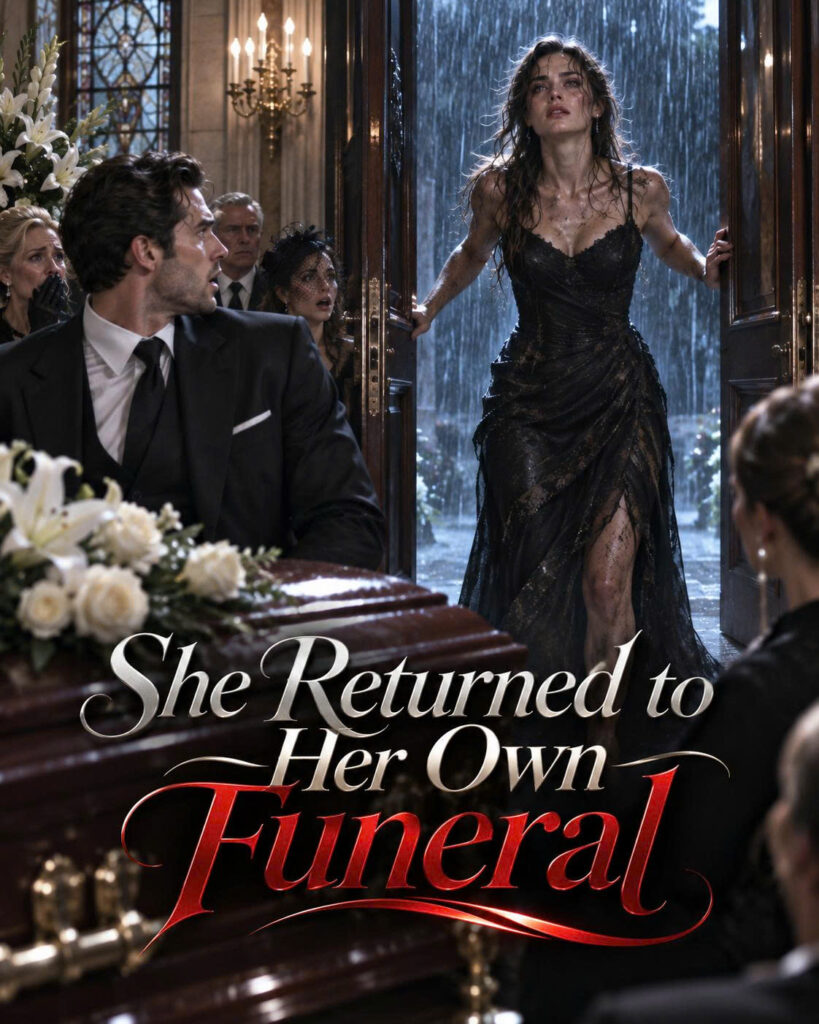
At 8:43 a.m., Evelyn Mercer entered the county courthouse wearing her mother’s green suit and the same white bandage she had worn at her funeral.
Outside, reporters stood behind a barrier, calling her name as rain misted their camera lenses.
Some wanted to know whether she’d been held captive.
Some wanted a comment about the attempted sale.
One shouted a question about her mental health, repeating the wording from Daniel’s guardianship petition.
Evelyn kept walking.
She’d spent the last two weeks being described by other people.
Inside, she would be allowed to speak for herself.
Hannah Price waited beside the courtroom entrance with two assistants and a box of numbered exhibits.
Her face was tired but focused.
She had worked through the night comparing the trust instrument, the claimed loan agreement, the digital approval records, and the video files.
The emergency motion was narrow: determine whether Haven Crest could enforce the alleged default and whether Daniel’s contested proxy could authorize a transfer of operating assets before a full hearing.
“We do not have to prove the entire criminal case today,” Hannah reminded her.
“We need to show serious questions about the authority documents and immediate risk if the transfer happens.
The criminal investigators will handle their case separately.”
Evelyn nodded.
The distinction helped.
She wanted the whole room to understand what had been done to her, but a courtroom was not a cathedral where a single declaration could make ninety-three people turn their heads.
It was a place built for sequences: dates, signatures, testimony, objections, documents.
The truth would have to arrive in a form that could survive interruption.
Daniel entered with Adrian Bell and two attorneys from a national firm.
He wore a charcoal suit and a dark tie, immaculate despite the rain.
Evelyn was startled by how familiar he looked.
This was the man who used to leave a glass of water beside her bed when she had migraines.
This was also the man who had called someone to count the basement rooms while she lay in an ambulance.
Both versions occupied the same body, and the recognition no longer comforted her.
Graham Sloane sat behind them, whispering into a phone.
He looked less polished than he had at the board meeting.
His cuff was damp, and one sleeve showed a faint coffee stain.
The small disorder pleased Evelyn more than she wanted to admit.
Power had always suited him because other people did the inconvenient work of keeping his world clean.
The judge, Margaret Ellison, began by asking the parties to identify the disputed instruments.
Hannah described the emergency proxy and loan pledge.
Bell claimed that Evelyn had approved a financing strategy before her accident and that Daniel had acted in good faith during what he reasonably believed was a crisis.
The judge asked whether any final legal determination of Evelyn’s death had been issued.
Bell admitted there had not.
“Then why did your client proceed as though her absence permanently extinguished her authority?”
Ellison asked.
Bell answered that the documents were designed to prevent operational paralysis.
Hannah asked to introduce the forensic copy of the notarized proxy and the medical records establishing Evelyn’s condition on the date of the alleged signing.
The judge allowed the exhibits for purposes of the emergency hearing, subject to later authentication and weight.
Evelyn took the stand.
She described the crash, the locked basement, the fractured wrist, and her escape.
She stated plainly when she could not remember the exact time of an event.
She explained that she had not signed the October proxy, had not approved the sale, and had never pledged the trust shares to Haven Crest.
When Bell asked whether she had previously seen a grief counselor, she said yes without embarrassment.
“You were under considerable emotional strain after your father’s death, correct?”
Bell asked.
“I was grieving.
That isn’t the same as agreeing to sell my company.”
“And you admit you took medication prescribed after that loss?”
“I took what my doctor prescribed, as directed.
That didn’t put my signature on a paper three days after someone locked me in a basement.”
A low sound moved through the courtroom before the judge called for quiet.
Bell shifted to the damage Evelyn had done during her confrontation with Daniel at Saint Agnes.
She agreed that she had struggled with him over a key ring and knocked over a flower stand.
Then she pointed out that Daniel had reached for the keys before the detective could take them.
Bell asked whether she could prove why.
“No,” Evelyn said.
“I can tell you what he did.
I can’t tell you what’s inside his head.”
Hannah had warned her that refusing to overstate an inference could matter more than a dramatic accusation.
She saw the judge make a note.
Evelyn continued describing the physical evidence: the empty coffin, the document case, the gate order made under her credentials while she was at the museum, and the newly discovered video showing her unconscious body carried into the intake building.
When she stepped down, Claire took the witness chair.
She looked frightened, and she had every reason to be.
She testified that she had delivered documents to Bell while knowing Evelyn had not reviewed them, and that Daniel had persuaded her to describe the transfers as authorized.
She admitted she had helped arrange access to a vehicle at Pier Nine.
Bell objected repeatedly, arguing that Claire faced potential criminal exposure and might be trying to shift responsibility to Daniel.
The judge allowed the relevant testimony but made clear its credibility would be assessed in light of the admissions.
“Why are you telling the court now?”
Hannah asked.
Claire’s voice shook.
“Because I saw my sister walk into her own funeral.
And I realized that every lie I had told to protect myself was being used to hurt her.”
Evelyn looked at Claire’s bruised face.
Forgiveness did not suddenly become easy.
But for the first time since the crash, she believed her sister understood the size of what she’d done.
Hannah then called a document examiner who had performed a preliminary comparison of the contested signature with verified samples.
The examiner did not claim to know which person had held the pen.
She identified unusual similarities among the repeated strokes, suggesting the questioned signature might have been traced or reproduced from an existing specimen rather than written naturally.
Bell argued that more testing was necessary.
The judge agreed, but noted that the dispute itself was significant when combined with the dates and medical evidence.
The most damaging exhibit was not dramatic.
It was a payment schedule.
Hannah’s accountant had identified money moving from Haven Crest’s financing vehicle to Breakwater Logistics, then to an account controlled by a subcontractor connected to Victor Rusk.
Several transfers coincided with the days of Evelyn’s detention.
One payment description read SECURITY CONTINUITY; another read RESOLUTION OF MERCER EVENT.
The phrases were vague enough to invite competing explanations, but the timing demanded investigation.
Sloane leaned toward Daniel and whispered furiously.
Daniel pushed his chair back an inch, signaling that he wanted distance from the man who had supplied the money.
Evelyn saw fear in him again.
This time she did not mistake it for guilt.
It might have been calculation.
He was already deciding which people he would sacrifice if the walls came down.
At 11:21 a.m., Judge Ellison announced a temporary injunction preventing enforcement of the disputed pledge and the transfer of the pumping division pending further proceedings.
She ordered preservation of the original instruments and directed the parties to provide additional authentication.
The ruling did not settle ownership, prove a criminal conspiracy, or determine Daniel’s guilt.
It did, however, stop the sale that had been moving toward completion since the funeral.
Evelyn closed her eyes.
The relief was physical.
For the first time in days she had room to breathe without a deadline ticking somewhere beyond the wall.
Hannah squeezed her good hand.
Claire cried quietly on the opposite bench.
Outside, reporters would reduce the ruling to a victory headline.
Inside, Evelyn knew it was a single locked gate in a much larger flood.
As the courtroom emptied, Ortiz approached with two detectives.
She asked Daniel and Bell to remain available for questioning concerning the forged records and the fire at the intake building.
Bell protested that his client was represented and would arrange an interview through counsel.
Ortiz replied that she understood and had no intention of bypassing that right.
Daniel smiled at Evelyn over the detective’s shoulder, a small private expression she recognized from arguments he believed he could still win.
“You think this makes you safe?” he murmured as he passed.
“No,” Evelyn answered.
“I think it means you’re running out of paperwork.”
She went outside through a side exit with Hannah.
The reporters had clustered at the main doors, leaving a quiet passage to the parking garage.
Evelyn was halfway down the ramp when she heard an engine rev too hard for the narrow lane.
A delivery van emerged from behind a column, moving fast.
Hannah grabbed her sleeve and pulled her behind a concrete support.
The van struck a bollard, bounced sideways, and stopped with smoke curling from its front wheel.
A man climbed from the driver’s side and ran toward the service stairs.
Evelyn saw the gray coat before she saw his face.
Victor Rusk had changed vehicles, not habits.
Two court security officers pursued him.
Ortiz, alerted by the collision, arrived at the far end of the ramp and shouted for Rusk to stop.
He hesitated, then turned abruptly and disappeared through an emergency exit leading toward the waterfront maintenance tunnels.
The collision had been close enough to leave a scrape on the concrete where Evelyn’s shoulder had stood seconds earlier.
Her knees shook.
Hannah looked at her with an expression that was equal parts concern and anger.
“You aren’t walking into a garage alone again,” she said.
“I wasn’t alone.”
“Then we’ll both stop doing it.”
Ortiz examined the van and found a temporary rental plate, a disconnected tracking device, and a cardboard box on the passenger floor.
Inside the box was the weatherproof film case stolen from Pier Nine.
Its seal had been broken, and the original reel was missing.
Attached to the lid was a small folded note addressed to Evelyn: THE CITY WILL PAY FOR WHAT YOUR FAMILY HID.
“Sloane,” Evelyn said.
Ortiz shook her head.
“Maybe.
Or someone wants you to say his name.”
The detective’s caution was frustrating and necessary.
The note might be a confession, a warning, or a deliberate attempt to misdirect them.
Evelyn had spent enough time interpreting clues as personal messages.
She was learning to let the evidence exist before she gave it a story.
That afternoon, an audit team examined the original city archive copy of the gate footage.
The reels and accompanying inspection files appeared intact.
The archivist, Ruth Caldwell, had kept detailed access logs for years, and the records supported the chain of custody.
A specialist confirmed that the footage showed a component installed in a manner inconsistent with the approved plans.
It did not identify every person responsible.
Hannah filed notice that the originals would be preserved and examined by independent experts.
The criminal investigation gained a new witness when an accountant employed by Haven Crest contacted Ortiz through his attorney.
He had prepared a financing summary that listed the Mercer trust pledge as “pending authority confirmation.”
His supervisor instructed him to remove the phrase before sending the documents to investors.
The accountant retained a draft because he had feared liability.
He agreed to provide it under proper legal protections.
“They knew there was no confirmed authority,” Hannah said after reading the summary.
“That makes the story about innocent emergency planning harder to maintain.”
Evelyn asked whether they could finally stop Daniel.
Ortiz explained that investigators were assembling evidence for prosecutors and that arrests required lawful grounds.
Evelyn understood the answer.
She hated the waiting.
But she had begun to distinguish between her need for justice and the machinery that could actually deliver it.
A rushed arrest that collapsed later would give Daniel one more story about being persecuted by an unstable wife.
At sunset, Mara Reddick asked to speak with Evelyn privately in the station’s interview room.
She had been listening to the courthouse coverage and wanted to tell Evelyn something that felt less like evidence than a confession.
Years earlier, Thomas had planned to disclose the gate defects but had hesitated because he worried the company would collapse and workers would lose their jobs.
Mara had argued that hiding a dangerous system would destroy more lives.
They had fought about it the night before he died.
“I spent years wishing I hadn’t pushed him,” Mara said.
“I thought if I’d stayed quiet, he would have been alive.”
“If you had stayed quiet, the gate would still be unsafe,” Evelyn replied.
“And he might still have died.
We can’t choose the past from a distance.”
Mara reached across the table.
“Your father tried to help Thomas.
He was late, but he tried.
Don’t let them turn his mistakes into a reason to erase what he did next.”
Evelyn held her hand.
There was no simple line dividing the innocent from the guilty in every decision.
Her father had signed a flawed plan.
Claire had carried documents she should have questioned.
Evelyn had ignored warnings.
But Daniel, Rusk, and their partners had made repeated choices to conceal risk and silence people who objected.
Accountability required seeing those differences without pretending the failures on her side did not matter.
When Evelyn returned to Nora’s house, a sealed package waited on the porch.
There was no delivery label.
Inside lay the ring Daniel had taken from her finger while she was unconscious, along with a single photograph of him standing at the edge of the quarry on the night of the crash.
On the back was a message written in block capitals: HE’S COMING TO FINISH WHAT HE STARTED.
Evelyn didn’t touch the photograph again.
She called Ortiz, photographed the package in place, and waited for officers to collect it.
Then she went upstairs and locked the bedroom door.
She had become strong enough to refuse a trap even when its bait was the wedding ring she once believed represented her safest place.
At 9:07 p.m., her phone lit up with an incoming video call from Daniel.
She handed it to Ortiz when the detective arrived and answered on speaker.
Daniel appeared inside the old Mercer family boat house.
Behind him, a storm-warning beacon swept red light over the windows.
“Bring the ledger,” he said.
“And come before the tide turns.
Or they’ll learn what your father signed before he tried to undo it.”
Evelyn looked at Ortiz.
Daniel had chosen the place where she learned to steer, the lesson about the rising tide, and the shame he’d spent years using as leverage.
But this time he wasn’t speaking to a woman who would rush to save a memory of him.
He was speaking to someone who had already filed his threats, preserved the recording, and called the police.
“I’m not coming alone,” she told him.
Daniel’s jaw tightened.
“Then you may never see me again.”
She thought of the empty coffin, the locked basement, the burned documents, and the river pressing against a gate that nearly failed.
Then she said the only answer he had never been willing to accept.
“That’s your choice.”