Chapter 1 – The Photograph on the Floor
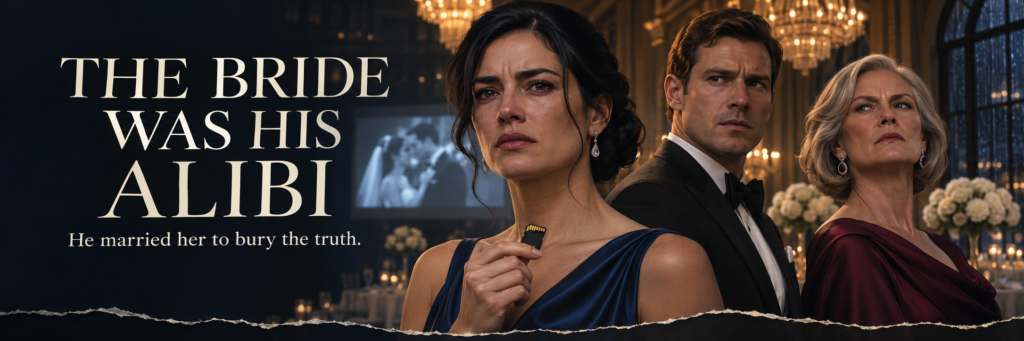
My mother-in-law slapped me beneath a photograph of herself accepting a humanitarian award.
The sound carried farther than the string quartet. A violin stopped in the middle of a note. The frame in my hands struck the edge of the display table, slipped, and landed facedown on the marble.
For a moment I could see nothing except the white flowers behind Celeste Mercer’s shoulder. One petal trembled in the air-conditioning. I remember that detail because everything else in the room seemed to have stopped moving.
“Your mother stole enough from this family,” she said. “You will not put her on our wall.”
Two hundred people had come to the Mercer House Hotel to celebrate its hundredth anniversary. They had been promised champagne, a historical exhibition, and news of a sale that would preserve the landmark for another generation. They had not been promised the sight of the owner’s daughter-in-law standing with one hand against her cheek.
I was thirty-one years old. Until that evening, I had believed humiliation would make me feel younger. Instead, it made the room suddenly simple. There was the woman who had struck me. There were the people watching. And there was my mother’s photograph, beneath my feet.
I bent to pick it up.
“Leave that,” Celeste said.
The frame’s glass had cracked across the corner. My mother was smiling behind it, wearing an ordinary white blouse, holding a stack of envelopes. Beneath her picture, in lettering I had spent the afternoon setting straight, was a caption: RUTH ELLIS, EMPLOYEE HOME FUND COORDINATOR.
I had found the photograph while restoring the hotel’s paper archive. No one had asked me to search for my mother. The hotel had hired my conservation studio to repair water-damaged records for the centennial exhibition. I had opened a carton marked LINEN INVENTORY and found a woman the Mercer family had spent eighteen years describing without ever showing her face.
“If she stole something,” I said, “show me the record.”
Celeste’s expression changed. Anger had been easy for her. The request seemed to require calculation.
My husband arrived between us, handsome and breathless, his black bow tie slightly crooked. Julian had a way of entering troubled rooms as if he had been sent to save everyone inside them.
“Mara. Come with me.”
He took my elbow. I pulled away.
“Your mother hit me.”
“I saw. We need to handle this somewhere private.”
“Then tell her to apologize here.”
A waiter lowered his tray. Near the entrance, an investor looked down at his phone with elaborate concentration. Julian noticed both of them. I saw him notice.
“You’ve had a difficult week,” he said softly.
My cheek burned hotter than before.
“Don’t make this about my feelings.”
Celeste smoothed the front of her burgundy gown. “That picture was never approved. The exhibition is about this hotel’s history, not a personal campaign.”
“She worked here for eleven years.”
“So did a great many people.”
“And you put their names on the wall.”
Behind Julian, his sister Avery stood with a camera hanging against her champagne dress. She was twenty-seven, usually restless, always looking for a better angle or an excuse to leave a Mercer event early. Tonight she looked fixed in place. Her gaze moved from my face to the picture, then to the screen above the ballroom doors.
Our wedding film was playing there without sound.
The hotel had hosted our reception three years earlier. Julian called it part of the building’s living history. I had agreed to let the film appear between archival images, although seeing my dead mother on a large screen still made me lose track of whatever I was doing.
There she was now, adjusting the blue ribbon around my wrist.
Then a cut. Julian and I dancing beneath the chandeliers. The perfect bride. The perfect son. The family that had welcomed me despite what my mother had supposedly done.
Ben Ortiz, the banquet captain, stepped close enough to speak without raising his voice.
“Mrs. Ellis’s photograph belongs with the other employee portraits,” he said.
Celeste stared at him. “You have tables to supervise.”
“They are supervised.”
I had known Ben for six years, since the first time my studio worked on the hotel. His father had repaired the elevators until his knees gave out. Ben rarely said anything that could not be followed by yes, ma’am. Now he held out a clean folded napkin for the broken glass.
I took it, and my hands began to shake.
That was the first kindness that evening. Not a speech. Not a defense that came with conditions. A square of linen, offered because I was holding something sharp.
Julian glanced toward the ballroom. “We have a presentation in five minutes.”
“You have one,” I said.
His fingers closed around my wrist again, less gently this time. The gesture was familiar enough to frighten me. He had steered me away from difficult conversations before. From his mother at Thanksgiving. From a former employee outside a restaurant. From an envelope my mother had brought to our wedding and later carried home unopened.
I had mistaken the steering for care.
“Let go.”
He did. Immediately. Too aware of the people around us to pretend he had not heard.
I handed the photograph to Ben. “Please put it somewhere safe. Don’t throw away the frame.”
“I won’t.”
Then I walked out before Julian could turn my departure into something he had arranged.
The powder room was empty. Someone had placed fresh roses beside the sinks, as if the building itself deserved consolation. I wet a towel and pressed it to my cheek. There was no dramatic injury, only heat and a red shape that would fade sooner than the memory of the room.
My phone vibrated.
Julian: I’m dealing with her. Please don’t leave. We should present a united front.
I read the last sentence twice.
For three years, marriage had meant joining him at the front of things. Charity photographs. Hotel openings. Dinners where women asked what it was like to be rescued from a life of freelance invoices and secondhand furniture. I had laughed because refusing the joke would have ruined the atmosphere.
I had kept my own surname professionally. At home, Julian called me Mrs. Mercer when he wanted to be charming. His mother called me Mara when she wanted to be generous, and your wife when she wanted something corrected.
My mother had called me every Sunday until she could no longer speak comfortably on the phone.
She had never once called Julian her son.
I used to think that was pride.
The door opened. Avery slipped inside and locked it behind her.
“Are you hurt?”
“I’m deciding.”
She nodded as if that made sense. Perhaps it did.
“Ben put the picture in the service office. He’s writing down what happened. The people nearest you said they’d give statements.”
I looked up. “Your mother isn’t going to like that.”
“I know.”
Avery took a tissue, folded it, unfolded it, then put it in the trash without using it. I had seen her frightened before: before exhibitions, during her father’s final illness, once when a ladder tipped beneath a lighting technician. This fear seemed older.
“There is something I should have told you,” she said.
From outside came the muffled beginning of applause. Julian’s voice rose through a microphone. He was thanking the guests for joining his family on a very special evening.
“About my mother?”
“About your wedding.”
I lowered the towel.
“I helped make the anniversary reel. I went through the raw footage again last week. Everything the original videographer gave us. My camera files, too.”
“And?”
“The version everyone has isn’t the sequence we shot.”
“Wedding videos are edited, Avery.”
“I know. I edited part of it. That’s what I’m trying to tell you.”
She sat on the small velvet bench near the wall. For once she looked like her brother: the same mouth trying to find a way into a sentence that would cost something.
“Do you remember the outage?”
Of course I did. Rain hammering the windows. The ballroom lights failing. A generator leaving us in dim yellow pools while technicians reset the equipment. Julian disappearing to deal with a problem, then returning with wet cuffs and a story about a service door blown open by the wind.
“The livestream kept going,” I said.
“It switched to the backup sequence. Your rehearsal dance from the night before. Mother asked for something pretty while they fixed the connection. The same flowers. The same room. You were in the dress for the lighting test.”
I remembered being annoyed about that test. My mother had spent an hour fastening the tiny buttons down my back only for the director to ask us to turn in circles. She had not added my blue ribbon until the following afternoon.
“I knew they used rehearsal footage during the outage. Julian told me afterward.”
“He told you about the stream. Not what they did with it later.”
The microphone outside produced a little squeal. A laugh followed, then Julian’s polished apology.
“The copy they gave the company investigator had that dance in it,” Avery said. “They labeled it eight forty-two. Live reception footage.”
“What investigator?”
She swallowed. “The one who interviewed Grace Bell.”
I knew the name vaguely. An accountant who had left after a disagreement. Someone Celeste described as unstable whenever another employee asked where she had gone.
“Avery. What happened at eight forty-two?”
“I don’t know all of it. I know you weren’t with Julian.”
She took out her phone. There was no theatrical pause. She simply opened a file, turned the screen toward me, and pressed play.
I appeared in a narrow corridor beside the ballroom, wearing my wedding dress. The blue ribbon was tied around my wrist. My bouquet lay on a chair. I was alone.
My younger voice said, “Where is he?”
Someone off-camera answered, “He said five minutes.”
Then a door slammed farther down the hall. I turned. The clip continued, but Avery lowered the volume when voices began.
“There’s more. I copied the whole folder for the lawyer who contacted me. I haven’t changed the originals.”
“What lawyer?”
“June Park. She represents the independent trustee of the employee restitution fund. Grace gave her my name. She asked whether I still had wedding files. I was going to tell you tonight. Before the speeches.”
My hand tightened around the towel.
I had not known there was a restitution fund. I had not known there had been an investigator. I had known every anniversary gift Julian bought me, every favorite restaurant, the exact place on his jaw where he liked to be kissed.
Outside, my husband was thanking his late father for teaching him the meaning of integrity.
“Send me June’s number,” I said.
Avery’s eyes filled, but she did not ask me to forgive her. That was the first thing she did correctly.
“Mara, there’s something else. June sent me a document from that night. She wanted to know whether I remembered seeing anyone sign it.”
“What document?”
She showed me a page with a list of names and a signature at the bottom.
My signature.
Above it were the words WITNESS TO EXECUTION OF BENEFICIARY RELEASES.
Below it was my mother’s name.
The date was my wedding day.
I looked from the little screen to the locked door. On the other side, two hundred guests began to applaud the man I had married.
And for the first time, I understood that my wedding might have been a day I remembered clearly and knew almost nothing about.