Chapter 2 – The Woman Behind the Smile
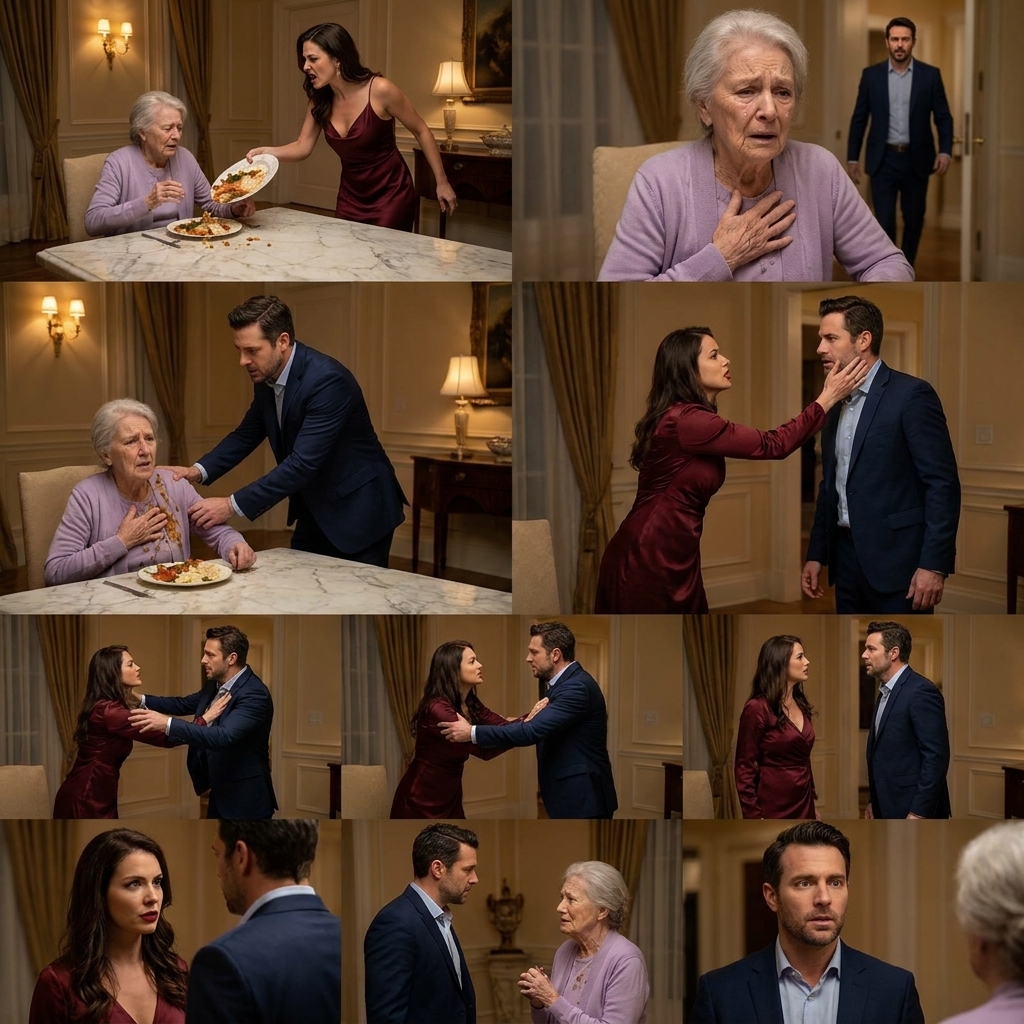
At St. Catherine’s Hospital, a doctor named Maya Patel examined Margaret while Daniel sat outside the treatment room with dried food on his cuff. Vanessa sent him six messages insisting the incident had been a misunderstanding.
He read them without answering. The paramedic had told him that shortness of breath in an older adult was never something to dismiss. Daniel kept seeing his mother’s face and wondering how long she had been afraid in his house.
“Was she frightened of me before today?”
The nurse did not answer a question she could not know.
The documents were less dramatic than the arguments surrounding them. They contained dates, signatures, numbers, and blank spaces where someone expected an answer. A page could prove that a payment occurred without proving why it was made.
A photograph could establish that two people had met without explaining their relationship. Daniel forced himself to remember that evidence did not become stronger merely because he needed it to support his fear.
Later, Daniel would remember an unremarkable detail from the scene: the faint hum of the air conditioner, the edge of a paper against a thumb, the way a voice dropped when the speaker realized someone was listening. That detail would stay when the louder words faded. “I don’t want another version made to sound better,” Daniel said. “I want what happened.” It was an awkward demand, because honest accounts rarely arrived in neat order. But awkwardness was preferable to another beautiful lie.
Margaret was stabilized but kept overnight for observation. Maya explained the tests without promising an easy explanation. When Daniel finally entered, his mother tried to apologize for the scene.
He stopped her. A folded paper napkin sat on the bedside table; she had been using it to hide the stains on her cardigan. He took it away gently, and her shoulders began to shake.
She admitted that Vanessa had been controlling who visited and when she took her prescriptions.
“I thought keeping quiet would keep the peace.”
Daniel realized silence had been mistaken for consent.
Outside the immediate argument, other lives continued. People walked dogs, opened shops, worried about bills, and prepared dinner. The ordinary world made the family’s private emergency feel both enormous and strangely invisible.
Daniel wanted a witness who could tell him what mattered. Instead he found that every witness carried only a fragment. He would have to put the fragments together without forcing them into a pattern they did not fit.
There was an almost physical urge to do something immediately about the locked box. Make a call. Drive somewhere.
Demand an explanation from the person least likely to give one. Margaret held back long enough to consider what would happen afterward. “If we rush, we give them a reason to say we’re confused,” someone observed. The warning was practical, not timid.
The family had already lost too much to choices made in panic. This time they would keep copies, confirm dates, and make sure the vulnerable person in the story was not forgotten while everyone chased the secret.
Back at the mansion, Daniel found the kitchen camera disconnected. The housekeeper, Rosa Alvarez, had been told to take every Thursday afternoon off. Rosa showed him a calendar of sudden schedule changes and remembered hearing Vanessa say that Margaret needed to learn obedience.
Rosa had not witnessed the food incident, and she refused to pretend otherwise. But she knew the house had become colder after Vanessa discovered a locked box in Margaret’s bedroom.
“She asked me who had the key. I said I did not know.”
Daniel had never known there was a box.
A person could love someone and still fail them badly. Margaret had understood that about herself long before Daniel did. The knowledge offered no comfort when she saw the hurt in his eyes, but it gave her a way to speak without claiming innocence.
She wanted him to know that her choices had been made in a world of fear and limited options. She also wanted to stop using those circumstances as a reason to withhold his own history.
Later, Vanessa would remember an unremarkable detail from the scene: the faint hum of the air conditioner, the edge of a paper against a thumb, the way a voice dropped when the speaker realized someone was listening. That detail would stay when the louder words faded. “I don’t want another version made to sound better,” Vanessa said. “I want what happened.” It was an awkward demand, because honest accounts rarely arrived in neat order. But awkwardness was preferable to another beautiful lie.
Vanessa met Daniel in the darkened study and tried tenderness first. She said she was exhausted, that Margaret resented their marriage, that one terrible moment should not erase their years together. Daniel asked why his mother’s medication had been moved to a cabinet she could not reach.
Vanessa answered with another accusation. When he reached for the door, she grabbed his wrist; he freed himself and asked her to stay elsewhere until Margaret felt safe.
“You are choosing her over your wife.”
He had finally understood that protecting someone was not a contest.
There was a particular cruelty in the way ordinary objects continued to look ordinary after a terrible thing had happened. A chair remained a chair, a door still opened onto the same hallway, and daylight did not dim to acknowledge what people had done. Yet the people who had been present carried the moment differently.
They remembered where each person stood, who spoke first, and which words were left unanswered. Later, when someone tried to reduce the incident to a misunderstanding, those details would matter. They would be the difference between a story designed to excuse behavior and an account of what actually took place.
There was an almost physical urge to do something immediately about the hospital and Rosa’s testimony. Make a call. Drive somewhere.
Demand an explanation from the person least likely to give one. Daniel held back long enough to consider what would happen afterward. “If we rush, we give them a reason to say we’re confused,” someone observed. The warning was practical, not timid.
The family had already lost too much to choices made in panic. This time they would keep copies, confirm dates, and make sure the vulnerable person in the story was not forgotten while everyone chased the secret.
That night Daniel found an old wedding photograph in which Vanessa was speaking to a stranger with silver-rimmed glasses. The man had attended their ceremony under the name Paul Mercer. Daniel remembered him leaving before dinner, after exchanging a long look with Margaret.
Searching old guest lists, he found Mercer’s invitation had been handwritten by Vanessa, not mailed through the wedding planner.
“Why did she invite him?”
The photograph seemed to hold its answer just outside the frame.
The hardest part was not knowing which memory to trust. A sentence spoken in anger could be true and still be meant to wound. A tender promise could be sincere and still conceal an omission.
The people involved had reasons to protect themselves, and those reasons did not always align with the facts. The only way forward was to ask specific questions, listen to uncomfortable answers, and resist the temptation to turn the first plausible explanation into the final one.
Later, Margaret would remember an unremarkable detail from the scene: the faint hum of the air conditioner, the edge of a paper against a thumb, the way a voice dropped when the speaker realized someone was listening. That detail would stay when the louder words faded. “I don’t want another version made to sound better,” Margaret said. “I want what happened.” It was an awkward demand, because honest accounts rarely arrived in neat order. But awkwardness was preferable to another beautiful lie.
Margaret called Daniel before midnight. She said there had been a man who worked at the hospital where Daniel was born, and that the name Mercer frightened her. She would tell Daniel everything when she came home, but she begged him not to confront the stranger alone.
Then a nurse interrupted to check her blood pressure. Daniel stared at the silent phone and understood that his mother’s story was larger than an unhappy marriage.
“Promise me you will not go to him tonight.”
Daniel promised, though he had already opened his car keys in his hand.
Margaret knew that fear changed the shape of time. Five minutes with someone angry could seem longer than an entire afternoon spent alone. She had learned to measure a day by footsteps, by the click of a latch, by whether the telephone was within reach.
She resented how small those calculations made her life. Somewhere beneath the fear was the woman who had raised a son, buried a husband, managed a household, and survived losses no visitor could see.
There was an almost physical urge to do something immediately about Vanessa’s shifting explanations. Make a call. Drive somewhere.
Demand an explanation from the person least likely to give one. Daniel held back long enough to consider what would happen afterward. “If we rush, we give them a reason to say we’re confused,” someone observed. The warning was practical, not timid.
The family had already lost too much to choices made in panic. This time they would keep copies, confirm dates, and make sure the vulnerable person in the story was not forgotten while everyone chased the secret.