Chapter 5 – The Last Yellow Bus
Denise stayed inside the terminal office while investigators secured the platform. Every instinct urged her to run to Emma, but she knew how easily a frightened reunion could become a dangerous scene. Price spoke quietly into her radio, and two officers guided Emma through a side entrance away from the arriving buses.
When the door finally opened, the sisters stared at each other.
Emma looked like the woman in the depot photograph, only more exhausted. Her hands trembled around the strap of her canvas bag. Denise saw the curve of their mother’s eyebrows and a tiny scar near Emma’s chin.
“Are you really Denise?” Emma asked.
Denise nodded. “I’m really Denise.”
Emma took a shaky breath. “I remember your voice. I don’t know how. Maybe I heard recordings later. But when I found the old family video, I knew it was you.”
Denise crossed the room and embraced her. Emma held on as though afraid the world might take them apart again.
For a long time neither spoke.
Then Emma whispered, “I’m sorry.”
Denise pulled back. “For what?”
“For working for them. For not coming sooner. For everything I didn’t understand.”
“You were a child when they took you,” Denise said. “You didn’t choose that.”
“I made choices later.”
“Then we’ll talk about those. But right now you’re here.”
Price gave them time before beginning a formal interview. Emma explained that she had grown up believing her name was Emma Hale and that the people who raised her were her biological parents. After their deaths, she found conflicting birth records. A job at Rusk Transportation gave her access to older files, where she recognized her own photograph.
“I thought it was a mistake,” Emma said. “Then I found the Carter hospital report.”
She had contacted Rachel because the reporter was already investigating fraudulent transport contracts. Together they traced payments, vehicle routes, and identity changes across decades. When Rusk discovered Emma had copied the ledger, she fled. She had been moving between temporary jobs, afraid that anyone she contacted would be watched.
“Why send the note to the bus terminal?” Denise asked.
“Because you always said a bus could take you somewhere safe. Rachel told me you still drove one.”
Denise laughed through tears. “I used to say that when you were tiny.”
“I know. It was in the family recording.”
Emma opened her bag and handed investigators a sealed storage device. She said it contained original accounting records, correspondence, and a list of children whose identities had been changed. Price arranged for the evidence to be copied and authenticated. Emma was offered protective services and legal advice before further questioning.
The vehicle circling the terminal was stopped without a confrontation. Its driver was questioned. No one was injured. Denise felt an unfamiliar gratitude for an ending that did not require another chase.
In the following weeks, the investigation produced arrests and formal charges against several people connected to the network. The legal process would take time, and not every allegation could be resolved immediately. Independent child advocates worked with families affected by the falsified records. The district replaced its tracking contractor and changed access rules so one company could no longer monitor every bus and passenger.
Raymond eventually admitted that he had allowed Rusk access to district systems in exchange for payments. He claimed he did not know the full extent of the operation. Investigators would test that claim against the evidence. Denise no longer tried to understand why a man she had trusted had chosen money over children’s safety.
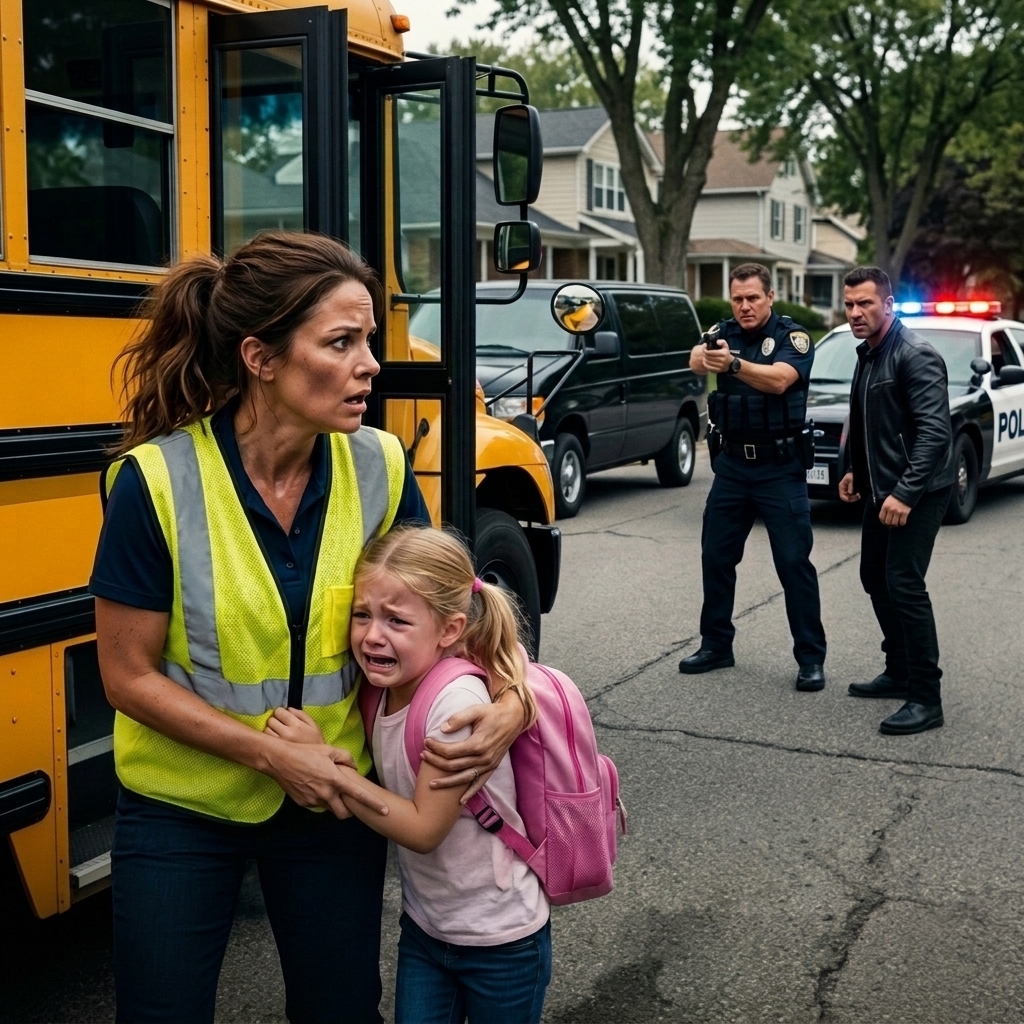
Officer Miller faced proceedings over his actions at the bus stop and his alleged role in the wider scheme. Denise testified about the gun pointed at her windshield, Lily’s warning, and the handshake she had seen. She spoke calmly, with the bus camera footage available to corroborate her account.
When asked why she had refused to surrender Lily to the officer, Denise answered, “Because the child was telling me she was in danger, and what I saw supported her. I wanted qualified people to verify the situation before anyone took her away.”
The room fell silent. Denise did not feel heroic. She had been terrified. But fear had not prevented her from acting carefully.
Rachel and Lily moved into a safer home. Rachel continued her reporting with legal and security support. Lily returned to school gradually, with a counselor helping her regain confidence. Denise visited only when invited, careful not to turn the child’s recovery into a story about herself.
One afternoon Lily ran toward her at the school gate carrying a drawing. It showed a yellow bus beneath a huge blue sky. Three stick figures stood beside it, holding hands.
“That’s Mommy, you, and me,” Lily explained.
Denise crouched to admire it. “I love the sky.”
“I made it extra big so there’s room for everybody.”
Denise smiled. “That’s a good idea.”
Emma joined them a moment later. Lily looked at her curiously.
“Are you the lost sister?”
Emma knelt beside Denise. “I was. Now I’m the found sister.”
Lily considered this and nodded. “That’s better.”
The three of them laughed.
Denise’s first day back behind the wheel came on a cool autumn morning. The district had reviewed her actions and cleared her to return. She checked the mirrors, tested the doors, and read the updated emergency procedures. A new radio channel connected drivers directly to independent emergency dispatch when necessary.
At the first stop, a boy climbed aboard carrying a science project. At the second, two sisters argued about who would sit by the window. Then the bus reached Lily’s street.
Rachel stood beside her daughter, holding a lunchbox and waving. Lily walked toward the doors without looking at the road in fear. She stopped at the curb, checked both directions as Denise had taught her, and climbed aboard.
“Morning, Denise.”
“Morning, Lily.”
“Is today going to be normal?”
Denise thought about everything that word had come to mean. Normal was not a guarantee that nothing bad would ever happen. It was the chance to go to school, make friends, complain about homework, and trust that adults would listen when something was wrong.
“I think it’s going to be a good day,” she said.
Lily smiled and took her seat.
After her route, Denise met Emma at their mother’s grave. They placed fresh flowers beside the stone and stood quietly together. Emma traced the carved letters with her fingertips.
“I wish she’d known I was alive,” Emma said.
“She never stopped believing it was possible.”
Emma wiped her eyes. “I want to know everything about her.”
“I’ll tell you,” Denise promised. “And you can tell me about your life. We have a lot of catching up to do.”
They walked back to the car side by side. The sky was clear, and the road ahead was ordinary, full of traffic lights and errands and places to be. Denise had spent years believing that the worst day of her childhood could never be answered. Now she knew the past could be investigated, the truth could be spoken, and a family could begin again without pretending the lost years had never happened.
That evening Lily sent her a photograph of the drawing pinned to the refrigerator. Beneath it Rachel had written a sentence in blue ink: THANK YOU FOR LISTENING.
Denise set the phone down and looked at the yellow school bus parked across the street. It was still just a bus, with scuffed steps and worn seats. But on one frightening morning it had become the place where a child found someone willing to believe her.
Tomorrow Denise would open the doors again.
And when the next child climbed aboard, she would be ready to listen.