Chapter 2 – – The House Beside the Lake
Chapter 2 – The House Beside the Lake
The first thing Emily noticed after the wedding collapsed was that nobody had asked whether she was all right.
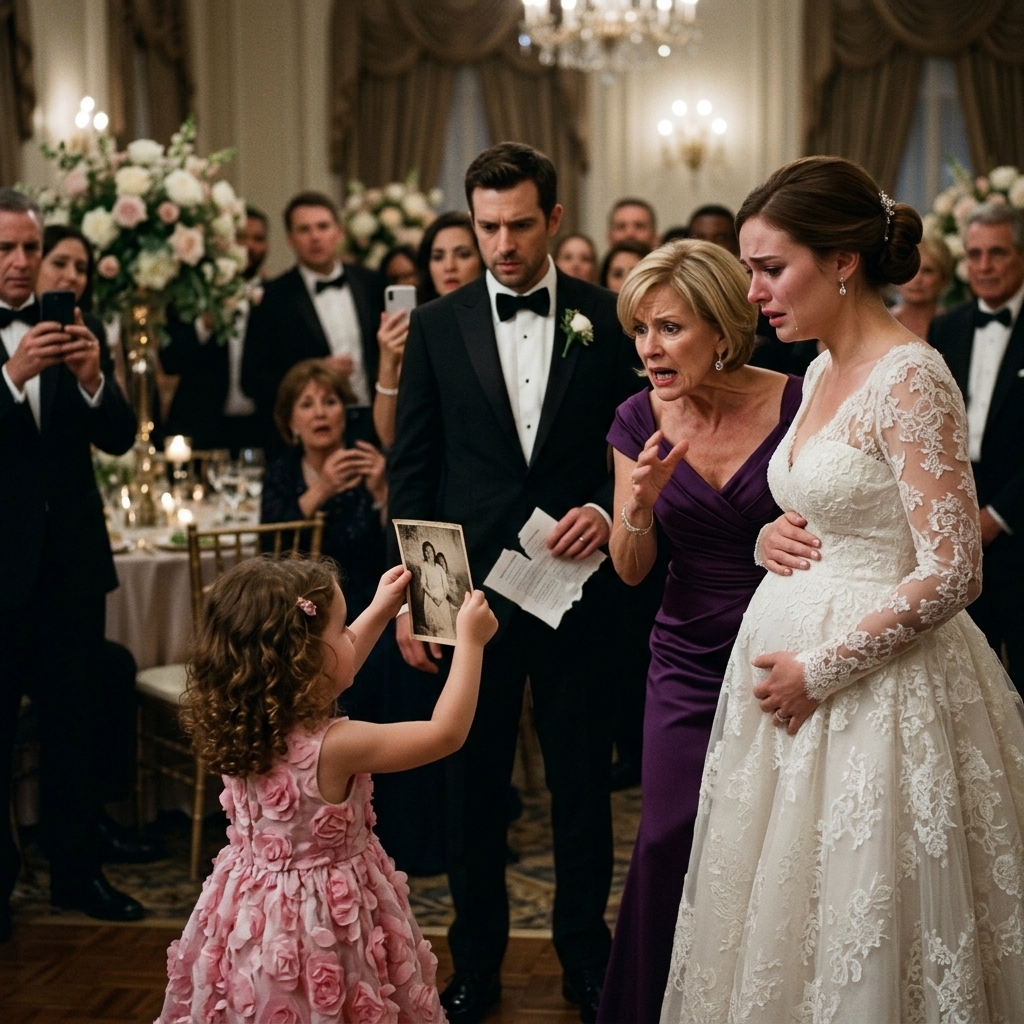
The hotel manager wanted to know who would pay for the broken champagne tower. The photographer wanted to know whether the deposit covered an event that ended before the vows. Daniel’s aunt wanted the photograph back, although she had never owned it. And Margaret Hale, who had struck Emily in front of two hundred guests, wanted a private conversation before anyone called the police.
Emily sat in the bridal suite with a cold towel pressed to her cheek. Her white dress was stained with red wine, and the tiny pearl buttons at her wrist had come loose when Daniel seized her arm. The room smelled of roses and expensive candles. Outside, the music had stopped, but voices still floated up from the courtyard.
Sophie sat on the carpet beside the bed, arranging flower petals into a circle.
“Is Grandma angry because I told the truth?” the little girl asked.
Emily lowered the towel. “You didn’t do anything wrong.”
“Then why did Uncle Daniel look scared?”
Emily had no answer. She could still see the photograph in his hands: his father, Thomas Hale, standing beside a dark-haired woman who resembled Emily so closely that the resemblance felt like a threat. A baby had been wrapped in a yellow blanket between them. On the back, written in blue ink, were six words: FOR THE CHILD WHO MUST NEVER KNOW.
A knock came at the door. Emily rose, expecting Margaret, but found Daniel instead. His bow tie hung loose, and there was a fresh cut across his thumb from the marriage certificate he had torn in anger.
“Where’s the photograph?” he asked.
Emily stared at him. “That’s what you came to say?”
“I need to see it again.”
“You called me a liar. You threw me out of our wedding.”
Daniel looked past her toward Sophie. “Can we talk without an audience?”
“She is four years old, Daniel. She isn’t an audience. She’s the only person who stood up for me.”
He flinched. For a moment Emily thought he might apologize. Instead he said, “My mother says that picture was stolen from her study.”
“Your mother also said my baby wasn’t yours.”
“Emily—”
“Did you believe her?”
He opened his mouth, then closed it. His silence answered more clearly than words.
Emily walked to the dressing table and took the photograph from beneath a folded veil. She held it by the corners so he could see the inscription. Daniel studied the faces. His father had died eighteen years earlier in a boating accident on Lake Bellweather. In every family portrait, Thomas was a smiling businessman with silver-rimmed glasses and a navy blazer. In this photograph, he wore a hospital bracelet and looked terrified.
“That’s him,” Daniel whispered. “But the woman…”
“Looks like me. I know.”
“Your mother had a sister?”
“My mother said she was an only child.”
“People lie about their families.”
Emily’s voice sharpened. “You would know.”
Sophie stood and approached Daniel with the solemnity of a child delivering an important message. “Grandma said the lady in the picture went away because she was bad.”
Daniel crouched. “When did she tell you that?”
“Yesterday. I found it in the blue box. She said if anybody saw it, our family would disappear.”
“Where’s the blue box now?”
“Grandma put it in her car.”
Daniel rose so quickly that Sophie retreated behind Emily. He noticed, and shame passed across his face.
“I’m sorry I frightened you,” he told her. Then he looked at Emily. “My father owned a house by the lake. Mother sold everything after he died, except that property. She told me it was condemned.”
“And?”
“I found out last year she’s still paying the taxes.”
Emily folded the photograph into an envelope. “Then that’s where we start.”
Daniel shook his head. “My mother won’t let us near it.”
“I’m not asking permission.”
By midnight, Emily had exchanged her wedding gown for jeans and a borrowed sweater. Sophie was staying with her mother, Laura Carter, who had arrived at the hotel pale and trembling after seeing the photograph. Laura had insisted the child needed sleep. She had also refused to explain why her hands shook when Emily mentioned Thomas Hale.
Daniel waited beside his car in the underground garage. The sight of him made Emily hesitate. Hours earlier she had been ready to spend her life with him. Now she wasn’t certain she wanted to sit beside him for forty minutes.
“You can follow in your own car,” he said.
“I intend to.”
The road to Bellweather narrowed between dark pines. Emily drove behind Daniel, watching his taillights curve through the fog. Rain collected on the windshield. She tried calling Laura twice, but both calls went to voicemail. On the third attempt, her mother answered.
“Emily, where are you?”
“On my way to the lake house.”
Silence.
“Mom?”
“Turn around.”
“Why?”
“Because that house is not safe.”
“Have you been there?”
Laura’s breathing changed. “Listen carefully. Whatever Daniel tells you, don’t go into the nursery.”
The call ended.
Emily nearly drove off the road. She pulled into a turnout and called back, but Laura’s phone was switched off. When Daniel stopped beside her, she showed him the screen.
“My mother knows the house,” Emily said.
“How?”
“She warned me about a nursery.”
Daniel stared through the windshield at the trees. “I grew up hearing there had never been children in that house.”
“Then somebody lied.”
They reached the property shortly after one in the morning. The gate was chained, but a narrow path ran through the trees toward the water. Daniel used a flashlight while Emily followed, her shoes sinking into wet leaves. The house emerged from the mist like a forgotten photograph: three stories of gray stone, a steep roof, and windows covered with plywood. One upstairs window glowed faintly.
“Did you leave a light on?” Emily asked.
“I haven’t been here in eighteen years.”
A car engine sounded behind them. Both turned. Headlights swept across the gate, then vanished.
“Someone followed us,” Daniel said.
“Or someone was already waiting.”
The front door had a new lock. Daniel tried a key from his father’s old ring; it turned on the second attempt. Inside, the air was unexpectedly warm. Dust lay on the floor, but the hall table was polished. A vase of fresh white lilies stood beneath a portrait of Thomas Hale.
“This place isn’t abandoned,” Emily said.
Daniel touched one of the flowers. “Someone was here today.”
They moved through a dining room covered in sheets and a library whose shelves had been stripped bare. A grandfather clock stood against the wall, stopped at 2:17. On the mantel was a silver frame, empty except for the pale outline of a photograph removed long ago.
Upstairs, a soft scraping noise came from the end of the corridor. Daniel raised the flashlight. There were four doors. Three were shut. The fourth stood open, revealing a narrow room painted yellow.
Emily stopped at the threshold. A wooden cradle sat beneath the window. Small painted stars decorated the ceiling, and a faded mobile of paper birds hung motionless above the mattress. The nursery smelled faintly of lavender.
“Your mother told me not to come in here,” Emily said.
Daniel moved past her. “There was never a baby here. That’s what she said.”
A white ribbon lay inside the cradle. Emily lifted it and found a tiny metal identification tag sewn to one end. The engraving had been scratched, but she could make out a date and two initials: E.C.
Emily’s birthday.
She felt the blood drain from her face.
Daniel read the date over her shoulder. “It could be a coincidence.”
“Then explain why my mother knew about this room.”
He did not answer. Beneath the cradle, Emily found a shallow drawer. Inside were three folded blankets, an empty medicine bottle, and a photograph of a young woman standing in a hospital corridor. The woman was Laura Carter, twenty-eight years younger, wearing a nurse’s uniform.
Daniel took the picture. “Your mother worked at the hospital?”
“She was a bookkeeper. She told me she’d never worked in medicine.”
A floorboard creaked outside.
Daniel switched off the flashlight. They stood motionless in the dark, listening. A shadow crossed the strip of light beneath the nursery door. Then came the click of a key turning in the lock.
“Hey!” Daniel shouted, rushing forward.
The door would not open. Someone had locked them inside.
Emily grabbed her phone. No signal. Daniel tried the window, but it had been screwed shut from outside. He kicked the door once, twice, until the frame splintered. The lock held.
From the hallway came a woman’s voice, quiet and familiar.
“You should have left the dead alone.”
“Mother?” Daniel called.
Footsteps retreated down the stairs.
Emily searched the room for another exit. Behind a rocking chair, she noticed a ventilation grille with a loose screw. A draft stirred the edge of the carpet. She knelt and pulled the grille away. Beyond it was a narrow service passage, barely wide enough for an adult to crawl.
Daniel looked doubtful. “You can’t go through there.”
“Watch me.”
She took off her sweater, tied it around her waist, and slid into the passage. Dust scratched her elbows. She moved slowly, protecting her stomach as she crawled toward a square of light. At the far end, a second grille opened into a linen closet. She pushed until it gave way, then stepped into the hall.
The house was silent.
She unlocked the nursery door from outside. Daniel emerged with the hospital photograph in his hand. They hurried downstairs and found the front door standing open. A black sedan was disappearing through the gate.
“That’s my mother’s car,” Daniel said.
Emily watched the taillights fade. “Then why didn’t she confront us?”
“Because she wanted to frighten us away.”
“Or because she was protecting something we haven’t found.”
They returned to the library. Emily examined the empty silver frame on the mantel. Behind it, the wallpaper was slightly raised. She pulled at a corner and uncovered a small wall safe. Daniel recognized the manufacturer’s emblem; his father had used the same brand in his office.
“I don’t know the combination,” he said.
Emily looked again at the grandfather clock. Its hands had stopped at 2:17. She tried 0217. The safe clicked open.
Inside was a leather folder, a sealed envelope, and a cassette tape labeled in Thomas Hale’s handwriting: FOR DANIEL, IF I DON’T COME HOME.
Daniel held the cassette as though it might burn him.
“Do you have anything that plays this?” Emily asked.
“In the car. My father kept an old recorder in the glove compartment. I never threw it away.”
The folder contained hospital invoices from the year Emily was born, a copy of a death certificate bearing the name Anna Benton, and a typed agreement signed by Margaret Hale and a physician named Robert Vale. Most of the document was blacked out. One sentence remained legible: The surviving child shall be transferred without public acknowledgment.
Emily read it twice.
“Surviving child,” she said. “What happened to the other one?”
Daniel turned over the death certificate. On the back, in Thomas’s handwriting, were three words: THIS IS FALSE.
Before they left the house, Emily noticed an indentation on the back of the agreement. Someone had written on a sheet of paper placed over it, hard enough to leave an impression. She tilted the page toward the kitchen light. The marks were faint but unmistakable: a street name, a date, and the initials L.C.
“Laura Carter,” Emily said. “My mother.”
Daniel looked at the initials. “Maybe. But why would my father keep an address connected to her?”
Emily tried calling Laura. The call rang once and went to voicemail. She tried again, with the same result. Her mother had been answering every wedding-related call for weeks, even the ones Emily wished she would ignore. Now she had vanished at the exact moment Emily needed her.
A floorboard creaked above them.
Daniel held up a hand. They had searched the upstairs bedrooms already. Both were empty, the windows painted shut, the beds covered in dusty sheets. Yet the sound came again, followed by the soft scrape of something heavy moving across wood.
“Stay here,” he whispered.
“No. We go together.”
They climbed the narrow staircase, Daniel one step ahead, Emily gripping the railing. At the landing they found a door neither had noticed before. It was disguised as part of the paneled wall, its brass knob painted the same faded cream as the wood. A thin line of light showed underneath.
Daniel pushed it open.
Inside was a tiny room with no furniture except a rocking chair and a wooden chest. The light came from a battery lantern, recently switched on. A wet footprint marked the floor beside it.
“Someone was here,” Emily said.
“Someone may still be here.”
Daniel checked the closet and the window. The window opened onto a narrow roof over the back porch. Rainwater dripped from its edge. Whoever had occupied the room could have climbed out only moments earlier.
Emily approached the chest. A handwritten label on its lid read FOR THE CHILD WHO COMES BACK. She recognized the lettering from Thomas’s note on the death certificate.
“Don’t open it,” Daniel said. “We don’t know what they left.”
But the chest had already opened a crack. Inside lay a child’s red mitten, a hospital visitor badge, and a folded letter addressed to Margaret.
Daniel unfolded the letter carefully. It was unsigned, but the message was direct: You promised the records would stay sealed. She has started asking questions. If Thomas learns what happened after the transfer, he will tell Daniel. We cannot allow that.
There was no date. The hospital badge, however, carried the same year as Emily’s birth. On its reverse, beneath a faded photograph, someone had written a number: 217.
“Two seventeen,” Emily said. “A room number?”
“Or a time.”
The rocking chair moved behind them, creaking like a warning neither could explain.
Both turned. A draft from the open window had caught its curved back, setting it into a slow rhythm. Emily stared at it until the movement stopped.
Daniel photographed the letter and the badge. Then he looked at the little mitten. “Why would my father hide this here?”
“Maybe he didn’t,” Emily answered. “Maybe the person who lit that lantern wanted us to find it.”
Suddenly, a car engine started outside, startling them both.
They hurried to the window. Through the rain Emily saw a gray sedan pulling away from the trees. Its rear license plate was smeared with mud, but a white sticker on the bumper stood out: a small bird with its wings spread.
She had seen that sticker before, on the back of a car parked across from her mother’s apartment two days before the wedding. The same car had remained there long after midnight.
“Daniel, somebody has been watching my mother.”
He glanced at her, then back at the disappearing taillights. “Did you tell anyone?”
“I didn’t think it mattered.”
“It matters now.”
Her phone vibrated. A message from an unknown number contained only a photograph. In it, Laura stood outside a hospital entrance beside a younger Margaret. Between them was a nurse holding two identical yellow blankets. The photograph had been taken decades earlier, but Laura’s face was unmistakable.
Below the picture appeared a single sentence: Ask her which blanket she carried home.
Emily’s hands went cold. Her mother had always told her that she was born alone, in a small clinic that closed years ago. She had never mentioned Margaret. She had never mentioned Thomas. She had certainly never mentioned two babies.
Daniel reached for the phone, but Emily pulled it against her chest.
“I need to hear it from her,” she said.
He nodded. “Then we find her. But first we make copies of everything. If someone came here to leave clues, someone else might come to destroy them.”
They closed the chest and left the room as they had found it, except for the badge and letter now sealed inside Daniel’s document folder. Emily paused at the landing. It felt like a place where people had been waiting, silently, for a particular door to open.
They carried the documents to Daniel’s car. Rain struck the roof as he inserted the cassette into the recorder. For several seconds there was only static. Then a man’s voice filled the vehicle, low and strained.
“Daniel, if you’re hearing this, I’ve failed to stop your mother. I want you to know that none of this was the child’s fault. There were two babies that night. Robert said one died, but I saw them both breathing.”
Daniel gripped the steering wheel.
The recording crackled.
“I signed papers because Margaret threatened to destroy Laura’s life. I believed I could fix it later. Then Anna disappeared, and the doctor changed the records. I don’t know which child they took, or where they sent her. But the girl in the yellow blanket—”
The tape abruptly stopped.
Daniel pressed play again. Nothing.
Emily looked at the photograph in her lap. A baby in a yellow blanket. A woman who looked like her. A hospital bracelet on Thomas’s wrist.
“What does this have to do with me?” she whispered.
Daniel looked at the birth date on the ribbon, then at Emily.
“Maybe everything.”
A phone began ringing in the back seat. Neither of them recognized the sound. Daniel reached beneath a folded jacket and found a small black phone that had not been there when they left the hotel. Its screen displayed one incoming message.
YOU FOUND THE FIRST CHILD. DO NOT LET MARGARET FIND THE SECOND.
Before either could speak, another message appeared.
ASK EMILY’S MOTHER WHAT HAPPENED AT 2:17 A.M.