Chapter 1 – The Woman Beside the Candle
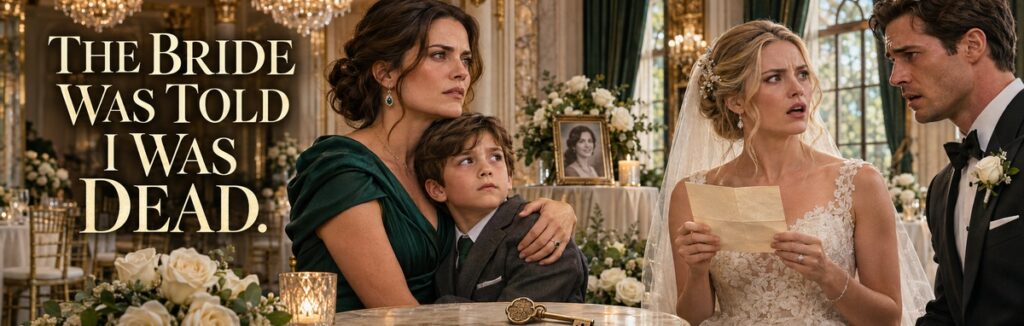
There were flowers waiting for me at my former husband’s wedding.
I did not see them until after the bride hit me.
At first, there was only the sharp movement of her hand, the sting across my cheek, and my son’s fingers closing around the emerald fabric of my dress. A waiter stopped beside us with a tray of glasses. Somewhere near the windows, a chair scraped the floor.
“You were paid to bring him here,” the bride said. “You don’t get to decide what happens next.”
I had been loosening Noah’s collar.
That was all.
He was eight, and the unfamiliar tie frightened him almost as much as the room full of strangers. He had asked me to fix it. I had bent toward him. Then the woman in white had turned an ordinary act of motherhood into a public offense.
“She’s my mom,” Noah said.
The bride looked at him with sudden concern.
“Sweetheart, your mommy is in heaven.”
My hand stopped halfway to my cheek.
For a moment, the entire ballroom seemed to tilt around a sentence that could not possibly belong to my life.
I was standing in Bellwether House, a hotel where I had once known the sound of every staircase. I was wearing shoes I had bought with money from restoring a damaged family Bible. My son was holding my dress. My former husband was less than twenty feet away.
And somebody had told this woman I was dead.
Ethan saw me looking at him.
He put down his glass.
The movement was careful. He had always been good at the first second of a crisis, before anyone else understood how much preparation had gone into it.
“Clara,” he said as he approached. “Let’s not do this here.”
I looked from him to the bride.
“What, exactly, are we doing?”
Her name was Vivian Hart. I knew it from an invitation addressed to Noah and delivered through Ethan. We had never met. Every attempt I made to arrange a conversation ended with a reason the timing was wrong.
Now she stood between us with her hand still lifted slightly from her side, as though she had not decided what to do with it after the slap.
“He said you were Noah’s caregiver.”
“I am his mother.”
“His mother died.”
I could hear her trying to hold the two statements apart. If she allowed them to touch, something enormous would break.
Ethan reached for her elbow.
“She’s been important to him. Children can become confused about names when they’re grieving.”
Noah made a small sound against my dress.
It was not confusion.
It was the sound he made when he knew a grown-up was about to ask him to agree with something untrue.
I moved him behind my hip.
“Say my name,” I told Ethan.
He frowned.
“This isn’t necessary.”
“Say it.”
“Clara.”
“My full name.”
Several guests had turned toward us. Vivian’s eyes moved between our faces.
“Clara Bennett,” he said.
“And who was I married to?”
“You’re upsetting Noah.”
“Who?”
His mouth tightened.
I answered for him.
“We were married for nine years. We divorced eighteen months ago. I live across town. I pack his lunch. I take him to school. I am not a memory.”
Vivian took a step backward.
The hotel ballroom was full of white roses, hanging glass, and carefully arranged promises. Behind Ethan stood a display welcoming guests to a new chapter. I recognized the window in the photograph behind the lettering.
It belonged to the old library upstairs.
Rose’s library.
I had not been in that room since the week our marriage ended.
That morning, before we left home, Noah asked whether his grandmother would be at the wedding.
“I don’t know,” I said.
“Dad says she’s resting.”
“Then she may not come.”
He looked disappointed. Rose Bennett had a habit of calling him Captain when he was small. She let him inspect the brass keys behind the hotel desk and told him every old building had a better memory than the people running it.
I missed her more than I admitted.
After the divorce, Ethan said his mother wanted distance from me. I believed him because believing that hurt less than calling her and hearing it directly. Later, when I did call, messages passed through the hotel office and came back unanswered.
Pride can look like respect from far enough away.
I told myself I was respecting her wishes.
At home, Noah had stood in front of the mirror while I adjusted his tie.
“Are you staying?”
“Until your dad is ready for me to leave.”
“He said we’d take a picture.”
“Then we’ll take a picture.”
“With everybody?”
I remembered hesitating.
“We’ll see what he arranged.”
My sister Jo, who had stopped by to return a casserole dish, watched from the kitchen.
When Noah went to find his jacket, she asked whether I had eaten.
“It’s a wedding. There will be food.”
“That isn’t what I asked.”
She cut a piece of bread and put it in my hand.
Jo had learned that if she asked directly whether Ethan was treating me fairly, I would spend ten minutes explaining his circumstances. Bread was harder to argue with.
I ate it standing beside the sink.
“Call me if the day goes badly,” she said.
“It’s not my day.”
“You still have to live through it.”
At Bellwether House, the front doors were open. Through them, I could see the familiar black-and-white floor and the long reception desk Rose had refused to replace.
A coordinator checked our names and directed me around the side.
“Mr. Bennett asked that the handoff happen near the preparation rooms.”
“I used to live here,” I said before I could stop myself.
She gave me the polite smile people use when information does not fit their schedule.
“This way will be easier.”
We passed the kitchen doors. I smelled butter, coffee, and orange peel. The smell brought back mornings when I worked in the library upstairs, repairing guest registers while Noah slept in a basket beside my chair.
Book restoration had begun as work I did for Rose. It became my profession after I left Ethan. I cleaned damaged pages, repaired bindings, and helped families keep letters that had survived people.
I knew how much meaning could be hidden in a crease.
I did not know yet how much could be hidden in a wedding.
At the turn in the corridor, Noah stopped beside an old brass bell mounted on a wooden base.
“Grandma used to let me ring that.”
The coordinator glanced at her schedule.
“We’d better keep moving.”
“It’s only a little bell,” he said.
“Not today, sweetheart.”
He took his hand away.
I remembered Rose lifting him onto the desk when he was too small to see over it. She told him the bell meant someone needed help, not that someone was important enough to make a noise. He rang it once, waited solemnly, then announced that his stuffed rabbit required a room.
Now he passed it as though he were a stranger.
Farther down the corridor, a young event assistant carried a seating chart toward the ballroom. I caught a glimpse of Rose’s name on a card tucked behind the clipboard.
“Is Mrs. Bennett expected?” I asked.
“I was told she couldn’t travel.”
“She’s nearby.”
The assistant looked uncertain.
“I only have the instructions for today.”
I apologized for delaying her. The apology came automatically, before I considered whether I had done anything wrong.
Noah watched the card disappear around the corner.
“Dad said she might come if I did a good job.”
I stopped walking.
“Whether Grandma comes isn’t something you can earn by walking correctly.”
“I know.”
But he didn’t sound as though he knew.
I straightened the little pocket square on his jacket and told him he could ask for me whenever he needed me. He nodded, then made me repeat it.
The coordinator took Noah to rehearse his walk. I waited in a room full of garment bags and spare chairs.
On a table lay a cream envelope with my name written on it.
Inside was a note from Ethan.
Please sign the acknowledgment before you leave. We can settle everything after the ceremony.
There was no acknowledgment attached.
I assumed someone had forgotten it. I put the note in my bag.
Then I heard Noah call for me.
Now, standing in the ballroom with my cheek burning, I remembered the envelope and understood that Ethan had expected something more from the afternoon than a marriage.
A gray-haired man moved between us and the gathering guests.
“Clara?”
Miles Reed, the hotel manager.
He had worked for Rose for nearly thirty years. When Noah was born, he sent a wooden train and a card saying that the hotel finally had a guest more demanding than the bridal parties.
He stared at me, then at Ethan.
“What happened?”
“A private misunderstanding,” Ethan said.
Miles looked at my face.
“Is that how you would describe it?”
“She hit me.”
He turned to Vivian. She did not deny it.
“Let’s get you some ice,” he told me.
“In a minute.”
I wanted answers before another room could close around me.
Vivian was looking toward a small table near the entrance. Her gaze had become fixed in a way that made me turn.
Two framed photographs stood among candles and white roses.
One showed a woman I did not recognize, older than Vivian, with the same eyes.
The other showed me.
It was my college graduation photograph. I wore a cap and gown and held the rolled certificate too tightly. My mother had taken the picture before she died, and Ethan had kept a copy in the study at our old apartment.
Beneath it, a card read:
IN LOVING MEMORY OF CLARA BENNETT.
Noah tried to read over my shoulder.
I shifted so he could not see the entire card.
Too late.
“Why does it say that?”
I could not answer immediately.
The flowers were fresh. Someone had cut the stems, filled the bowls, and arranged my supposed absence at a height where people could pause respectfully before going in to celebrate.
I touched the edge of the frame.
My reflection moved over the photograph.
There I was twice: a younger woman sealed behind glass, and a living woman trying to remember how to breathe.
“Ethan,” Vivian said.
He did not look toward her.
“You told me she died.”
“I need you to trust me.”
She looked at my face again.
“I did.”
The words were quiet. They hurt him more visibly than anything I had said.
Miles asked a staff member to clear a little space around us. He did not order me out. He moved the nearest guests back instead.
That small decision changed the room.
I was no longer the disruption being managed. I was a person someone had decided to listen to.
I took out my phone and found the email containing the final divorce documents. Vivian read the names and the date.
“This isn’t a death certificate,” I said. “It never was.”
Her fingers tightened around the phone.
“Then the hospital?”
Ethan closed his eyes briefly.
“Vivian.”
“The night you said you sat beside her bed. The letter. All of it.”
The word letter made me look up.
“What letter?”
She turned toward a chair near the flower arch. A cream folder lay on the seat, ready for the officiant.
Ethan moved first.
Vivian reached it before he did.
“Give that to me,” he said.
She held it against her chest.
“No.”
The guest nearest the chair stepped away as though distance could protect him from choosing a side.
I remained beside the memorial table. Noah was holding my hand now, not my dress. He kept touching my fingers, counting them without looking.
“Mom?”
“I’m here.”
“You aren’t going somewhere after the picture?”
I knelt despite the tightness in my skirt.
“I’m taking you home.”
He glanced toward Ethan.
“Dad said things would be different after today.”
I looked up at the man I had once trusted with every important part of my life.
“What things?”
Noah shook his head. The refusal was frightened rather than stubborn.
Vivian opened the folder.
The paper inside was pale yellow, folded twice, with a line of handwriting visible along the top.
I knew the shape of that handwriting.
I knew the little hook at the end of the first word.
It was mine.
Whatever Ethan had planned for the wedding, he had brought my voice with him.
He simply had not expected me to bring the rest of myself.