Chapter 3 – Room Seventeen
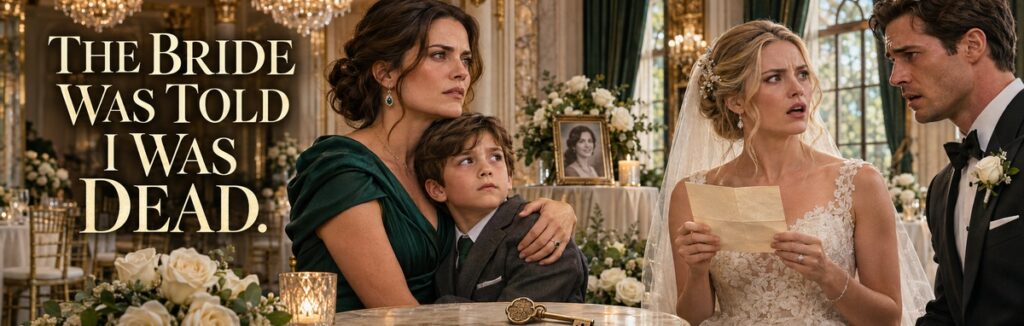
The key still fit.
That surprised me more than it should have.
So much had changed since I last stood outside Rose’s library that I expected the lock to reject me too. But the brass teeth turned with the same reluctant click, and the door opened onto a room that smelled of leather, dust, and rain trapped in old wood.
Jo had taken Noah downstairs with Lena. They were finding something less complicated than a wedding for him to eat. Miles stood beside me in the hallway, holding the note Rose had written.
“She asked you to work here,” he said. “That’s enough for me to let you look.”
I stepped inside.
The library occupied a corner of the old hotel, beyond the rooms guests usually saw. Number seventeen had once been a bedroom. Rose kept the number because she disliked replacing useful things merely to make them match.
There was a fireplace, a tall window facing the garden, and a green reading chair with a depression in the cushion shaped by decades of her sitting there.
The chair was covered by a sheet.
So were the shelves.
In the center of the room stood three packing crates.
I stopped.
“What’s happening here?”
Miles looked at the labels.
“I wasn’t told anything was being moved.”
One crate had a shipping date for the following Thursday. Another was marked private collection. On the desk lay a list of items to be removed: registers, correspondence, framed photographs, decorative books.
Decorative books.
I had spent six months repairing one of those registers after a pipe burst above the storage room. It contained the names of guests who stayed here during hurricanes, honeymoons, funerals, and the years when the hotel nearly closed.
Rose said the book was proof that a building could keep people safe without knowing whether they would ever become important.
Someone had reduced it to a line in an inventory.
I took photographs of the room as we found it. Miles called the office and asked that no collection be released without his confirmation and Rose’s direct approval.
He did not threaten anyone. He spoke clearly, repeated the instruction, and asked for the caller’s name.
Practical authority was quieter than Ethan’s version.
Before approaching the desk, I lifted the corner of a sheet covering the long worktable.
The mark from my old lamp was still there, a pale circle in the darker wood. Beside it lay a strip of cloth I had used to support a weakened binding. Someone had placed my tools in a tin rather than throwing them away.
“Lena did that,” Miles said. “She thought you’d want them.”
I opened the tin. A bone folder, two brushes, a pencil shortened almost to nothing. Ordinary tools, none valuable enough to appear on the inventory.
They made my absence feel suddenly measurable.
I remembered the first register Rose asked me to repair. I was nervous about accepting money from my husband’s mother and tried to call it a favor. She told me favors were how families discovered they could stop paying women for useful work.
We argued over the fee.
She won.
Ethan had laughed when I told him. He said his mother could make a ceremony out of buying a pencil.
At the time, I thought the joke affectionate.
Now I found the little invoice pinned inside the tin. Rose had written paid beside the amount, followed by a note asking me to charge more for the next difficult job.
I sat with that slip of paper in my hand.
Here was another record contradicting the account I had lived with for eighteen months. A woman who supposedly wanted me gone had kept my work protected and my name attached to it.
Miles looked toward the crates.
“I should have asked why these weren’t being handled by you.”
“What were you told?”
“That you’d moved on. That contacting you would upset the family.”
I closed the tin.
There was the same instruction again, adapted to another person: don’t ask, because asking would hurt someone else.
“Next time, call me,” I said.
“I will.”
He said it without adding an excuse. I believed that more readily than a long explanation.
At the desk, I found my old restoration notebook.
The first page listed work still to be done: repair the blue album, stabilize the water-damaged ledger, make protective folders for Grace’s letters.
I stared at the last entry.
Grace.
At the time, it had been one name among many in Rose’s collection. Now a woman with that name stood in a memorial frame downstairs.
“Do you remember Grace?” I asked Miles.
He came closer.
“Grace Hart?”
“I think so.”
“She worked here years ago. Before I became manager. Her husband did maintenance. Good people.”
I looked at the list again.
“Vivian’s mother?”
Miles nodded slowly.
“I didn’t put it together until I saw her father’s name on the event paperwork. They left before you knew the place.”
The hotel seemed to expand around me. Rooms I thought I knew opened onto histories that had never involved me, histories Ethan could have used to make himself familiar to another family.
I found a thin envelope in the notebook. It contained the first page of the letter I wrote before the divorce. I had drafted it here because Rose’s library was the only place in the hotel where people knocked before entering.
The copy in Vivian’s folder had begun halfway down the page.
The missing opening said: When we live in separate homes, Noah must never be made to explain one parent to the other.
I put the two versions beside each other.
There was no subtle ambiguity. The original was about two living parents learning to live separately. The version in the wedding folder had been arranged to sound like a farewell.
Miles read without touching either page.
“She should see this.”
“Vivian?”
“Rose too.”
I photographed the documents and placed them in separate protective folders. My hands steadied as I worked. Paper had rules. Support a weak fold. Keep the original order. Do not rub at a stain merely because you want it gone.
There was comfort in knowing how to care for something without needing it to stop looking damaged.
At the back of the desk drawer, I found a small clothbound book.
Rose called it the House Book.
It was not an official record. It held notes, photographs, recipes, sketches, and messages from people who had worked at Bellwether House. A chef had written down a soup recipe after refusing to share it for twenty years. A porter had pasted in the first photograph of his granddaughter. My own handwriting appeared beside a picture of Noah asleep in a laundry basket.
I turned the pages.
Near the middle was a photograph of two young women standing behind the reception desk.
One was my mother.
The other had Vivian’s eyes.
I sat down in Rose’s chair before I realized I had moved.
The sheet slipped to the floor.
My mother had worked here one summer before she married my father. She mentioned it occasionally, usually when Rose teased her about misplacing room keys. I knew they had remained friends. I had not known Grace Hart was part of that friendship.
On the back of the photograph, in Rose’s handwriting, were three words:
Our difficult girls.
Underneath, she had added the year.
I laughed once, unexpectedly, then covered my mouth.
Neither woman had been easy, according to the family stories. Both had worked hard. Both had died before I understood how many questions I would want to ask them.
Downstairs, their daughters had been placed on opposite sides of a lie.
I looked toward the window.
Ethan had grown up in this hotel. He knew the stories. He knew where Rose kept the letters, whose grief still had edges, and which memories made people lower their guard.
The wedding had not been built in a few careless conversations.
He had furnished it from the lives around him.
My phone vibrated.
Vivian’s number appeared in a message forwarded through Miles.
I have something he asked me to sign tomorrow. I don’t understand why your name is in the accompanying papers.
She attached a photograph of a document cover.
Bellwether House. Proposed acquisition and management agreement.
I looked at Miles.
“Is the hotel being sold?”
His face became very still.
“Ethan has been discussing a partnership.”
“With the Harts?”
“Yes.”
“Did Rose agree?”
“I haven’t heard that from her.”
It was the answer of a man suddenly reviewing months of conversations in a different order.
We left the library locked. Miles kept a separate record of what we had examined. I carried only the original letter draft, the small House Book, and the folder Rose had specifically left for me. He noted those too.
I was not going to turn uncertainty into an excuse to take whatever I wanted.
Downstairs, Noah sat beside Jo in a room overlooking the garden. He had removed his jacket and was eating scrambled eggs from a bowl.
“They made breakfast,” he said.
“That sounds good.”
“It’s not breakfast time.”
“Apparently the kitchen has exceptions.”
He smiled faintly.
Jo looked at the folders in my arms and waited until he was occupied with his food.
“How much worse?”
“Different worse.”
I told her about Rose’s note, the shipping crates, and the proposed sale.
“You’re going to see her.”
It was not a question.
“Tomorrow.”
“Then tonight you eat, document the injury, and sleep.”
“I have work due.”
“You also have a face somebody hit and a child who’s been told to keep impossible secrets.”
She said it gently, which made it harder to dismiss.
We arranged for Noah to stay with her the following afternoon if he wanted to. I would speak with Rose first, before making him part of another adult revelation.
Miles came to the door carrying a final envelope from Ethan.
“He asked me to give you this.”
Inside was the acknowledgment mentioned in the earlier note.
It stated that I had received all personal possessions remaining at Bellwether House and had no outstanding claim regarding family items held there.
A list included my mother’s ring.
The date was that day’s date.
The space for my signature waited beneath a paragraph saying the return had been completed before the ceremony.
I looked at the ring now resting safely in the little pocket inside my bag.
“He expected me to sign this before I saw her wearing it.”
Jo took the paper and read it.
“Don’t sign anything.”
“I wasn’t going to.”
That felt good to say without needing to be persuaded.
Miles looked ashamed.
“I should have questioned more.”
“Then question what happens next.”
He nodded.
At home, Noah asked whether he had to throw away the suit.
“No.”
“I don’t want to wear it.”
“Then you don’t have to.”
We hung it in the closet. I put the tie on the shelf rather than in the trash. He watched the placement carefully, then nodded as though we had agreed on something larger.
Jo took photographs of my cheek with my permission and helped me make a clear written account while the details were fresh. I decided to have the injury checked rather than guess. The visit was uneventful and reassuring. It did not make what happened insignificant.
Later, after Noah fell asleep, I opened the House Book on the kitchen table.
The photograph of my mother and Grace lay beside Rose’s letter.
My phone buzzed with a message from Ethan.
Stay away from my mother. She doesn’t need more confusion.
I read it once.
Then I saved it.
For eighteen months, the possibility of hurting Rose had kept me from asking why she never answered.
Now I had a note in her handwriting telling me the door was open.
I called the number Miles gave me for Seabrook Cottage.
A woman answered.
“May I speak to Rose Bennett?”
There was a pause while she asked who was calling.
“Clara.”
I heard footsteps. A distant question. The scrape of a chair.
Then a voice I had missed more than I knew.
“Clara? Where in God’s name have you been?”
I sat down.
“Across town.”
“He said you left the country.”
I looked at the brass key on the table.
“He told me you never wanted to see me again.”
Neither of us spoke for several seconds.
When Rose answered, the anger in her voice was not directed at me.
“Come tomorrow,” she said. “Bring the truth. I’m tired of receiving his version.”