Chapter 2 – A Letter from a Living Woman
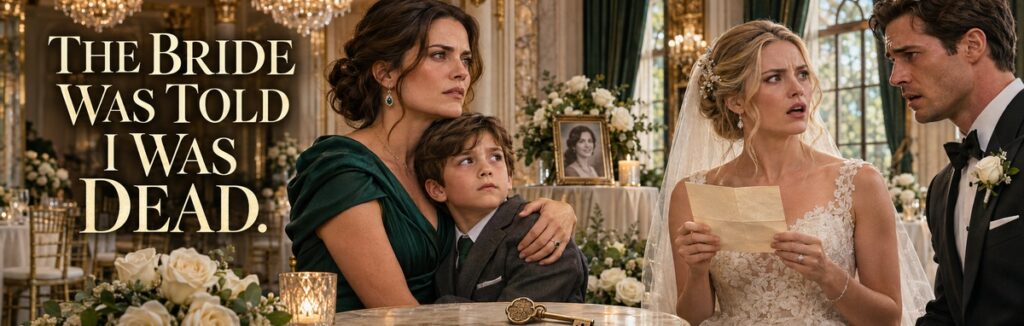
Vivian read the first sentence twice before she spoke it aloud.
“If I am no longer in the room, please make sure Noah knows he has not been left behind.”
I remembered writing those words at two in the morning, sitting on a packing box in the apartment I was about to leave. Noah had been asleep in the bedroom. Ethan had gone out rather than finish another argument about how we would explain the divorce.
I had written because our spoken conversations kept becoming contests over who was allowed to finish.
There had been no hospital.
There had been no final illness.
“That letter is about our separation,” I said.
Ethan looked at the paper in Vivian’s hands.
“It was private.”
“You put it in a folder for an officiant.”
Vivian unfolded the bottom section. Her bouquet lay abandoned on a chair.
“He told me you wanted it read before the vows.”
“I didn’t know you existed when I wrote it.”
She looked as though someone had quietly removed a step beneath her feet. Behind us, the musicians were still playing. They could not see what was happening from the corridor outside the ballroom. The familiar wedding melody continued through a scene that no longer knew how to contain it.
Miles signaled to the coordinator.
The music stopped.
I held out my hand.
“May I?”
Vivian gave me the paper.
At first glance, the handwriting looked continuous. The upper half was familiar: my slanted letters, the uneven space between two words where I had paused to listen for Noah. Farther down, the lines became strangely smooth.
I restored old documents for a living, but I was not going to pretend that looking at paper made me a forensic examiner. I could say one thing with certainty.
The final paragraph was not mine.
It asked Ethan to find a woman Noah could call Mommy. It said a child should not grow up with an empty place at the table. It gave a blessing to a future wife.
The real letter asked him not to use our child as a messenger.
He had changed the request into permission.
“Did you show this to Noah?” I asked.
Ethan glanced at our son.
“He needed reassurance.”
My anger became so sharp that I had to look away for a moment.
Noah was studying the letter with the rigid attention he gave adults who claimed they knew what he felt.
I lowered the paper.
“I never asked anyone to replace me.”
His mouth trembled.
“Dad said you wanted a different life.”
“I wanted a life where we weren’t fighting all the time. I never wanted a life without you.”
He looked toward Ethan.
“You said I couldn’t tell.”
“Buddy, this isn’t the time.”
I knelt beside Noah.
“You can talk to me.”
He spoke quickly, as though the words might disappear if he stopped.
“He said if I talked about you, you’d get mad and take me away and he wouldn’t come back.”
The nearest guests heard. A woman covered her mouth. Someone else looked down at a phone.
“Please put that away,” Miles said.
The phone lowered.
I kept my attention on Noah. There would be time to be furious in rooms where he did not have to watch my face.
“You don’t have to hide me to keep your dad,” I said. “What he told you wasn’t fair.”
“Are you mad at me?”
“No.”
“Even because I didn’t say?”
“Especially not because of that.”
He leaned against me. I held him until his hands stopped pulling at my sleeves.
When I stood, Vivian was staring at the other portrait on the memorial table.
“My mother was called Grace,” she said.
It seemed at first like the beginning of a different conversation.
Then she looked at Ethan.
“You asked me about the last night. You asked what she said when she couldn’t finish a sentence. You told me Clara did the same thing.”
He tried to take her hand.
She stepped away.
“I was trying to understand you.”
“You were telling me something happened to you that happened to me.”
She picked up the small card beside Grace’s portrait. I could not read all the decorative script, but I recognized the intention of it: an absent mother receiving thanks for a new beginning.
“I wrote these,” she told me. “I thought I was honoring both of you.”
“You didn’t know.”
The sentence surprised us both. I did not mean that nothing else mattered. I meant only that the card was not the same choice as her hand striking my face.
She understood the difference a moment later.
“But I hit you.”
“Yes.”
“He said you’d try to take Noah out of the ceremony. He said you were unstable. I thought—”
She stopped.
I waited.
“It doesn’t matter what I thought. You were helping him.”
Her voice had changed. The bride who issued orders a few minutes earlier was still there, but she was now speaking without the protection of believing herself innocent.
“I’m sorry.”
I nodded once.
That was all I could give her.
Ethan began explaining to the guests that the ceremony would start after a short delay.
The confidence of the announcement made Vivian turn.
“No.”
He lowered his voice.
“We can discuss this upstairs.”
“You said she died.”
“Please don’t make one mistake the whole story.”
“It wasn’t one mistake. You made a table.”
The simplicity of the accusation silenced him.
He had selected the frame. He had sent the photograph. He had arranged the flowers around the place where my voice should have been. Every piece required another decision.
Vivian looked down at her engagement ring.
That was when I saw the small engraving along the side of the setting.
Three tiny leaves.
One was worn almost flat.
I had traced them with a fingernail when I was a child sitting on my mother’s lap.
“Where did you get that ring?”
Vivian looked up.
“Ethan gave it to me.”
“When?”
“When he proposed.”
I felt the room narrow around that single object.
After my mother died, I wore her ring on a chain until the clasp broke. I put it in a small velvet box in our bedroom. During the move after the divorce, the box disappeared.
Ethan said one of the movers must have taken it.
He comforted me while I cried.
Now the ring glittered on another woman’s hand in front of a portrait of my supposed death.
“It’s my mother’s.”
Vivian looked toward him.
He shook his head.
“Clara, don’t.”
“There are initials inside. M and T. Marie and Thomas. My parents.”
Vivian began to remove it.
The ring caught against her knuckle. Her hands were shaking too badly to turn it.
“Can you help?” she asked me.
I hesitated.
Then I held her hand gently, turned the setting, and eased the ring free.
The gesture was strangely intimate after the violence between us. I did not mistake it for forgiveness. Two people could cooperate for five seconds without deciding what they would mean to each other afterward.
The initials were there.
Vivian placed the ring in my palm.
“Keep it.”
Ethan reached toward us.
“You can’t just—”
“You gave me something you stole from her,” Vivian said.
“I intended to explain.”
“When?”
He did not answer.
I closed my fingers around the ring. It was warm from her skin. For a moment, I remembered my mother turning dough in a bowl, the stone catching flour, her laugh when I asked whether the diamond could make bread taste expensive.
The memory belonged to me.
I would not let him make it another prop.
Vivian turned to the coordinator.
“There won’t be a wedding.”
The woman looked once toward Ethan, then back to Vivian.
“I’ll take care of it.”
Guests began moving in small, uncertain groups. Nobody wanted to be the first person to leave or the last person to remain. A waiter quietly removed the champagne tray.
Ethan looked at me.
“What am I supposed to tell everyone?”
“You know more about what you told them than I do.”
Before we left the ballroom, a woman I did not know approached with tears in her eyes.
“I sent flowers,” she said.
I looked at her.
“When he told us about you. I sent flowers to his office. He said the family wasn’t ready for visitors.”
Her distress was sincere, but Noah was listening.
“I’m sorry you were told that,” I said. “I can’t discuss it with everyone right now.”
She nodded immediately and stepped back.
It was the first boundary I set that afternoon with someone who accepted it without making me defend it.
Another guest asked whether I wanted the photograph taken away. I said I would take it myself. He lifted the frame carefully and handed it to Miles, who kept the card with it rather than tearing it up.
The gesture steadied me. Evidence and possessions could be handled without becoming a spectacle.
Noah looked at the empty place on the table.
“Do you feel better now?”
“A little.”
“Because the picture moved?”
I considered the answer.
“Because someone asked what I wanted before moving it.”
He looked toward the chair where Vivian’s bouquet lay.
“Nobody asked me about the flowers.”
“They should have.”
I took his hand. There were more things to understand than either of us could manage in that room. We did not have to understand them all before leaving it.
Miles opened the door to a private sitting room and asked whether Noah and I wanted some space. This time, I said yes. I had enough answers to understand that we needed distance before we could find the rest.
He brought ice, water, and a plate of small sandwiches. Noah ate two without speaking.
I called Jo.
“Can you come?”
She did not ask whether I had overreacted or whether Ethan had an explanation.
“Where are you?”
I told her.
“I’m on my way.”
Miles sat near the door. He looked older than he had when we first met, but his anger made him seem suddenly solid.
“I didn’t know he was telling people that,” he said.
“About me?”
“Any of it. The family materials were handled by an outside event team. Ethan told me you weren’t attending.”
I looked at the sandwich untouched on my plate.
“He brought Noah here knowing I’d be with him.”
“I understand that now.”
He said he would record what he had witnessed and preserve the relevant event records. I asked him to. I also asked him to keep guests from approaching Noah for explanations.
“Of course.”
There was a soft knock.
Lena Ortiz stood in the doorway. She had supervised housekeeping at Bellwether House since before Ethan and I married. When I was pregnant, she used to leave crackers outside the library because she knew I was too nauseated to cross the kitchen.
She looked at my cheek and began to cry.
“Lena.”
“I’m sorry. I didn’t see until—”
“You don’t have to apologize for not being in the room.”
She wiped her face, then reached into her uniform pocket.
“Rose asked me to keep this safe.”
It was a small envelope, creased from being handled and put away.
My name was written on the front.
Not in Ethan’s tidy lettering.
In Rose’s heavy, impatient script.
“When?”
“Before she went to the cottage. She said it was for you if you came back to the house.”
“Why didn’t anyone send it?”
Lena looked toward the hallway.
“Ethan said he had your new address. He said he would take care of it.”
I opened the flap.
Inside was a brass key with a little oval tag.
17.
Beneath it lay a folded note.
Clara, there are things in my library that nobody has the right to throw away. If you still want the work, the key is yours.
I read it twice.
Rose had not written that she never wanted to see me again.
She had offered me a way back.
“Where is she?” I asked.
Lena glanced at Miles.
“At Seabrook Cottage.”
“Does she know about today?”
Miles’s face changed.
“She knows what Ethan told her.”
Noah looked up from his sandwich.
“Grandma says Mom works far away.”
The room went still.
I turned toward him.
“When did she say that?”
“When Dad took me. I wanted to tell her you live by school, but Dad said Grandma gets things mixed up.”
I held the key so tightly its teeth pressed into my palm.
He had not told everyone the same lie.
He had told each of us the one that kept us apart.